When a home on a private well starts running out of dependable water, storage is often one of the first solutions people consider. That reaction makes sense. If the shower fades, the washing machine fills slowly, or the house struggles when several fixtures run at once, it is natural to think the home needs more water on hand. A cistern, a water storage tank, and a Well Manager system can all be part of that conversation, but they do not solve the same problem.
How to increase water pressure in a cost effective, provable, and guaranteed way?
The important question is not only where water can be stored. The real question is whether the system can collect water at the pace the well can safely produce it, hold enough reserve for the home, protect the well pump, and deliver that stored water back with usable pressure.
- A cisternmay be a good storage option for certain properties, especially when large-volume exterior or buried storage makes sense.
- A water storage tankmay be a more practical fit for homes that need reserve water closer to the existing mechanical system.
Well Manager fits when the problem is not just storage but also managed collection, storage, and repressurization for a well that still produces water but cannot keep up with peak demand.
Compare Cisterns, Storage Tanks, and Well Manager by Function
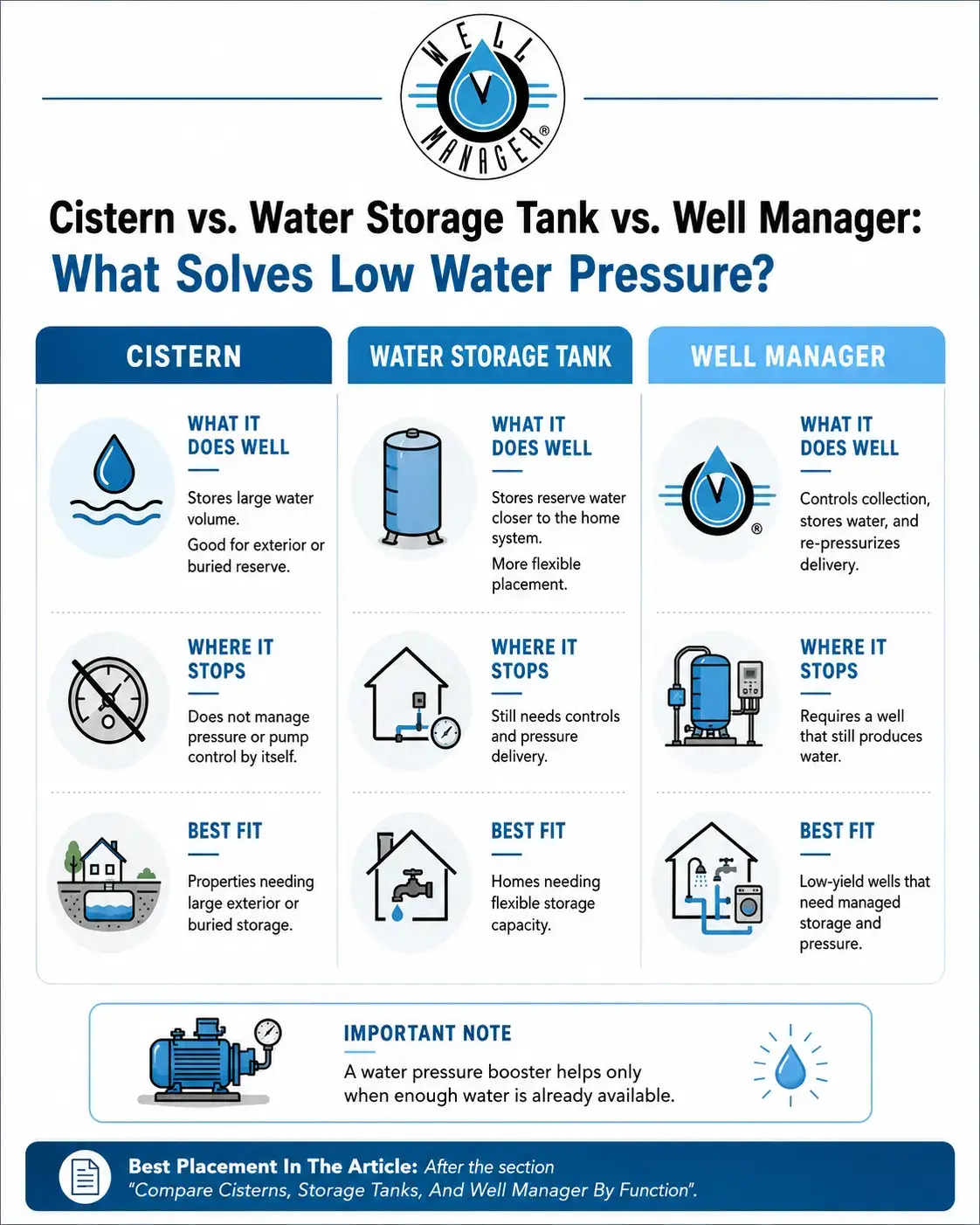
The best way to compare these options is by function, not by assuming one is always better than the others are. A cistern stores water. A storage tank also stores water, often in a more flexible location depending on the home and system layout. Well Manager also stores water, but the primary purpose is to manage how water is collected from a low-yield well and delivered back to the home. That difference matters because low pressure can come from more than one failure point.
| Option | What It Does Well | Where It Stops | Best Fit |
| Cistern | Stores larger water volume | Does not manage pressure or pump control by itself | Properties that need large exterior or buried reserve |
| Water Storage Tank | Stores reserve water closer to the home system | Still needs controls and pressure delivery | Homes that need flexible storage capacity |
| Well Manager | Controls collection, stores water, and re-pressurizes delivery | Requires a well that still produces water | Low-yield wells that need managed storage and pressure |
This comparison is not meant to dismiss cisterns. A cistern can be the right storage choice when the property, space, installation conditions, and water demand support it. The key is that a cistern should be chosen because large-volume storage is the right fit, not simply because the home has low pressure. If the real problem involves slow recovery, pump cycling, low delivery pressure, or poor controls, storage alone may not address what the homeowner actually feels inside the house.
A Cistern Stores Water, But It Does Not Automatically Fix Pressure
A cistern is primarily a reserve solution. It gives the property a place to hold water, so the home is not dependent only on what the well can produce at the exact moment water is needed. That can be valuable when a well still recovers over time but cannot keep up with concentrated demand. In that situation, storage helps separate water production from household use. The cistern gives the system more water to draw from during peak periods.
The limitation is that storage and pressure are not the same thing. A cistern can hold water, but the home still needs that water delivered to showers, faucets, appliances, and fixtures with usable pressure. In the research already gathered, EPA’s private well guidance matters because it frames private well owners as responsible for their own household water systems rather than relying on a regulated public supply. That context supports the practical point here: the storage decision should start with how the private well actually behaves. If the well is slow, the design has to account for that slow recovery rather than treating low pressure as a simple pump problem.
A cistern can be part of a strong system when it is sized, controlled, and connected correctly. It can also become an expensive holding tank that does not change daily water performance if the pressure side is ignored. The homeowner may have more water in reserve but still experience weak showers or slow-moving fixtures. That is why the question should not be, “Can a cistern hold enough water?” The better question is, “Will this storage setup actually solve the pressure and recovery problem?”
When a Cistern Makes Practical Sense
A cistern makes practical sense when a property needs a large reserve and has the right installation conditions for that kind of storage. In many cases, cisterns are installed outside, buried, or placed where they require more space and planning than an indoor tank would. That does not make them a bad option. It means they need to be evaluated as part of a larger storage project rather than as a simple pressure fix.
A cistern is usually more reasonable when the homeowner is solving a reserve-capacity issue rather than a complete pressure-management issue. The well still needs to produce usable water over time, and the stored water needs to be properly returned to the home. If a property has the space, access, and installation conditions for exterior or buried storage, a cistern can make sense. If the home mainly needs managed storage and re-pressurization inside an existing system, another approach may be more direct.
A cistern may be worth discussing when:
- The property needs larger-volume storage.
- Exterior or buried storage is realistic for the site.
- The well still produces water over time.
- The system can include proper controls and pressure delivery.
- The homeowner understands that storage alone is not the full pressure solution.
That is the respectful way to position cisterns. They are not wrong equipment. They are specific equipment for specific conditions. The mistake is buying one because the house has low pressure before confirming whether the issue is actually reserve, pressure, pump control, well recovery, or a combination of those problems.
Why a Water Storage Tank May Be a Better Fit for Some Homes
If you want to the answer to “how to increase water pressure?” it’s simple. A Well Manager is a 100% guaranteed system that will work for you.
A water storage tank can be a more practical storage option when the home needs reserve water but does not need, want, or have space for a larger exterior or buried cistern. Depending on the home, a tank may be placed indoors or outdoors as part of the mechanical system. For existing homes, that can matter because installation space, access, freezing concerns, and serviceability are real constraints. A less invasive storage approach can be valuable when the goal is to add usable reserve capacity without turning the project into a large-site installation.
The storage tank still has the same basic limitation as a cistern. It holds water, but it does not automatically control the well or deliver pressure. The prior CDC private well research is useful here because CDC explains that private systems are often groundwater wells and are not monitored like public water systems. That source is not a tank recommendation, but it reinforces the point that the homeowner’s actual source and system need to be understood together. A tank can support the system, but it does not eliminate the need to consider recovery, pump operation, pressure, and water quality.
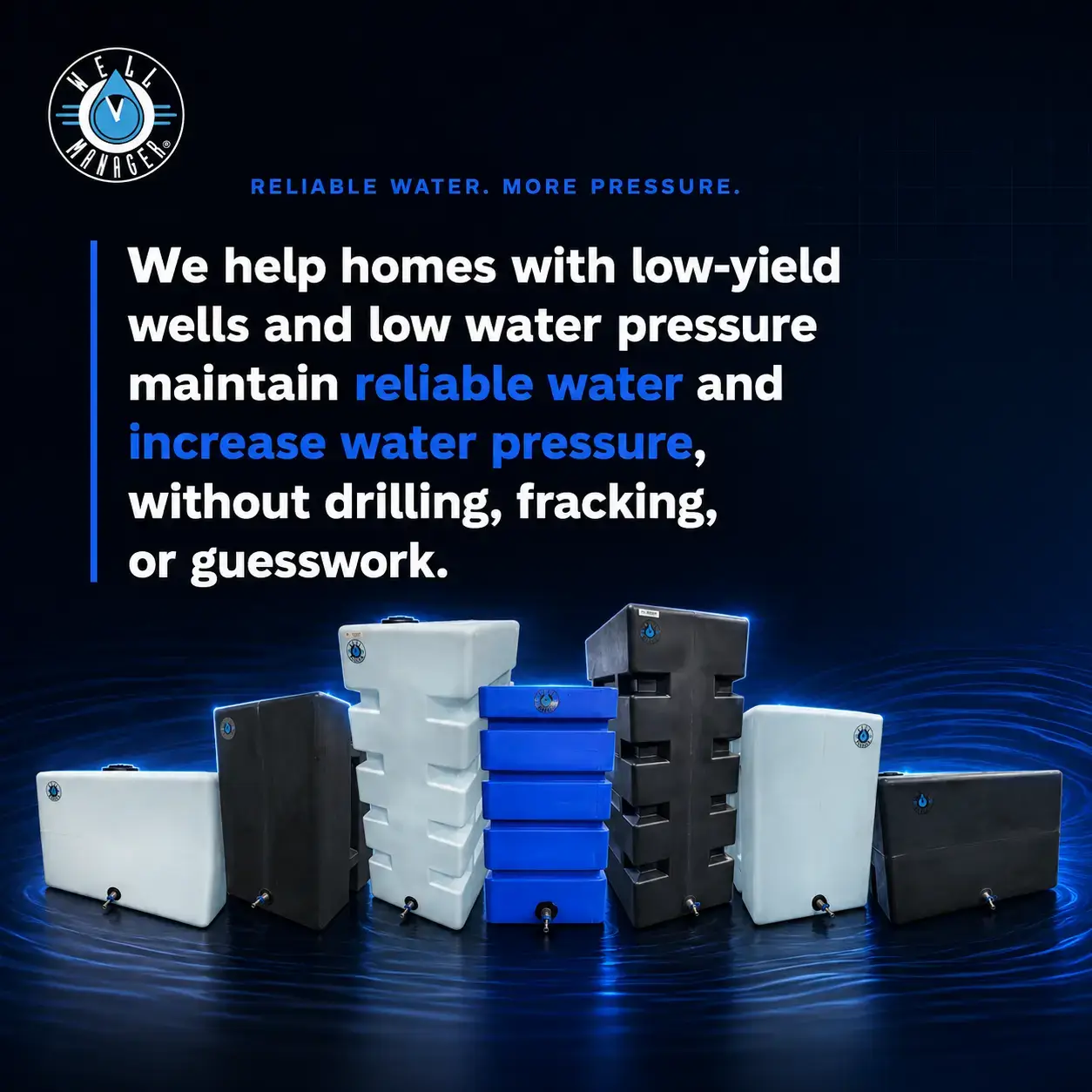
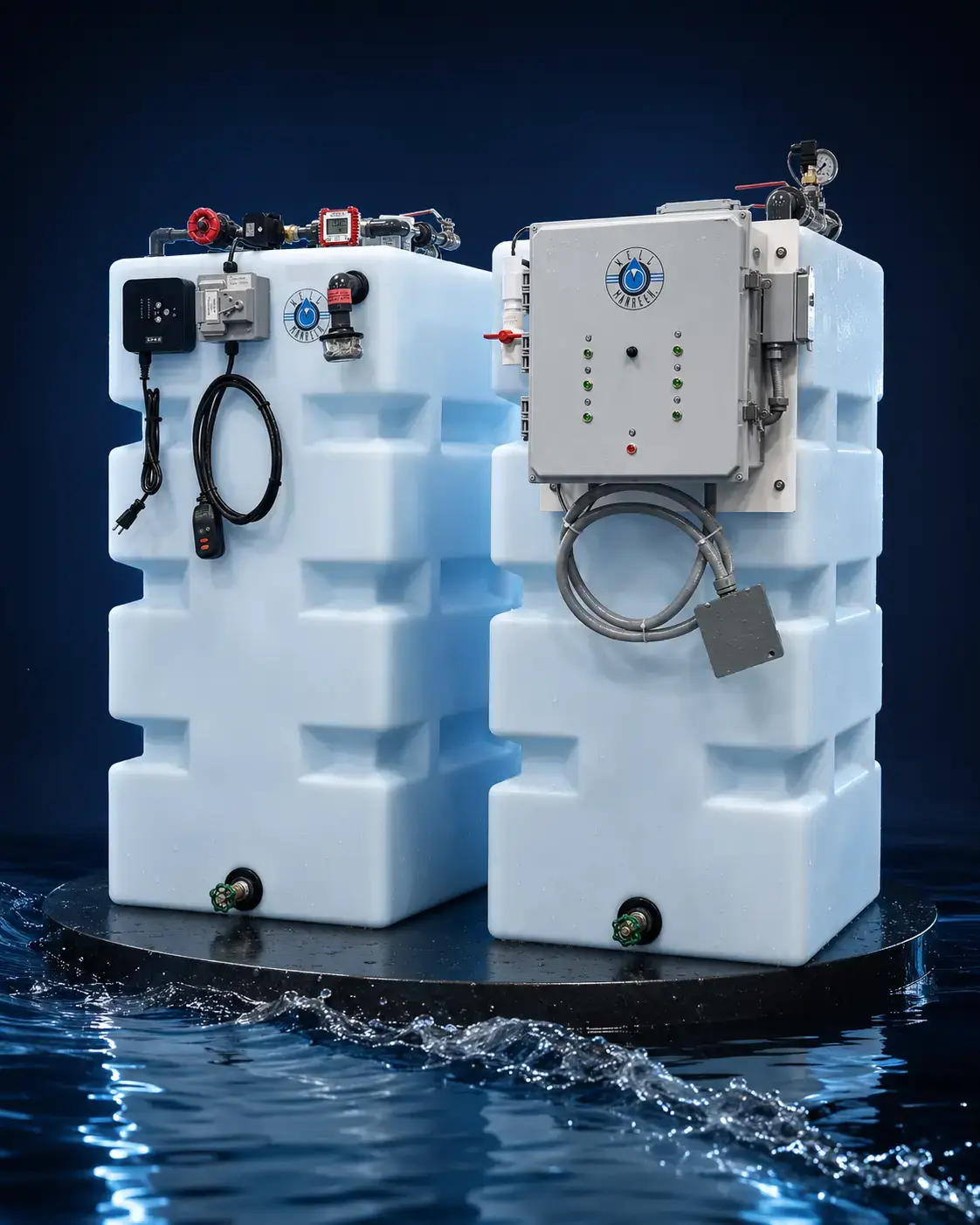
This is where Well Manager’s tank design details matter. Well Manager’s standard 210-gallon doorway tanks are designed to fit into many existing homes more easily than large buried storage options. Multiple tanks can also be manifolded together, so some homeowners can start with one or two tanks and add capacity later. The value is not only the tank itself. The value is that storage can be designed around the home’s layout, the well’s production, and the household’s pressure needs.

Where Well Manager Fits in the Decision
Well Manager is a good fit when the homeowner needs more than a cistern or a plain storage tank. The system is designed for wells that still produce water but cannot meet peak household demand in real time. Instead of forcing the well to satisfy every fixture at the moment demand happens, Well Manager collects water as the well can provide it. The system then stores that water and delivers it back to the home under usable pressure.
That difference is important because it changes the conversation from storage volume to system performance. A cistern may hold a large amount of water, and a tank may provide a reserve inside the home, but the water still has to be managed. Well Manager is built around controlled collection, storage, and re-pressurization. That is why it belongs in this comparison. It is not just another container. It is a way to manage the gap between what the well can produce and what the household needs during daily use.
Bottom Line: Choose the System That Solves the Full Water Problem
Stop asking “how to increase water pressure” because there are solutions (at least one is guaranteed).
- A cisterncan be a valid choice when a property needs large-volume storage and has the right space, access, and installation conditions.
- A water storage tankcan be a practical fit when the home needs to reserve water closer to the existing system.
- Well Manageris the better conversation when the problem is not just where to store water, but how to collect it, protect the well pump, store usable reserve, and deliver that water back with pressure.
Before investing in a cistern, tank, or water pressure booster, confirm whether the issue is storage, pressure, recovery, pump control, or a source-side failure. If your well still produces water but cannot keep up with household demand, Well Manager can help determine whether simple storage is enough or whether your home needs controlled collection, storage, and re-pressurization.