A low-yield well fix can cost a few thousand dollars or tens of thousands of dollars, depending on what actually has to be fixed. That is why the first price a homeowner hears is not always the most useful number. Drilling, hydrofracking, storage tanks, and managed storage systems all solve different problems, so their costs should not be compared as if they are interchangeable. The better question is not only, “What is the cheapest option?” The better question is, “What am I paying to solve, and how long is that fix likely to hold up?”
For many homeowners, the search starts with well water low pressure, a shower that fades, or a house that cannot keep up when multiple fixtures run. Those symptoms often create pressure to make a fast decision, especially when drilling or hydrofracking is presented as the obvious next step. The problem is that a low-yield well is not always a failed well. In many cases, the well continues to produce usable water over time, but the home needs a better way to collect, store, and deliver it when demand is highest.
Low-Yield Well Cost Comparison
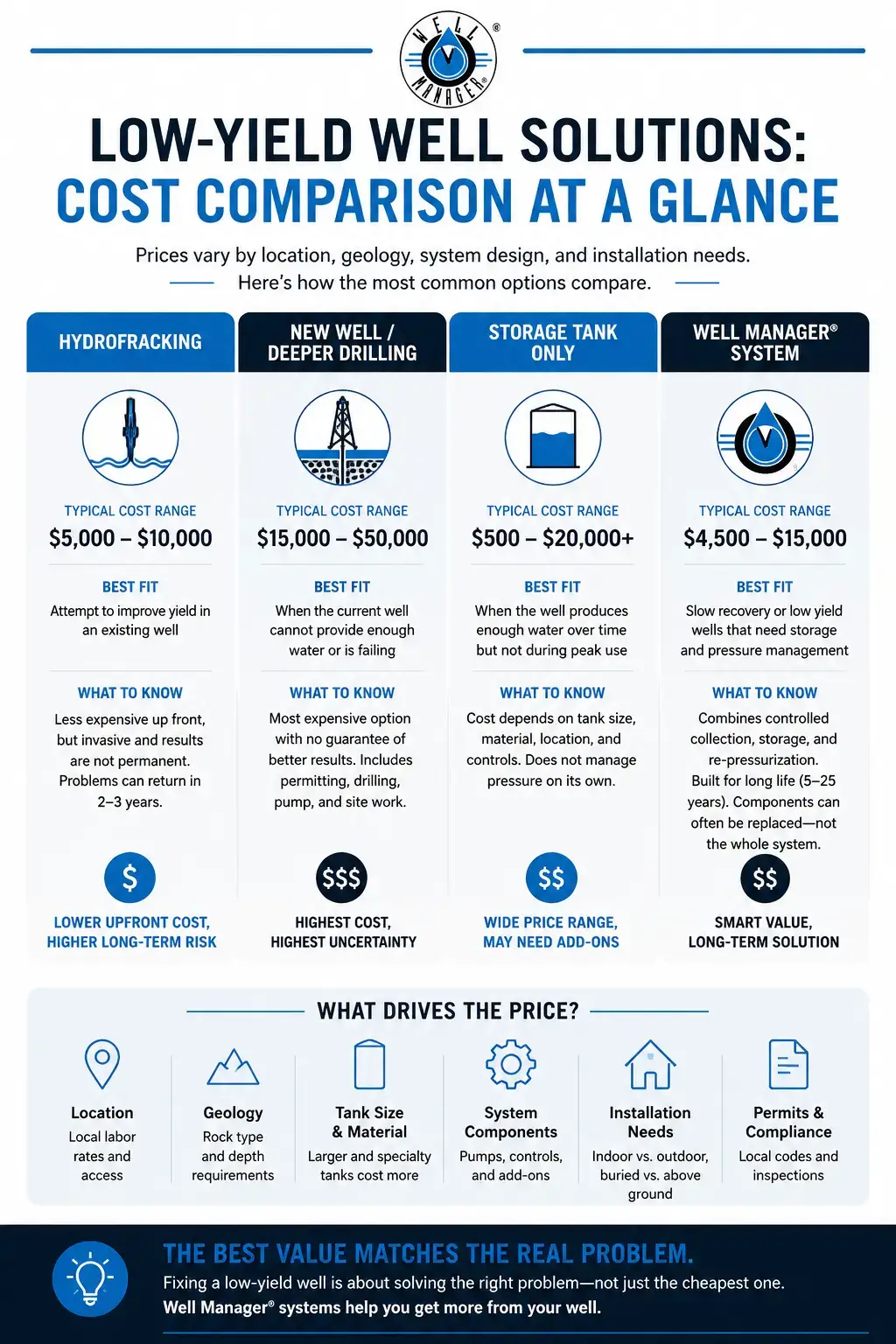
The most useful way to compare low-yield well costs is to separate source fixes from storage and delivery fixes. Drilling and hydrofracking try to change how much water the well can provide. Storage tanks and Well Manager systems work with the water the well already produces, making it more usable during daily demand. This table gives homeowners a realistic planning view without pretending that every property will price the same way.
| Option | Typical Planning Range | What You Are Paying For | Main Cost Risk |
| Hydrofracking | $5,000 to $10,000 | An attempt to improve yield in certain existing wells | The result may be temporary, limited, or not enough for the home |
| New Well or Deeper Drilling | $15,000 to $50,000 | A new or deeper water source | High upfront cost with no guaranteed better yield |
| Storage Tank Only | $500 to $20,000+ | Stored reserve for water the well already produces | A tank alone may not solve pressure, controls, or pump cycling issues |
| Well Manager System | $4,500 to $15,000 | Controlled collection, storage, and re-pressurization | The system must be sized and configured correctly for the home |
These ranges are planning ranges, not quotes. Final pricing depends on region, geology, rock type, depth, tank size, material, layout, access, local code, controls, pump work, and add-on components. The wide spread is exactly why this decision should not start with the lowest number on paper. A low upfront price can still be expensive if it solves the wrong part of the problem.
Why the Cheapest Option Is Not Always the Best Value
Low-yield well repairs become expensive when the first fix does not hold up or does not match the real failure. A homeowner might spend less on hydrofracking, see improvement for a while, and then face the same shortage again a few years later. Another homeowner might receive a $30,000 drilling estimate, only to learn that the existing well still produces enough water over time and needs managed storage rather than a new source. In both situations, the real cost is not only the invoice. It is the cost of choosing before the system has been diagnosed correctly.
This is where cost and diagnosis have to stay connected. A true source problem means the well does not produce enough usable water over time. A timing problem means the well produces water, but not fast enough during morning, evening, laundry, or multi-fixture demand. A pressure problem means water is available, but the delivery system cannot provide it at a usable rate. Those problems feel similar in the house, but they should not lead to the same purchase.
What Drives the Cost of Drilling or Deepening a Well
Drilling is usually the most expensive option because it is trying to change the source. The cost can climb quickly because the contractor may need to drill deeper, pass through difficult rock, install casing, handle permitting, run electrical work, connect the new source to the home, test the water, and possibly address the old well. That is why a planning range of $15,000 to $50,000 is realistic in many situations. The final number depends heavily on region and geology, which means two homes with similar symptoms can receive very different estimates.
The financial risk is uncertainty. A new or deeper well may produce more water, but it is not guaranteed to yield exactly what the homeowner expects. If the existing well is dry, collapsed, structurally failed, or unable to produce usable water, drilling may belong near the top of the conversation. If the well still produces water slowly throughout the day, drilling may be only one of several options. In that situation, the homeowner should compare drilling against storage and managed delivery before committing to the highest-cost path.

Why Hydrofracking Costs Less but Carries Uncertainty
Hydrofracking usually costs less than drilling because it uses the existing well rather than creating a new one. A typical planning range of $5,000 to $10,000 makes it attractive for homeowners who want to avoid the cost of drilling. It can help some wells, especially certain bedrock wells, but it should not be treated as a guaranteed permanent fix. The result depends on the well, the rock, the fracture network, and the contractor’s process.
The main financial issue is durability. Hydrofracking can improve performance for some homeowners, but some see the same problem return after a few years. If the home is dealing with well water low pressure because the well cannot recover fast enough during peak use, hydrofracking may or may not change that enough to justify the cost. It is less expensive than drilling but still a meaningful investment. The better question is whether it improves the actual limitation or only delays the next decision.
Why Storage Tank Pricing Has Such a Wide Range
Storage tanks have the widest price spread because a tank can be simple or part of a larger system. A small or basic tank may be inexpensive, while a larger indoor, outdoor, buried, metal, or specialty tank setup can cost much more. Size, material, installation location, plumbing, controls, freeze protection, pump work, access, and local requirements all affect the final number. That is why a planning range from $500 to $20,000 or more can be accurate without being very useful by itself.
The cost question is whether storage alone is enough. A tank can provide the home with a water reserve, which is helpful when the well produces slowly but steadily. However, a tank by itself does not automatically manage the well, prevent poor pump cycling, or create strong household pressure. If the system lacks the right controls, float setup, and re-pressurization, the homeowner may still feel like the original problem was not solved. In those cases, the lower tank cost can become part of a larger cost later.
Where Well Manager Fits Financially
A Well Manager system usually sits between a basic storage tank and a full drilling project. The typical range of $4,500 to $15,000 depends on the system, tank count, layout, controls, pressure needs, and any add-on components. It is not meant to be presented as the cheapest possible option. It is better understood as a managed alternative when the well continues to produce usable water over time, but the home needs a better way to collect, store, and deliver it.
The value is that the system does more than hold water in a tank. It is designed to collect water in a controlled way, store it for household use, and re-pressurize it so the home does not rely solely on the well’s real-time recovery during peak demand. That matters when a homeowner is comparing long-term cost, not just upfront cost. Depending on use, water conditions, maintenance, and components, the system is designed for long service life. In many cases, individual components can be repaired or replaced without replacing the entire system.
Which Low-Yield Well Fix Usually Makes the Most Financial Sense?
The best value depends on what the homeowner is actually paying to solve. A low-cost option is not a good value if it leaves the same limitation in place. A high-cost option is not automatically better if it changes the wrong part of the system. The table below gives a cleaner way to think about the decision.
| Situation | Cost Conversation That Usually Makes Sense | Why |
| The well is completely dry | New source, drilling, or well replacement | Storage cannot help if no water is being produced |
| The well pump has failed | Pump repair or replacement first | A managed system still needs a functioning well pump |
| The well has collapsed | Well repair, replacement, or new source | The source-side structure has to be addressed first |
| The well produces water slowly | Storage or Well Manager system | The issue may be timing, recovery, and peak demand |
| Hydrofracking helped but the problem returned | Long-term storage and management comparison | The lower-cost fix may not have solved the lasting limitation |
| The home has water but weak delivery pressure | Pressure solution or ConstaBoost review | Adequate supply exists, but delivery needs support |
Homeowners do not need to become well-system experts before asking for a quote. They need to know whether the money is going toward a source fix, a temporary yield attempt, a storage-only setup, or a managed system. That distinction makes the estimate easier to understand and easier to compare.
Bottom Line on Low-Yield Well Costs
Fixing a low-yield well can cost anywhere from a few thousand dollars to tens of thousands of dollars. Hydrofracking is often less expensive than drilling, but it carries uncertainty. Drilling may be necessary when the source is truly failing, but it is usually the most expensive option. Storage tanks can be affordable or expensive depending on the setup, but storage alone may not solve pressure, controls, or peak-demand issues.
For many homeowners dealing with well water low pressure, the best financial decision starts with identifying whether the home lacks source water, recovery time, stored reserve, or pressure delivery. If the well is dry, collapsed, or missing a functioning pump, the source or pump problem comes first. If the well continues to produce usable water over time, a Well Manager system may offer a more complete and often lower-cost alternative to drilling because it combines controlled collection, storage, and repressurization. The cheapest fix is not always the lowest first price; it is the option that solves the right problem for the longest practical time.