![]() |
Latest News |
||
|
|
|||
Girl Scouts'
Commitment to Environment Prompts Use of Well Manager® at Expanding
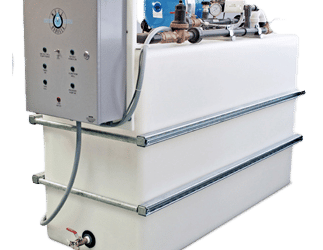
Campsite in Sourland Mountains They are lessons that have not been lost on two leaders of the Girl Scouts of Rolling Hills Council: Marilyn Siegel, Chief Executive Officer, and Ruth Hall, Director of Camp Services. One of the campgrounds falling under Hall's jurisdiction is Camp Agnes DeWitt in Hillsborough. Each summer, nearly 2,000 Girl Scouts convene at this camp in the Sourland Mountains to learn about nature and themselves. And every summer, water is scarce at the 152-acre camp, which relies on three wells, each one slow to replenish, to meet the needs of as many as 250 campers each week. When the Girl Scout’s Board of Directors
approved plans to build a pole barn and provide water to outlying
campsites, Hall found herself facing a new challenge: drawing enough
water to meet the increased needs, without adding more stress to the
aquifer. She could: Where There's a Well, There's a Way Hall called on experts to examine the problems facing the campground. The three wells had proved inadequate for current campsite uses, and woefully inadequate for the proposed expansions. And there were the flushometer toilets in the Activity Center which, when the water pressure was too low, would all come on at once, flooding the septic system and emptying the well connected to that building. The result was a tremendous waste of water and the hard-to-deal-with reality that five of the eight toilets could not be used. Tom Stover of Stover Well Drilling in Ringoes directed Hall to J. Andy Reid of Reid Plumbing Products in Hopewell, NJ. Reid's company produces well management equipment that is in use on low-yield wells across the US and Canada. After consulting with Reid, Hall discovered that it would be possible to do everything she wanted without drilling additional wells. "They could have replaced the toilets and solved the problem in one building, but they would still need to dig a new well to supply the pole barn and campsites. Given the Sourlands' reputation for poor wells and Hall's previous experience drilling dry holes on the property, I suggested she consider a way to make more efficient use of the existing wells, and she agreed," said Reid. "What we came up with is a flexible plan that will permit expansion of the facilities, and correct the existing water supply problems, without limiting future expansion possibilities," Reid said. "I've learned that where there is a well, there is a way to make it work efficiently, no matter how low the yield." Under the new plan, all three of the camp's wells, which now operate independently, will be combined into a single resource operated by a Well Manager® System. The Well Manager®, covered by several patents and produced by Reid's company, will collect small amounts from each well, on a rotating basis, and deposit the water into a surprisingly small, unpressurized water storage tank in the well house. The amount of water collected from each well will be based on its ability to contribute so that no well will be over taxed. From that one central location, water will be distributed at a controlled rate to various local storage sites at Camp DeWitt. Reid calls this a Distributed Storage System. It was originally developed by Reid's company for the arid Southwest and permits a number of buildings to function on a seemingly inadequate well(s). The system expands easily by adding local storage when a new building or group of buildings is constructed and, because water distribution is controlled, it is impossible for any one client to pump a well empty because they cannot use more than their allocated share of the supply. Local storage and delivery will be handled by another of Reid's products, the Herculan ConstaBoost Static Storage System (HCB System). There will be two of these for now: a 220-gallon unit at the pool house and a 425-gallon system to serve the community program center and the new pole barn. Improved pressure and water availability will allow use of all the toilets once again. If the toilets malfunction and begin wasting water there is a device to turn them off automatically until the problem can be corrected. The combined fill rates of all these tanks will be only a fraction of the combined wells' total capacity and the rate at which water is delivered to plumbing will be four times that of the current system. The end result will be more water availability for the Girl Scouts, less waste and a dramatically reduced influence on the local water supply using the existing wells. Work is currently underway at the camp, and expected to conclude by Oct. 31. To learn more about Well Manager, contact Reid at 609-466-1785 or jandyreid@wellmanager.com, or visit www.wellmanager.com. # # # #
High-end Custom Home
Builder to Include a Well Manager® or Herculan Constaboost™ in all
New Homes Hopewell, NJ (April 14, 2004) – Monkton, MD-based F.C. Batton & Sons, fine custom homebuilders since 1902, has announced plans to install a Well Manager® or Herculan ConstaBoost System™ in each new home the company builds. Well Manager® will be used in new homes with low-yield wells, and Herculan ConstaBoost System™ will be installed in homes with better wells. Either way, “all of our homes will have plumbing performance to please our most demanding clients,” said Rick Batton, president of F.C. Batton & Sons. “We are so happy with the performance these systems provide that we are contacting owners of homes built before we discovered Well Manager® and ConstaBoost™. Several of the homeowners we’ve reached have said they want a system installed in their homes.” Batton said his company decided during the drought of 2002 to test Well Manager® in two new homes. “I was very pleased with the product’s winning combination of excellent results and low maintenance,” said Batton, who had tried a different system earlier, and was disappointed by the amount of maintenance required. Complaints about poor pressure are so common in houses relying on wells that most contractors don’t pay much attention when they hear them. The prevailing opinion is that this is just part of the charm of living in the country with a well water supply. Batton has never felt this was acceptable but, until he discovered Well Manager®, there wasn’t much to do other than raise the settings on the well pump pressure switch. When Batton asked if there was something to boost the pressure on wells of better yield, where water treatment equipment has resulted in low pressure and poor plumbing performance, he discovered Herculan ConstaBoost Systems™. Well Manager® and Herculan ConstaBoost Systems™ are manufactured by Reid Plumbing Products under two separate patents. Both systems deliver consistent flow and pressure so that all the showers in a four-bath home can be used at the same time. Batton’s company builds homes that average 5,000 square feet and typically include 3 ˝ baths (often with features like showers with body sprays, which require more water and pressure to operate properly). Tack on a garden irrigation system, and the strain on a well operated with a normal pump system can be severe. In fact, two recently built homes required multiple wells to accommodate garden irrigation needs. “That was before we knew Well Manager® was available,” Batton said. “We won’t need to drill an extra well anymore.” Baltimore-based Joppa Plumbing & Heating, Batton’s pump contractor, will handle their Well Manager® and ConstaBoost™ installations. J. Andy Reid, CEO of Reid Plumbing Products and inventor of the Well Manager® and Herculan ConstaBoost™ said, “installing one of our systems when a home is first built is a good step. It will deliver the kind of performance people are accustomed to when they live with city water and, at the same time, prolong the life of the well and reduce the impact that pumping can have on an aquifer.” # # # # Batton Learned of Well Manager® From Long-Time Subcontractor Batton learned of Well Manager® through one of his long-time subcontractors, well drilling company J. Edgar Harr Sons of Cockeysville, MD. Paul Fabiszak, then president of J. Edgar Harr, broke the traditional mold of well driller in January 2002 when his company began distributing Well Manager®. Fabiszak told a local reporter then that he’d decided to partner with Well Manager® because “it’s very well thought out. For every question I asked [the inventor] about things that could go wrong, he had designed ways to keep it from happening. It makes a low-yield well yield very comfortably.” According to Reid, making “a low-yield well yield very comfortably” was exactly what Well Manager® was designed to do. Reid began working on Well Manager® in the mid-1990s, when customers with low-yield wells complained that they couldn’t draw enough water to support their daily household needs. Reid examined traditional water collection methods and realized that those systems can’t keep up because they were not working with nature but expected nature to work with them. “Attempting to force nature to do anything is a losing proposition. Well Manager is the result of studying nature’s infrastructure – the aquifer - to see how it transmits ground water so we could find a way to get in step with it. Most lack-of-water problems result from the way water is collected from the well, not because there is not enough water to collect. When you figure out how to work with nature you can get amazing things to happen ” said Reid. In developing Well Manager®, Reid drew heavily on his four-plus decades of plumbing experience – much of it in areas of NJ and Pennsylvania where homeowners rely on less-than-perfect wells. “Some look at a Well Manager and, seeing a large tank full of water, say there is nothing new about that. And, of course they are right. It’s not the tank, it’s that we can fill it again and again to provide a reliable supply of water and superior plumbing performance using wells that previously could not keep up with demand and provided poor pressure”, says Reid. One customer called the sudden abundance of water a miracle. “It’s not a miracle, just good management” say Reid.
Today Reid’s systems are in homes, parks, churches, and institutions across the US and Canada. # # # # About F.C. Batton & Sons, Inc.: Builders of custom, quality homes, additions and renovations since 1902, F.C. Batton & Sons Inc. earned the coveted Builder of the Month designation from Builder/Architect magazine because of their commitment to excellence. Learn more at www.battonandsons.com, or by calling F.C. Batton & Sons at 410-628-6510. About Joppa Plumbing & Heating Co. Inc. – Joppa Plumbing & Heating Co. Inc., owned by Ken Oldewurtel Jr., was established in 1989 to serve residential and commercial clients in Baltimore County, MD and surrounding counties. Oldewurtel has been in the profession since 1975, and associated with F.C. Batton & Sons since 1979. To learn more, contact Oldewurtel at 410-335-1700.
Reid Plumbing Products’ PumpChamber™
Earns U.S. Patent The PumpChamber™ converts a standard submersible well pump to an end suction pump, allowing a vertically mounted standard submersible well pump to collect from bodies of water as shallow as 2 ˝ inches. Referred to as the Tank PumpChamber™, this model can be used in atmospheric water tanks, cisterns, dug wells or streams. See http://www.wellmanager.com/pump_chamber-limitations.htm for illustrations. “Submersible well pumps are used around the world in all sorts of applications, in ways the designer never imagined. Many of these creative applications fall just outside the design limits of the pump’s motor. That’s why PumpChamber™ is so important,” said Andy Reid, CEO of Reid Plumbing Products and inventor of this product. “Many contractors lay submersible pumps on their side in cisterns and storage tanks though this drastically reduces life expectancy. Pumps installed this way can empty a vessel to about 7”. A Tank PumpChamber allows the pump to be vertically mounted and still empty a tank down to 2 ˝”. This extends the life of the pump and allows atmospheric water storage systems to be much smaller because more of the stored water is usable.” The wall-mounted version of PumpChamber™ can be installed in pressurized piping systems. In this form it can be used as a booster to correct low-pressure problems on buildings connected to a municipal supply or to draw water from a tank or open body of water up to fifteen feet below the pump. PumpChamber™ is available with or without a pump. Tank PumpChamber features a smooth uniform exterior so it can be installed through a UniSeal gasket into any size or shape tank - even in cases where the PumpChamber is taller than the tank is high. #### USDA Contract Will Put Well Manager® in National Park Campground Hopewell, NJ, Feb. 5, 2003 A Well Manager® System, like those in use across the continent to manage wells as poor as 0.1 GPM, has been purchased by the USDA, Forest Service to operate the new well at the ‘Jumbo’ Campground in Western Colorado’s Grand Mesa, Uncompahgre and Gunnison National Forest which hosts an estimated 6,000 campers annually. Because of the geology of the area, surface water contamination of the aquifer is a potential problem. By slowing the rate at which water is drawn from the well, Well Manager® will reduce the likelihood that contaminants, like parasites and biological agents, will be drawn toward it from nearby lakes and streams. The contract with the Forest Service calls for three 425- gallon tanks, a Well Manager® pump control panel, level controls, meters, pumps, a chlorine- mixing chamber and spare parts. The Well Manager® system custom-designed for the campsite will manage the collection of water from the well, provide contact time for chlorine treatment, provide the storage required by federal guidelines and deliver water to the campground at constant pressure. The project manager is Gordon Griswold, civil engineer with the Forest Service, who anticipates installing the system by October 2003 in time for a test run before winter sets in. When it’s time for the Jumbo campground to officially reopen in May 2004, Well Manager® will be in place and fully operational. ####
HOMEBUYERS BEWARE: OMISSION IN PLUMBING CODE
Imagine this scenario. A family is buying a home, and during the inspection process, the plumbing inspector turns on the tap for one kitchen sink, one bathroom sink and one bathtub. For good measure, the inspector flushes a toilet. With everything seemingly in working order, the homebuyer is issued a certificate of occupancy (CO). CO in hand, the family moves into the new home, and soon discovers that there is not enough water or pressure to run two showers at once and flush a toilet; run the dishwasher or washing machine while anyone is bathing; or run the custom multi-outlet shower in the master bath for longer than a couple minutes, if at all. These are just a few examples of the things that go wrong, according to Andy Reid, CEO of Reid Plumbing Products LLC in New Jersey. Until an omission in the National Standard Plumbing Code 2000 is rectified, Reid says, homeowners won’t have a legal leg to stand on when they move into their new home and discover there is not enough water for their plumbing to work properly. As now interpreted by the New Jersey Department of Community Affairs, this code requires a plumbing inspector to verify that there is adequate water to supply one bath or shower, one toilet and two sinks (one in the bathroom and one in the kitchen). There does not need to be adequate flow to operate bathrooms beyond the first, a dishwasher, a washing machine or an irrigation system -- even though the code says the piping system must be sized for proper operation of all connected fixtures and appliances. “Consumers believe that the plumbing code will insure that the plumbing in a new home works correctly, but it doesn’t,” said Reid, who has 40-plus years experience in plumbing. After sending a letter to the State of New Jersey’s Department of Community Affairs, Reid heard from Thomas Pitcherello of the Division of Codes and Standards, Code Assistance Unit. Pitcherello, one of 10 members from across the United States that make up the National Standard Plumbing Code Committee, agrees with Reid that this is something that only a code change can correct. “Until then, consumers are unprotected,” Reid said. “There should be a sign on the front of every new home with a disclaimer saying, ‘Let the buyer beware. A CO doesn’t necessarily mean that everything will work to your satisfaction’.” Reid offers these tips for prospective homebuyers:
Home sellers should also be wary, said Reid, who knows of several families who were successfully sued after the buyer discovered the water supply was insufficient to meet their unique needs. “There might be enough water for your family, but if the family looking at your home is larger, they will also have a larger water need. When a prospective homebuyer asks about the well, tell them the truth. If you run out of water occasionally, they may run out every day and you may find yourself discussing the matter with their attorney,” said Reid. Reid is asking homeowners who’ve encountered water supply problems in new homes to contact him at 609-466-1785, or jandyreid@wellmanager.com, before April 8. He is keeping a file of complaints to share with the National Standard Plumbing Code Committee, which in March will begin discussing code changes for 2006. In addition, Reid suggests that homeowners file complaints with consumer protection agencies. While there is no Lemon Law for new home purchases, Reid hopes that code changes will lead to mechanical systems functioning as the code says they should. #### |
|||
|
|
|||
![]() |
|||
|
© 2006, Reid Plumbing Products, LLC US: 800 211 8070 Worldwide: +1 609 466 4347 |
|||