A well water low pressure problem can feel like a plumbing issue at one house, and often it is. However, research published in July 2026 shows what can happen when groundwater extraction exceeds the limits of certain aquifer formations on a much larger scale. In California’s Sacramento Valley, researchers found that intensive pumping during drought was associated with rapid land subsidence, irreversible compaction, and the permanent loss of some groundwater-storage capacity.
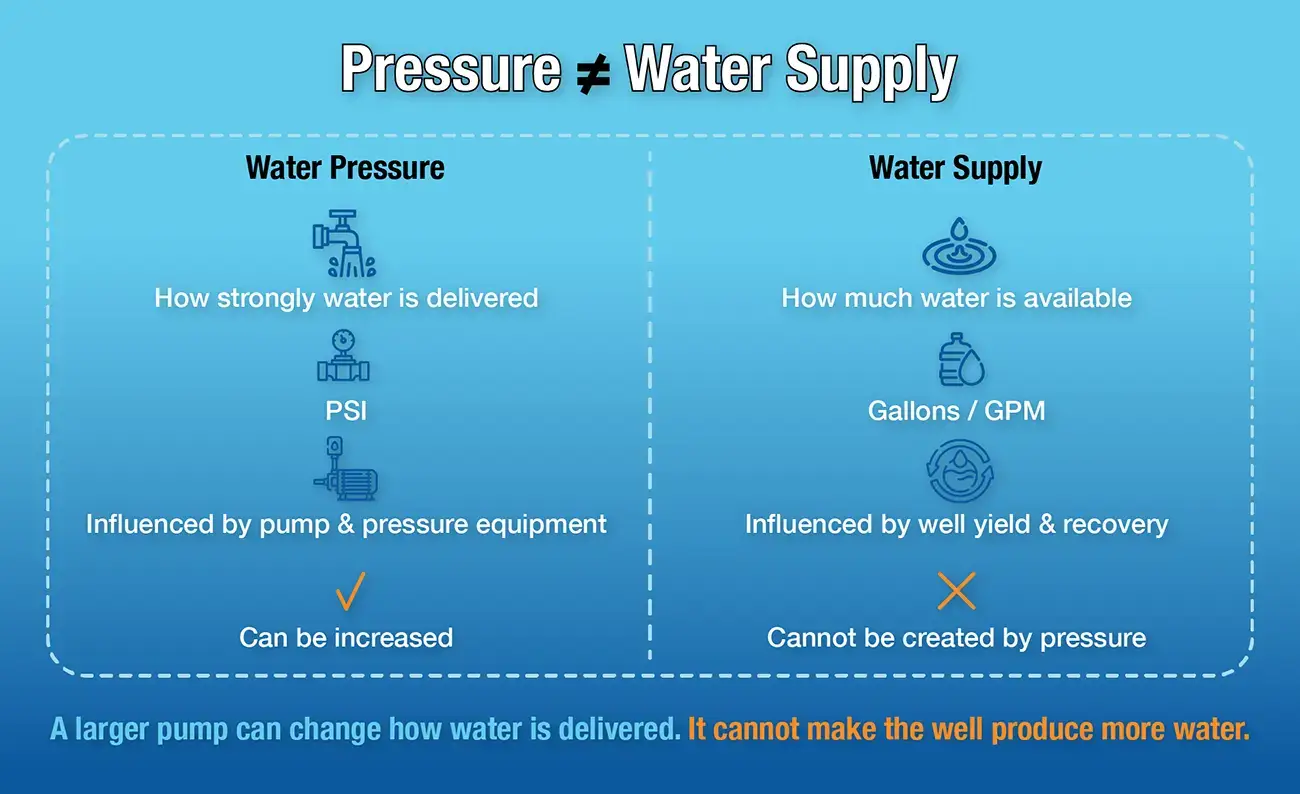
That finding does not mean low pressure at one home proves that a regional aquifer is collapsing. It reinforces a principle we believe matters at every scale: water pressure is not the same as available water. Before asking a well to pump harder, homeowners need to understand how much water it can produce, how quickly it recovers, and how demand compares with that supply.
Can an Aquifer Permanently Lose Storage Capacity?
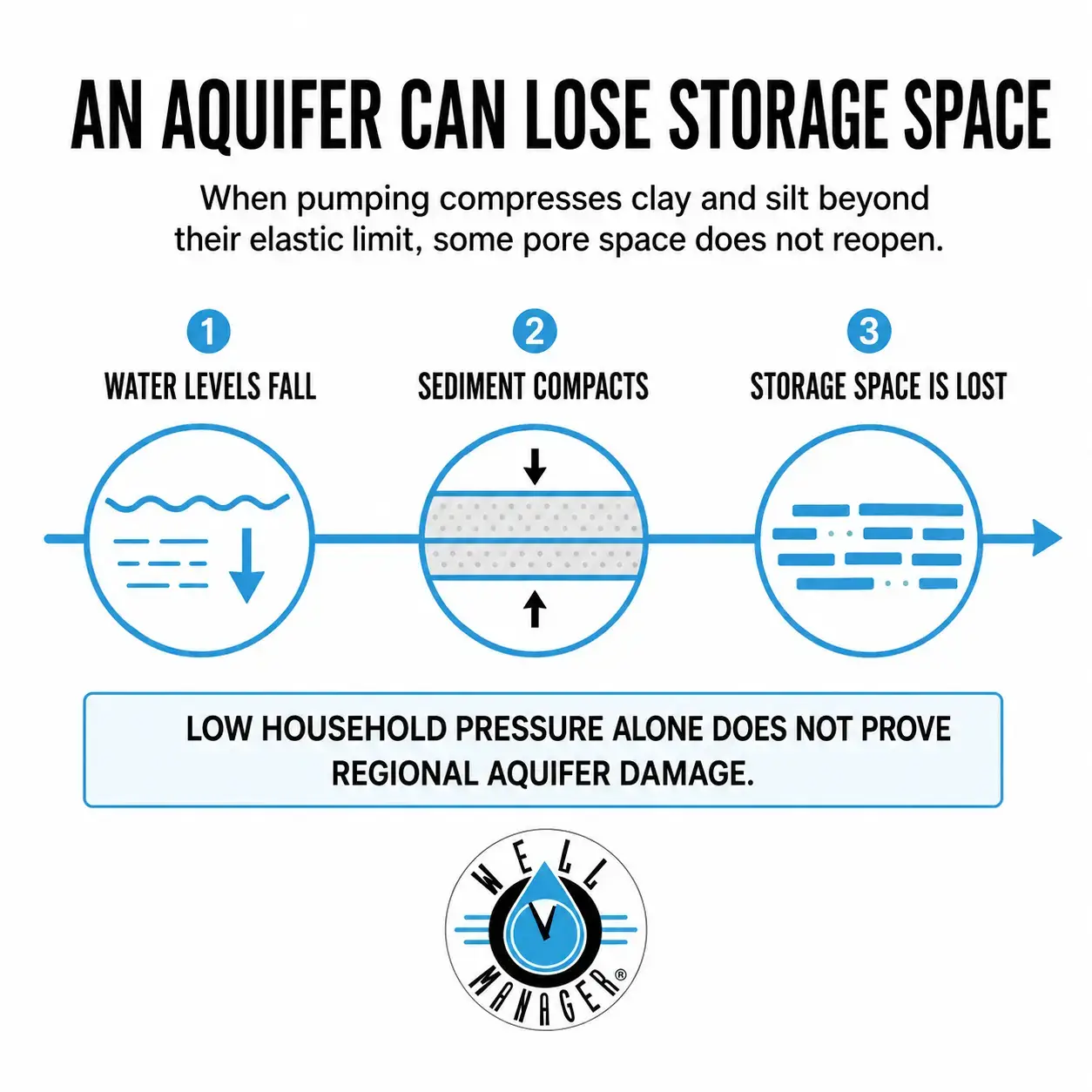
Yes. In aquifer systems containing compressible layers of clay and silt, groundwater removal can reduce water pressure within the sediment and increase the load carried by its grain structure. Some of that compression is elastic: the ground sinks while water levels are low and rebounds when they recover. If pumping pushes the system beyond its previous stress limits, however, the grains can rearrange into a denser structure. The lost pore space may not reopen, even after groundwater levels rise.
That is how an aquifer can lose part of its physical ability to store water. It is also why a well water low pressure complaint cannot, by itself, explain what is happening underground. Household pressure can be measured at the plumbing system; regional compaction requires groundwater records, land-motion data, and hydrogeologic analysis.
The Sacramento Valley study combined satellite radar, GPS stations, monitoring-well records, and satellite gravity measurements. The results separated two sharply different periods:
- Before 2021: Much of the measured land movement tracked seasonal groundwater changes and was largely reversible.
- During the 2020–2022 drought: Large areas shifted toward predominantly irreversible compaction. Some localized areas sank by as much as 50 centimeters per year, and estimated permanent storage loss reached approximately 0.2 cubic kilometers per year in 2021–2022, about five times the rate estimated for 2016–2020.
Why Sinking Land Means More Than a Lower Water Level
A falling water level and a shrinking aquifer are related, but they are not identical. A water level may decline during pumping and later recover through recharge. Storage capacity describes the space within the aquifer system that can hold water. When fine-grained layers compact irreversibly, some of that space is physically removed.
The process can be understood in four stages:
- Groundwater is withdrawn. Water levels and pore-water pressure fall.
- Sediment carries more load. Clay- and silt-rich layers begin to compress.
- A threshold is exceeded. Particles rearrange into a tighter formation.
- Storage space is lost. Water levels may recover, but the compacted pore space does not fully return.
The U.S. Geological Survey explains that excessive pumping has caused permanent subsidence in some aquifer systems by reducing the pore spaces that once held water. Uneven subsidence can also affect canals, roads, levees, pipelines, buildings, and wells. This is not simply a temporary shortage; it is a physical change underground.
Does Low Water Pressure Mean the Aquifer Is Depleted?
No. Low household pressure can begin in three different parts of the system:
- Equipment: A failing pressure tank, undersized or worn pump, or control problem
- Delivery: A clogged filter, restriction, leak, or high simultaneous demand
- Source: A well that cannot recover as quickly as the home is using water
More than one condition can exist at the same time.
The distinction begins with four related concepts:
| Measurement | What it describes | What it does not prove |
| Pressure | The force moving water through the household system, usually measured in PSI | How much groundwater the well can produce or how quickly it can recover |
| Yield | The rate at which the well supplies water, usually measured in gallons per minute | Whether the pressure equipment and household plumbing work correctly |
| Recovery | How quickly the water level returns after pumping stops | Whether the pump can meet peak demand or rebuild household pressure |
| Storage capacity | The amount of water an aquifer or storage vessel can hold | The pressure available at a fixture or the well’s current recovery rate |
A shower may weaken in every one of these situations, but the proper response is different. A pressure-equipment failure calls for equipment work. A restriction must be corrected. A slow-producing source may require demand management or storage. Raising a pressure setting without making this distinction can miss the real problem.
What Low Pressure Can Actually Tell a Well Owner
A conventional pressure tank holds only a limited amount of usable water. If household demand exceeds what the well and pump can deliver, pressure may fade during a long shower, irrigation cycle, or overlapping use. The pump may struggle to reach cut-out, and performance may improve after the well rests. Those symptoms show the system cannot keep up, but they don’t identify whether the cause is the well, pump, tank, controls, filtration, plumbing, or a combination of problems.
The useful next step is measurement:
- Test the source: Determine current yield, drawdown, and recovery.
- Test the equipment: Record pump output, cut-in and cut-out pressure, pressure-tank drawdown, and cycling behavior.
- Measure demand: Compare the source and equipment with realistic peak household water use.
These tests determine whether the property has a pressure problem, a delivery problem, or a limited source. A larger pump or higher pressure setting may move water faster, but neither makes groundwater enter the well faster. If the well produces usable water slowly, controlled collection and storage may help the home use that water at a different rate than the well produces it. That approach manages available water; it does not create groundwater, repair a damaged well, reverse aquifer compaction, or protect a regional basin.
Don’t Lose Your Water
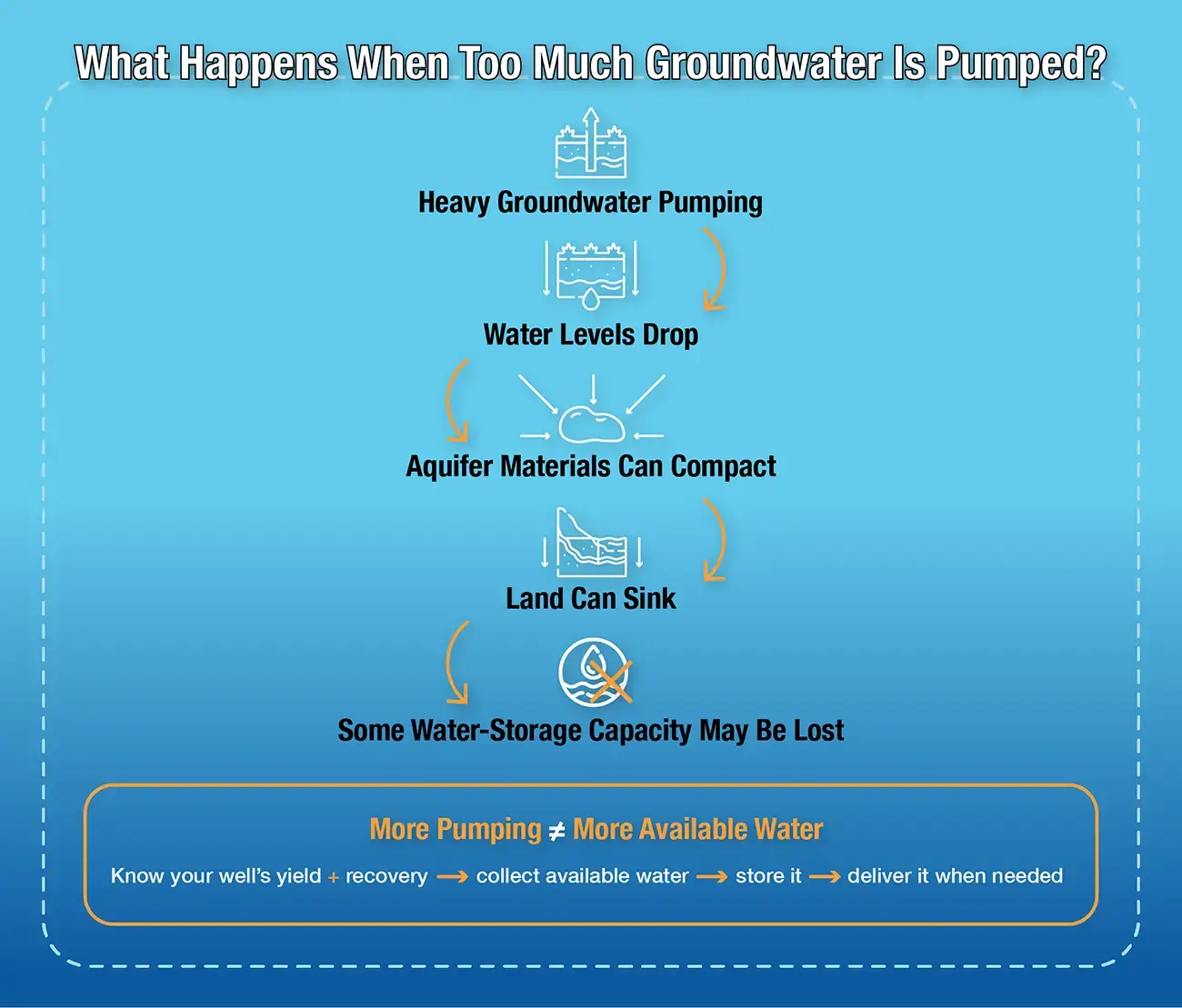
The Sacramento Valley study shows that an aquifer can lose storage capacity when intensive pumping causes irreversible compaction. Sinking land indicates physical change underground, not merely a temporary decline in water levels. A homeowner cannot diagnose that condition from low household pressure, which can have many equipment and supply causes. At the property level, the responsible response is to measure yield and recovery before increasing pumping. Well Manager can help collect, store, and deliver water from a limited but usable well, but it cannot create groundwater or repair an aquifer. The lesson at both scales is the same: manage water according to what the source can reliably provide.