
If your well water pressure starts strong and then drops off, the system is not behaving unpredictably. It is exposing a very specific limitation in how water is being supplied. The initial pressure comes from water already under pressure in the system. In contrast, the later pressure depends on how quickly the well can replenish that water and how effectively the pump can deliver it. When the system transitions from stored pressure to real-time supply and cannot keep up, pressure falls. That drop is not a sudden failure. It is the point where the system reaches its actual capacity.
Tired of Your Well Water’s Low Pressure?
Most homeowners recognize this pattern immediately once they experience it. A shower feels normal for a few minutes, and then gradually weakens. If water use stops and the system is given time to recover, pressure returns. That sequence is consistent because it reflects how all well systems operate under demand. The key is not the drop itself, but when and how it happens.
What Does It Mean When Pressure Starts Strong And Then Fades?
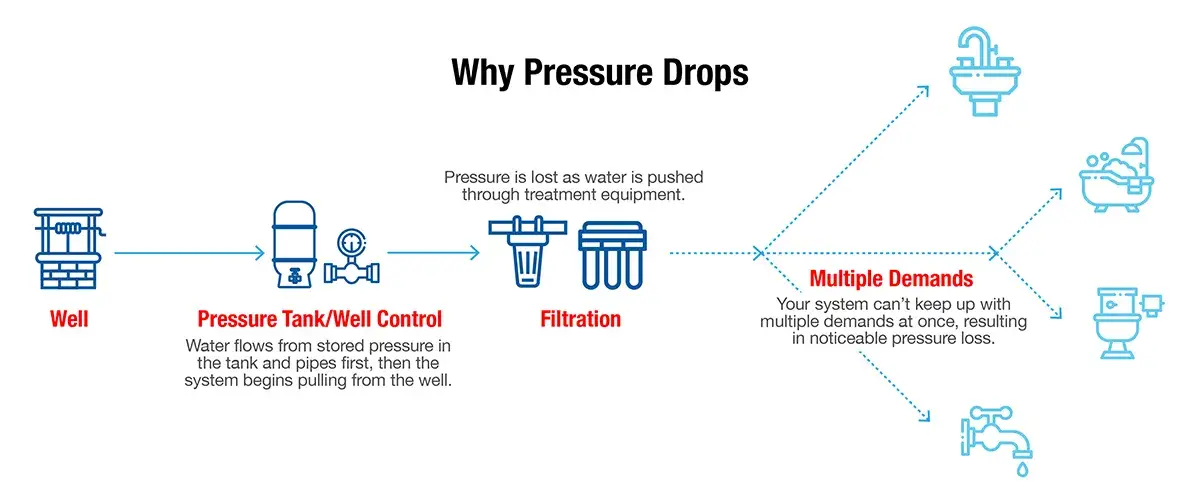
When pressure starts strong and then fades, it means the system can meet short-term demand but cannot sustain it. A well system is not a constant-pressure source. It is a system that blends stored energy with ongoing production. The stored portion creates a stable, immediate response when water is first used, but it is limited. Once that reserve is gone, the system must rely entirely on the well’s recovery rate and the pump’s ability to deliver water continuously.
The pressure drop occurs at the exact moment the system shifts from stored support to real-time production. If the well cannot replace water as quickly as it is being used, the system falls behind. Pressure declines because supply cannot keep up with demand, not because pressure is inherently unstable.

Why Does The System Feel Normal At First?
The system feels normal at first because the initial flow is supported by water that has already been pressurized and stored inside the tank. In a typical well system, the pressure tank acts as a buffer, holding a limited volume of water under pressure between pump cycles. When a fixture is opened, the stored water is released immediately, creating a strong, consistent flow regardless of what the well is doing at that moment.
The limitation is that this stored volume is much smaller than most people assume. Tank size is often misunderstood because the labeled capacity does not reflect the usable water capacity. In most residential systems, only a portion of the tank volume is available between the pressure switch’s cut-in and cut-out settings, which means the reserve is consumed much faster than expected under normal use.
What matters in practice:
- A tank labeled at 44 gallons may only provide ~10–12 gallons of usable water
- Usable drawdown is typically 20–40% of total tank volume
- A standard shower at ~2.5 GPM can exhaust that reserve in 4–5 minutes
Once that stored water is depleted, the system is no longer buffered. It must rely entirely on the well and pump to keep up with demand, which is where limitations begin to show.
Why Does Pressure Drop after A Few Minutes Instead Of Immediately?
The delay in pressure loss is directly tied to the duration of the stored reserve. While the pressure tank is supplying water, it masks any imbalance between supply and demand. The system appears stable because it is drawing from a pre-pressurized source. Once that reserve is exhausted, the system must immediately rely on real-time production from the well.
At that point, the system follows a predictable mechanical sequence. Higher pressure settings increase the rate at which water leaves the system, thereby accelerating the rate at which stored water is depleted. Faster depletion forces the system to depend on the well sooner. If the well cannot keep up with demand, pressure begins to decline. The timing of the drop is therefore not random. It reflects how quickly the system transitions from stored delivery to sustained delivery and how far it falls short once that transition occurs.
How Does Well Recovery Rate Factor Into This?
The recovery rate determines whether your system can maintain pressure once the stored water is gone. It measures how quickly groundwater flows back into the well after water has been removed, and it is the most important factor in sustained performance.
A well can produce enough water over an entire day and still fail during active use. This happens because household demand is not evenly distributed. Instead, water use occurs in short bursts, with multiple fixtures running at the same time. During those periods, the system must deliver water at a rate far above the daily average.
For example, a well producing one gallon per minute can generate more than enough water over 24 hours for a typical household. However, if that same household demands eight to ten gallons per minute during peak use, the system begins to draw water faster than the well can replace it. The pressure tank delays the effect, but once it is depleted, the imbalance becomes visible.
Useful thresholds to anchor expectations:
- Wells under ~3 GPM are generally considered low-yield
- Around 5 GPM is often a baseline for stable residential use
- Peak household demand can exceed 8–12 GPM during simultaneous use
These numbers are not about the total water supply. They define whether the system can keep up in real time.
Why Does Peak Demand Matter More Than Total Water Supply?
Peak demand matters because well systems fail under short-term load, not long-term averages. A household may use only a few hundred gallons per day, but that water is used in concentrated bursts rather than spread evenly over time.
During those periods, multiple fixtures may be running simultaneously. A shower, faucet, and appliance can easily push demand beyond the system’s capacity. When that happens, the system consumes stored water first, and then falls behind once it must rely on the well. This is why a system that appears adequate on paper can still struggle in practice. Daily supply answers whether you will run out of water completely. Peak demand determines whether pressure will hold while you are using it.
What Are The Most Common Causes Of This Pressure Pattern?
When pressure starts strong and then fades, the issue is usually tied to how the system performs under sustained demand. The pattern itself helps narrow the possibilities. The most common causes include:
- Low well recovery rate:Water is being drawn faster than it returns, and pressure improves after rest
- Limited effective storage: The pressure tank provides only a short buffer before the supply must take over
- Pump limitations:The pump can start strong, but cannot maintain the required flow under continuous demand
- System restrictions: Filters, treatment equipment, or mineral buildup reduce flow, especially under load
- Declining well performance:Sediment, scale, or biological buildup reduces how much water enters the well
Each of these issues becomes visible at the same moment: when stored pressure is no longer supporting the system.
Why Increasing Pressure or Pump Size Usually Doesn’t Fix It
Increasing pressure or installing a larger pump changes how quickly water moves through the system, but it does not change how much water is available. A higher-pressure system increases discharge rate, causing stored water to be used more quickly and forcing the system to rely on the well sooner.
A larger pump can increase the flow rate, but if the well cannot supply water at that rate, it simply accelerates the drawdown. The system reaches its limit faster rather than later. What does not change in either case is the rate at which groundwater enters the well. That is determined by geology, not equipment.
When Does A Booster Pump Actually Help?
A booster pump improves performance only when the supply already meets demand, but pressure distribution is inconsistent. In those cases, it can stabilize delivery and improve how water reaches fixtures throughout the home.
However, when the underlying issue is limited recovery or insufficient supply, a booster pump cannot solve the problem. It cannot increase well yield or replenish groundwater. It only amplifies the water that is already available. If supply is the constraint, the system will still fall short under sustained use.
Final takeaway
Pressure that starts strong and then drops off is not a general complaint. It is a clear signal that the system is transitioning from stored pressure to real-time supply and failing at that transition. The early performance reflects what has already been stored. The later performance reflects what the system can actually sustain.
The drop occurs exactly where demand exceeds recovery and storage combined. Once that point is reached, the system is no longer buffered, and its true capacity is exposed.