

Boosting Pressure on Naturally Flowing Wells
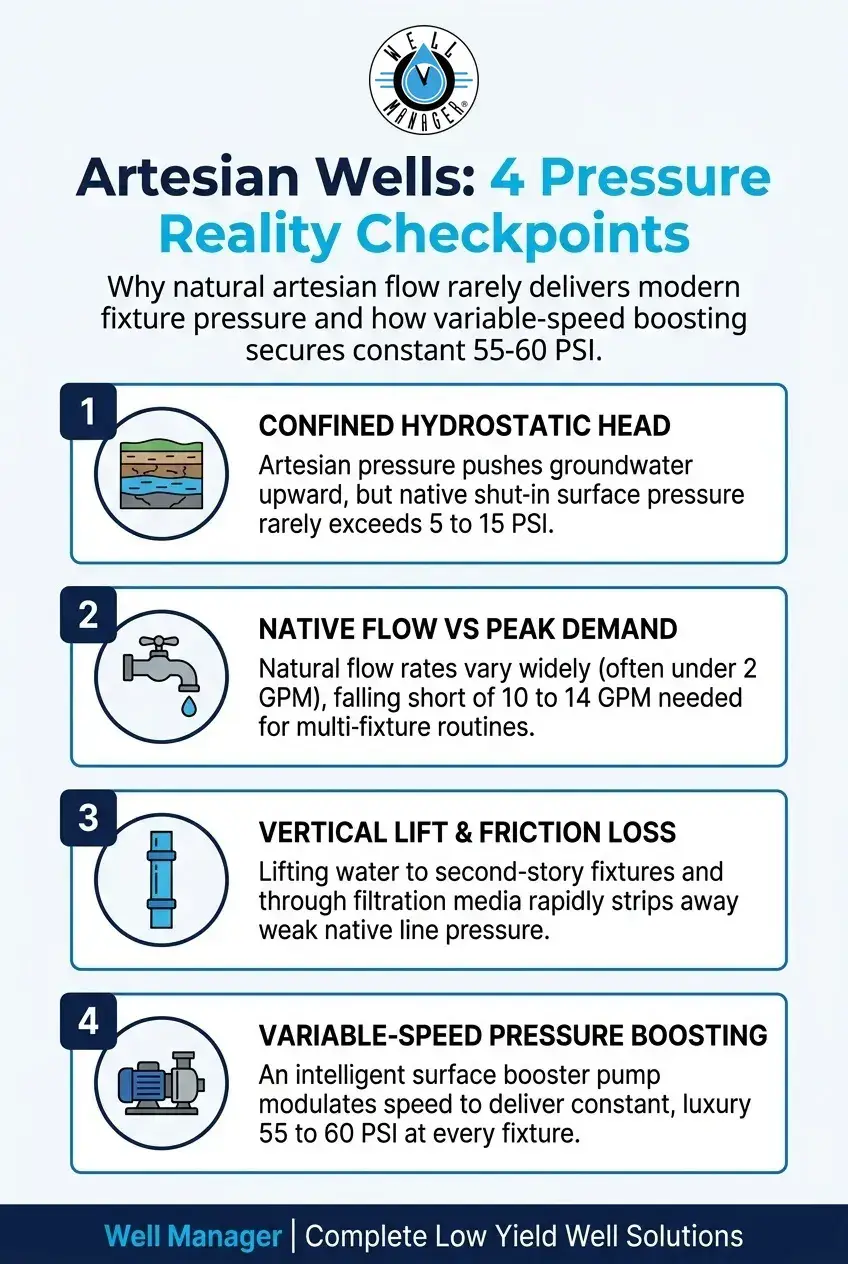
Why does an artesian well that naturally overflows at ground level still leave upper-floor showers with weak, sputtering flow? While artesian wells often overflow naturally at the surface, installing the right water pressure booster system is necessary because natural ground pressure rarely provides the fifty to sixty PSI needed for modern multi-story homes. Artesian pressure simply pushes water to the surface of the earth, lacking the mechanical force required to push water through filtration units, water heaters, and second-floor fixtures simultaneously. Understanding how to harness and boost natural artesian flow transforms an unpredictable natural spring into strong, reliable household water pressure.
Many property owners feel confused when an artesian well overflows into the yard, yet faucets upstairs sputter and deliver weak pressure. It seems contradictory that a well with water pushing upward by natural force can’t deliver a satisfying, invigorating shower. However, examining the difference between natural surface overflow and modern household pressure requirements makes the solution clear and straightforward.
Homeowner Fundamentals: How Artesian Water Pressure Really Works
An artesian well occurs when a drilled borehole penetrates a confined aquifer trapped beneath an impermeable layer of dense clay or solid rock. Because the aquifer’s recharge area sits at a higher geological elevation in surrounding hills, gravity exerts constant pressure on the trapped water. When a well taps this confined layer, natural hydrostatic pressure forces groundwater up the casing toward the surface without requiring a downhole pump.
While this natural upward push is impressive to watch at the wellhead, native artesian pressure is usually quite modest in plumbing terms. An overflowing wellhead often produces only two to five PSI of positive pressure, which is barely enough to spill water over the top of the casing pipe. Modern residential plumbing systems, by comparison, require fifty to sixty PSI to operate appliances, water softeners, and high-flow showerheads efficiently.
Furthermore, lifting water to upper-story bathrooms consumes significant pressure to fight gravity. For every 2.3 feet of elevation gain from the basement to a second-floor bathroom, water loses one full pound per square inch of pressure. Without dedicated mechanical boosting, natural artesian flow cannot deliver the pressure necessary for comfortable modern living.
Why Common Direct In-Line Booster Pumps Often Fail
When homeowners seek assistance with weak artesian pressure, plumbers frequently recommend installing a simple in-line booster pump directly on the incoming supply pipe. While an in-line booster seems straightforward, connecting it directly to an artesian well line often causes frustrating operating failures.
Direct in-line pumping on artesian systems introduces three serious mechanical risks:
● Cavitation and Pump Motor Burnout: If household water demand exceeds the well’s natural flow rate, the booster pump sucks against a restricted supply, causing vacuum cavitation that destroys pump impellers and burns out motors.
● Sucking Silt and Air Bubbles into Plumbing: Creating negative suction on an artesian line pulls fine sediment and air bubbles from the wellbore, clouding household water and quickly plugging filter cartridges.
● Vulnerability to Seasonal Flow Variations: Natural artesian output fluctuates across seasons, and an in-line pump that functions adequately during wet spring months will starve for water during dry summer weather.
Forcing high delivery flow directly from an unpredictable wellhead violates basic fluid dynamics. When an in-line pump starves for water, it generates loud vibrations, surges uncontrollably, and delivers erratic pressure to upstairs bathrooms. A dependable boosting setup must separate incoming artesian recharge from household water delivery.
How Atmospheric Storage and Pressure Boosting Work Together
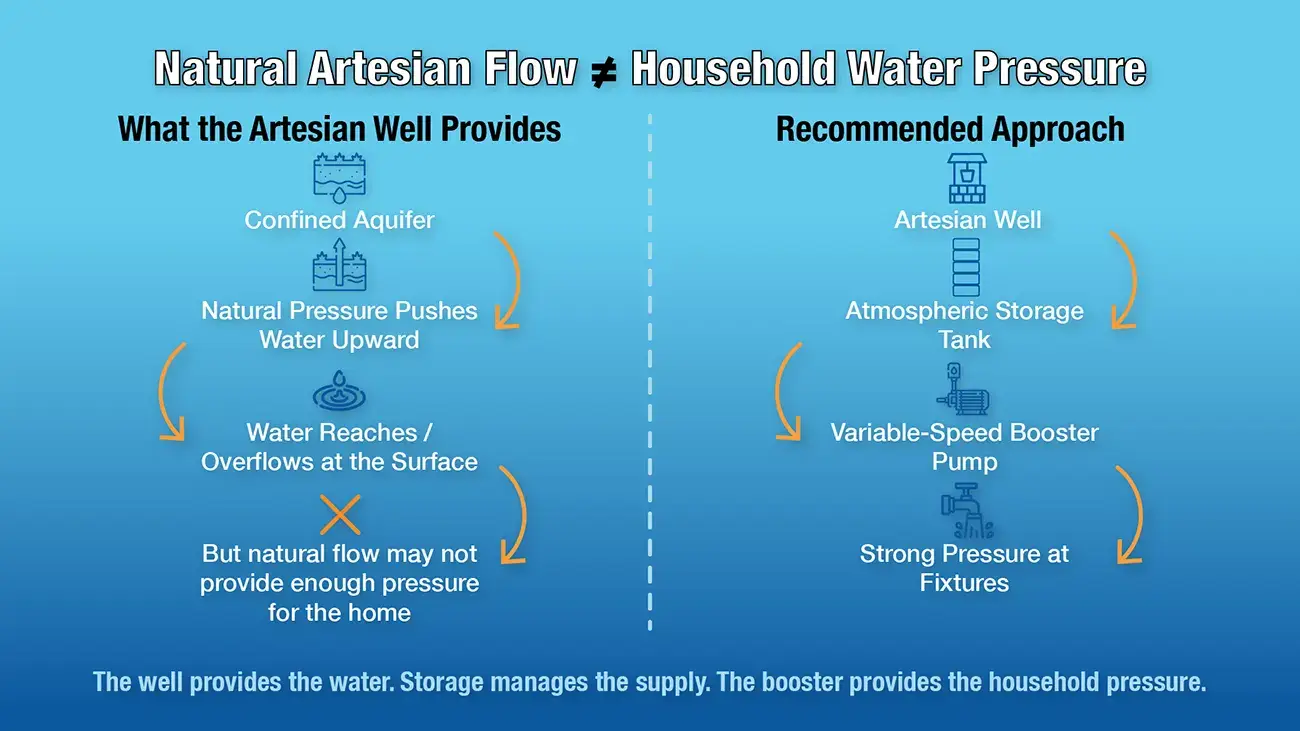
The proven engineering method for managing an artesian well combines non-pressurized atmospheric storage with an intelligent booster pump. Instead of connecting a booster pump directly to the incoming well pipe, natural artesian flow discharges freely into an indoor atmospheric storage tank. Because the tank is open to atmospheric pressure, incoming water encounters zero backpressure, allowing the well to flow naturally at its optimum rate.
The atmospheric storage tank serves as a generous buffer that decouples natural well flow from instantaneous household usage. Even if an artesian well produces only two or three gallons per minute, the tank steadily collects thousands of gallons over each twenty-four-hour cycle. This dedicated indoor reservoir guarantees that abundant water is always staged and ready when family members turn on multiple fixtures.
A smart, variable-speed booster pump draws clean water directly from the storage tank to pressurize the household plumbing network. The booster pump senses water demand instantly and adjusts its motor speed to maintain smooth, whisper-quiet sixty PSI pressure throughout the residence. Showers maintain strong, invigorating flow regardless of whether laundry is running downstairs or irrigation timers are active outside.
Comparing Pressure Boosting Options for Artesian Wells
| Boosting Method | Operating Principle | Risk of Air & Sediment | Second-Floor Fixture Pressure | Equipment Longevity |
| Atmospheric Storage with Booster (Well Manager) | Artesian flow fills indoor tank; booster delivers to house | Zero; tank serves as natural settling buffer | Constant, unwavering 55-60 PSI at all levels | Longest; booster never runs dry or cavitates |
| Direct In-Line Booster Pump | Pulls directly on incoming well line without a tank | High; creates negative suction on wellhead | Fluctuates wildly; drops when demand exceeds flow | Prone to impeller cavitation & motor burnout |
| Sealed Wellhead Pressure Cap | Seals casing pipe to force artesian pressure into house | Moderate; can force water to break out around casing | Weak; rarely exceeds 15-25 PSI of usable pressure | High risk of subterranean casing leaks |
| Standard Bladder Pressure Tank Only | Relies entirely on native artesian pressure to fill bladder | None | Extremely weak; cannot overcome upper-floor elevation | Bladder cycles frequently with poor pressure |
Pre-Installation Checkpoints for Naturally Flowing Artesian Wells
Before selecting boosting equipment for an artesian well, property owners can perform three simple checks to evaluate wellhead conditions. Documenting these basic characteristics ensures that specialists size storage tanks and booster pumps accurately.
Homeowners can observe three practical benchmarks:
● Measure Natural Open Discharge Rate: Direct the overflowing wellhead discharge into a five-gallon bucket and time the fill rate with a stopwatch to determine natural flow in gallons per minute.
● Verify Elevation Difference to Highest Fixture: Estimate the vertical height difference between the wellhead and the highest second-floor shower to calculate elevation head requirements.
● Check Water Clarity and Sand Content: Collect a clear glass jar of water from the overflowing wellhead and allow it to sit undisturbed for ten minutes to check for settled sand or silt particles.
Recording these observations allows water systems engineers to select the ideal booster horsepower and storage tank dimensions for the property. Verifying natural overflow volume prevents undersizing equipment and ensures continuous water availability during dry summer months. With accurate wellhead measurements, homeowners can install a boosting system that delivers years of dependable, trouble-free service.
Transforming Artesian Flow into Reliable Pressure with Well Manager
A naturally flowing artesian well is an extraordinary groundwater asset, but enjoying strong fixture pressure requires the right mechanical approach. By directing natural well flow into atmospheric storage and boosting delivery independently, homeowners enjoy the best of both worlds. Families protect their well from suction damage while enjoying invigorating showers and dependable pressure at every faucet.
Since 1996, Well Manager has designed and manufactured patented water harvesting, storage, and constant-pressure booster systems for artesian and low-yield wells. The company’s proven systems provide reliable, city-like water pressure to rural residences, farms, and estate properties across North America. To learn how to optimize an artesian well with custom atmospheric storage and boosting, call Well Manager today at (800) 211-8070.