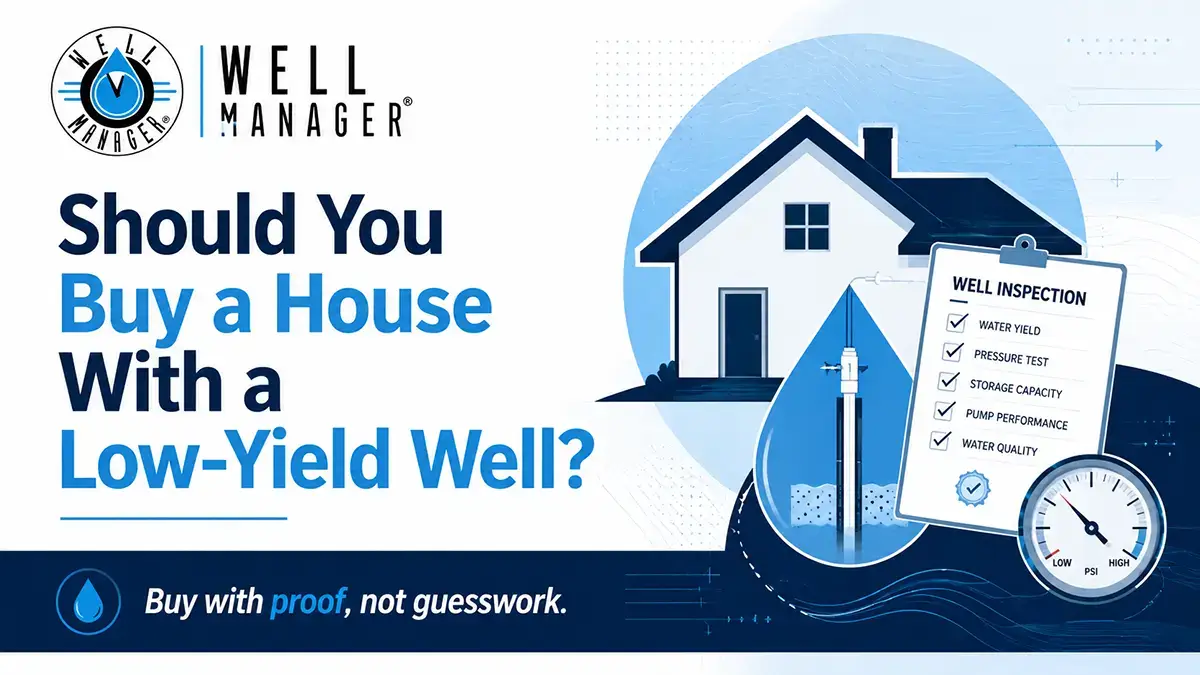
The house checks the right boxes—the price, layout, and location work. Then the inspection turns up a low-yield well. That finding does not automatically kill the deal, but it changes the decision.
A buyer now needs to know whether the well system has enough proven supply, recovery, storage, pressure, and safe water to support daily life. The smart question is not whether the well carries a low-yield label. The smart question is whether the house will deliver enough water for the household’s normal routine.
A low-yield well becomes manageable when the system has been tested, documented, and built around the well’s real capacity. The same well becomes a serious buying risk when the seller has no records, no recent water test, no recovery data, or no clear answer for what happens during showers, laundry, and other peak-use periods. Buyers should ask for proof before closing, especially if normal use could include back-to-back showers, dishwasher cycles, laundry, guests, or outdoor water use.
This issue also shows up after moving in. One new homeowner near Lambertville, New Jersey, bought in a rocky well area and later found the system struggled when household use overlapped. His situation matters because it was not an abstract well concern. It was a daily-use question about whether the home could run the shower, dishwasher, and washing machine without depleting the water supply.
A Low-Yield Well Is Not an Automatic Deal Breaker
A low-yield well does not automatically make a house a bad purchase. The buyer needs proof that the system matches daily use and peak demand. If the well recovers well, stores enough water, and delivers steady pressure, the home still represents a reasonable purchase.
A buyer should treat the well as a capacity question rather than a label. Penn State Extension’s 2025 Using Low-Yielding Wells explains that a 1-gallon-per-minute well equals 1,440 gallons over 24 hours, while household use often arrives in short bursts. That point changes the buying question from whether the well is slow to whether the system stores and delivers enough water during the household’s busiest periods.
The buyer should not decide solely on the gallons-per-minute figure. A slow well becomes more workable when stored water is available before the household needs that water. The stronger decision comes from matching proven output to the way the home will be used.
What the buyer should decide
- Does the well produce enough total water over a full day?
- Does the well recover after showers, laundry, and other heavy-use periods?
- Does the home have enough stored water before peak demand starts?
- Does pressure stay usable when normal fixtures overlap?
- Does the seller have records, or only verbal reassurance?
What the Well Must Prove Before Closing
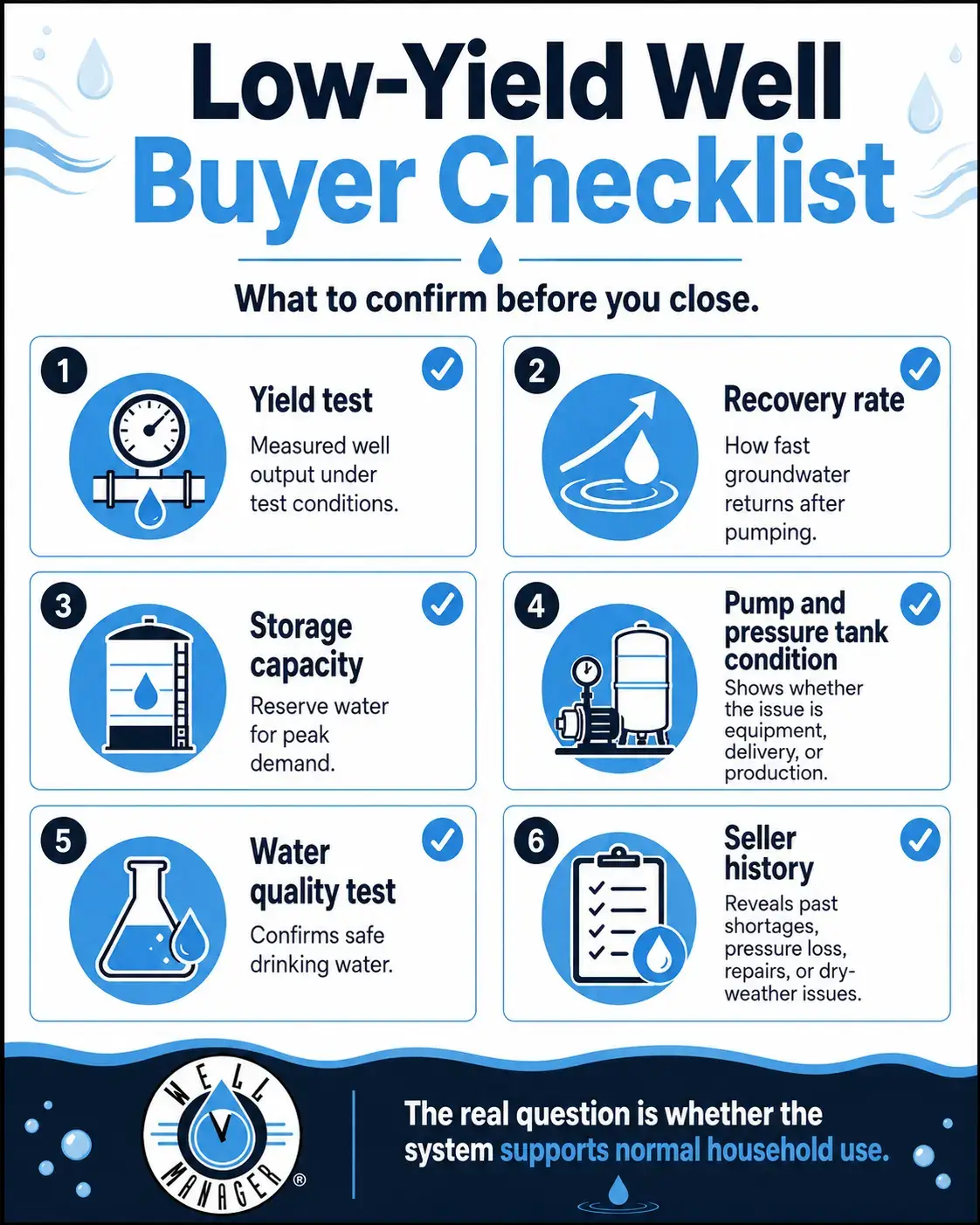
The well must prove more than one test number before closing. The buyer needs evidence on yield, recovery, storage, equipment condition, water quality, and seller history. Those factors show whether the home has a manageable water system or an unresolved daily-use problem.
The checklist below keeps the decision tied to the purchase. Each item answers whether the water system is ready for normal household use. The buyer is not buying a well label. The buyer is buying the daily experience of living with that system.
| What Must Be Confirmed | Why the Buyer Needs It | What the Answer Shows |
| Yield test | Shows measured output under test conditions. | Whether the well produces enough water to support the home over time. |
| Recovery rate | Shows how fast groundwater returns after pumping. | Whether the well recovers after showers, laundry, and other periods of heavy use. |
| Storage capacity | Shows how much reserve water the home has. | Whether peak demand has support beyond the well flow. |
| Pump and pressure tank condition | It shows whether weak pressure comes from equipment. | Whether the problem is production, delivery, or both. |
| Water quality test | Shows whether the water is safe to drink. | Whether the buyer inherits a treatment or safety concern. |
| Seller history | It shows past pressure loss, shortages, repairs, or dry-weather issues. | Whether the concern is rare, seasonal, or routine. |
Water quality belongs in the same closing decision as the private well because the buyer inherits it after the sale. EPA’s 2026 Private Drinking Water Wells states that private well owners are responsible for safe drinking water and that the federal government does not regulate private domestic wells under the Safe Drinking Water Act.
Documents to Request Before Signing
- A recent well-yield test with the date, testing method, pump duration, and measured production.
- Recovery or drawdown information from a well professional, not only a seller estimate.
- A recent drinking water test that includes the common private-well safety markers for the area.
- Pump and pressure tank age, service history, and known replacement needs.
- Seller notes on dry-weather performance, pressure drops, water interruptions, or waiting for the well to recover.
When a Low-Yield Well Is Still a Workable Purchase
A low yield well is more workable when it produces enough total water over time, and the system stores enough reserve water during busy periods. The buyer should judge the well as part of a delivery system. Recovery, storage, and pressure equipment decide whether daily use feels normal.
A slow well works better for one household than another. A small household with spread-out water use places less strain on the system than a large household with back-to-back showers, laundry, and outdoor watering. The same well can feel normal to one buyer and frustrating to another.
Bob Halpern’s situation fits this buying question. After moving to the Lambertville, New Jersey, area, he had trouble coordinating normal household uses and heard from a local well driller that running the well dry could damage the well pump. Drilling deeper or drilling another well remained possible, but it was too expensive for a new homeowner, so he looked for another way to manage a limited but usable source.
Signs the System Can Support the Home
- The well yield supports the home’s total daily water use.
- The recovery rate supports repeated use after the well draws down.
- Storage capacity supports the busiest water-use period of the day.
- Pressure delivery remains steady when normal household use overlaps.
- A recent water quality test supports safe drinking water before closing.
- Seller records show stable performance instead of repeated complaints.
These facts answer the buying question better than the phrase “low yield” does. MassDEP’s 2025 Model Board of Health Regulations for Private Wells evaluate private well capacity by considering peak demand, well yield, and stored water. That makes the buyer’s concern clear: a water system should meet real household demand, not only look acceptable on a single test result.
When a Low-Yield Well Should Make You Pause
A low-yield well should make the buyer pause when the system lacks proof. Missing yield results, unclear recovery data, no recent water test, pressure failure during normal use, or a history of shortages all raise risk. The buyer should not accept vague reassurance when records are missing.
The biggest warning sign is uncertainty before closing. A slow but documented well is easier to evaluate than a well with missing records. A buyer should pause when the seller cannot explain how the system performs during normal demand.
A warning from a well driller should carry weight. If a professional says the current use pattern could run well dry and risk damaging the pump, the buyer needs to know whether the system prevents that outcome. That is different from a minor inconvenience or a single weak shower.
Red flags that should change the conversation
- No recent professional yield test is available.
- No recovery information is available.
- No storage system supports peak demand.
- No recent drinking water test is available.
- The seller reports weak pressure during normal use.
- The seller reports are waiting for the well to catch up.
- Pump or pressure tank history is missing.
- Dry-weather performance is unknown.
Water testing should stand out as a closing requirement, not a side issue. EPA’s 2026 Protect Your Home’s Water recommends annual testing of private wells for total coliform bacteria, nitrates, total dissolved solids, and pH. The same EPA source recommends additional testing after repairs, flooding, new construction, or changes in the taste, odor, or color of the water.
How Storage Changes the Buying Decision
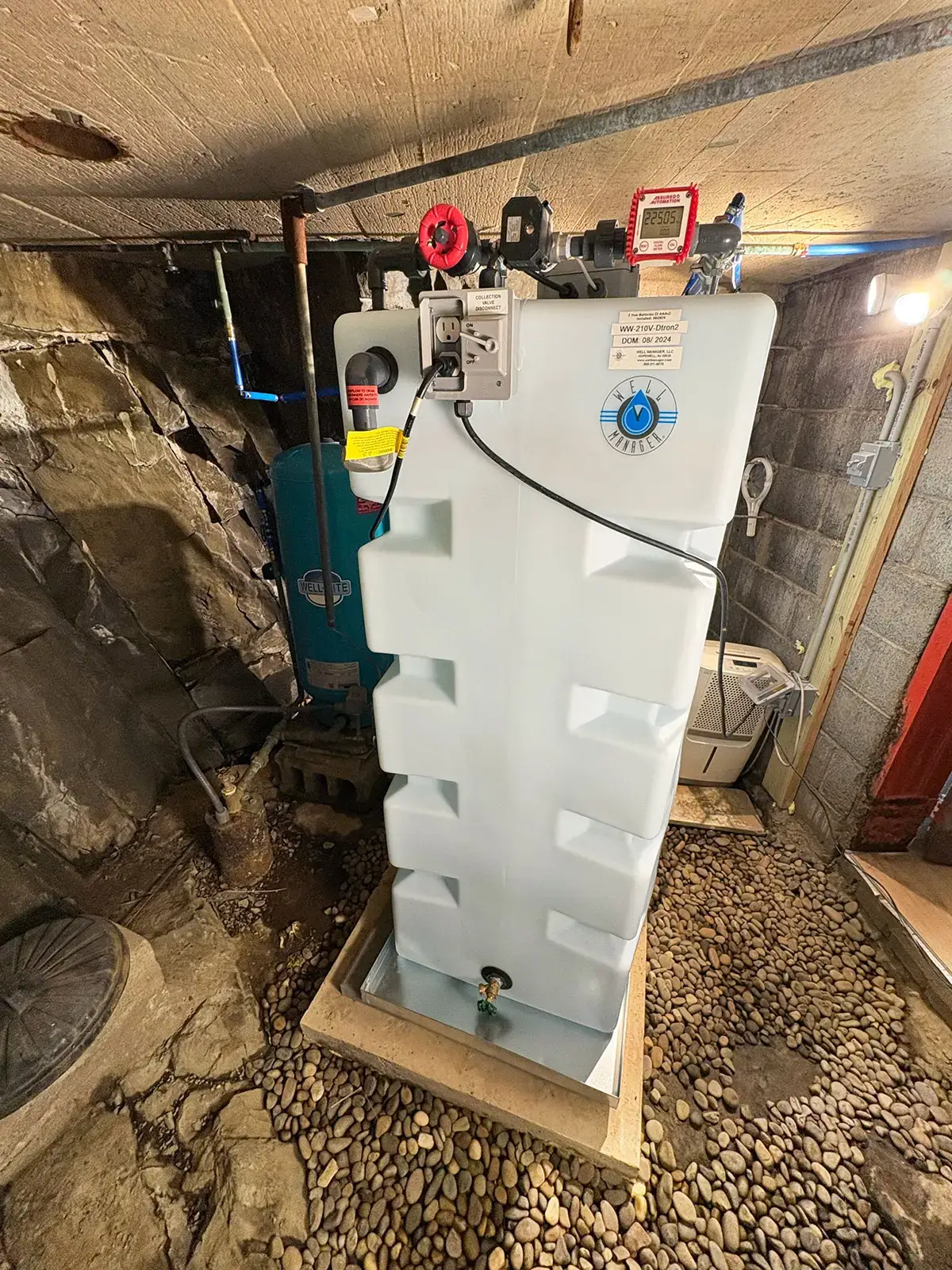
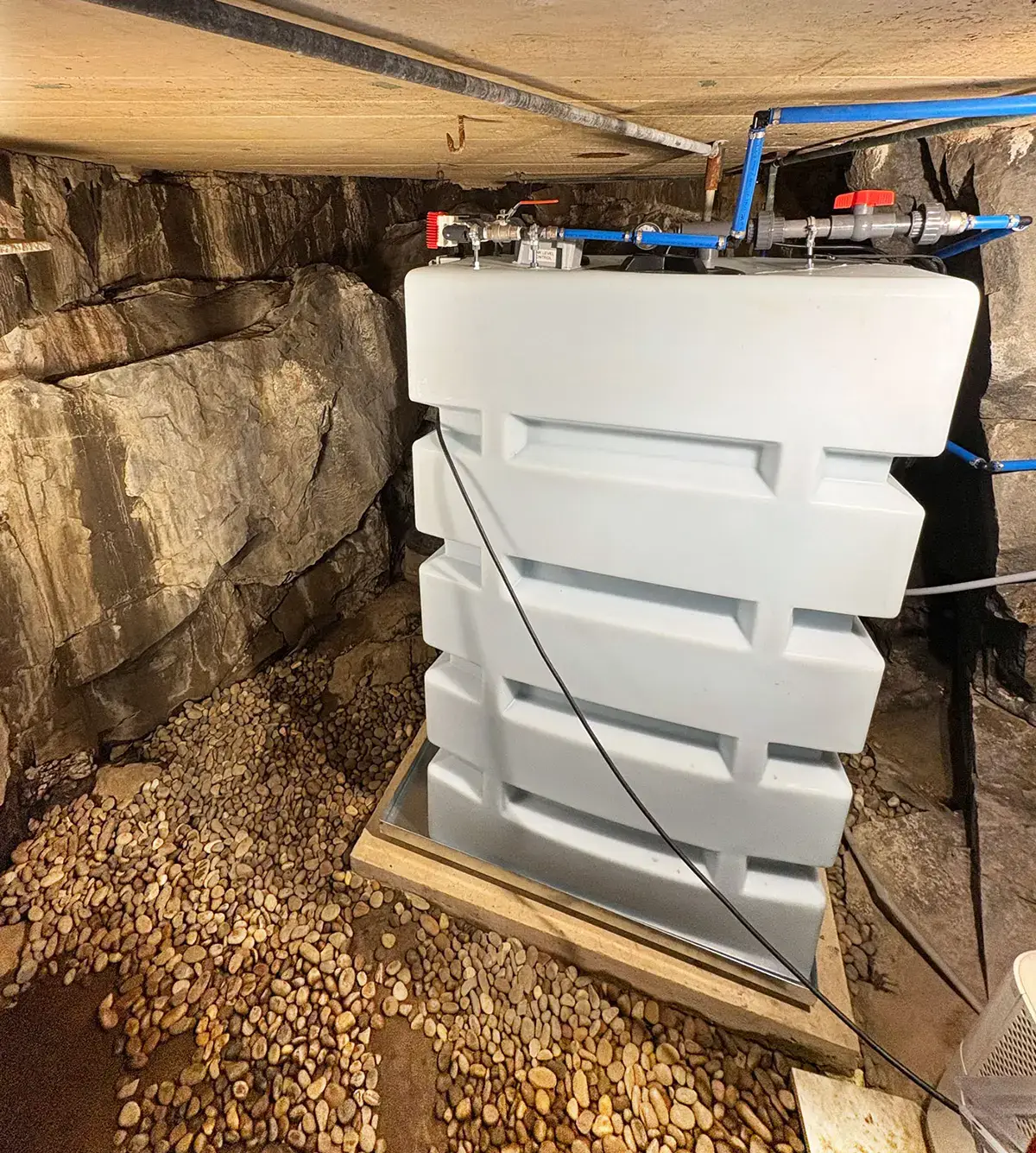
Storage changes the buying decision when the well produces enough water over time but cannot meet short-term heavy use. A storage system does not create new groundwater. Storage provides the home with a water reserve, so the well does not need to supply every fixture in real time.
This distinction matters because buyers often hear weak pressure and assume the pump is the answer. A stronger pump does not make groundwater enter the well faster. A better system design stores water at a rate the well can support, then delivers it at a rate the household needs.
Why Fixture Overlaps Matter
The practical issue is not one fixture. A home might handle one shower, one laundry load, or one dishwasher cycle, but struggle when those uses stack. Storage helps when the well produces enough water over time but cannot meet the household’s peak water needs in real time.
| Real-World Detail | What It Proves for a Buyer |
| The homeowner struggled when the shower, dishwasher, and washing machine all ran at the same time. | Peak demand matters more than whether a single fixture works. |
| A well driller warned him not to keep running the well dry. | The issue included pump protection and system stress, not only convenience. |
| Drilling deeper or drilling another well was too expensive for a new homeowner. | Buyers should understand management options before assuming drilling is the only path. |
| After the Well Watcher™ installation, he reported better pressure and less fear of running out of water. | A limited but usable source can become more livable when storage and delivery match the well’s real capacity. |
Storage belongs in the decision when several facts line up. The well has limited but usable production. The household needs better delivery during peak use. The system needs a way to separate slow recovery from immediate household demand.
- The well produces enough total water over a full day.
- The well struggles during short peak-demand periods.
- The recovery rate is steady enough to refill stored supply.
- The home needs steadier pressure during normal fixture overlaps.
- The water quality is acceptable or treatable before closing.
- The buyer wants dependable daily use without forcing the well.
Water Well Journal’s 2022 Engineering of Water Systems explains that lower-capacity wells often depend on stored water and timed refill patterns to meet later demand. That trade-source point supports the practical buyer concern. A low-yield well often requires storage and controlled delivery rather than a single, larger pump.
Where Well Manager Fits the Decision
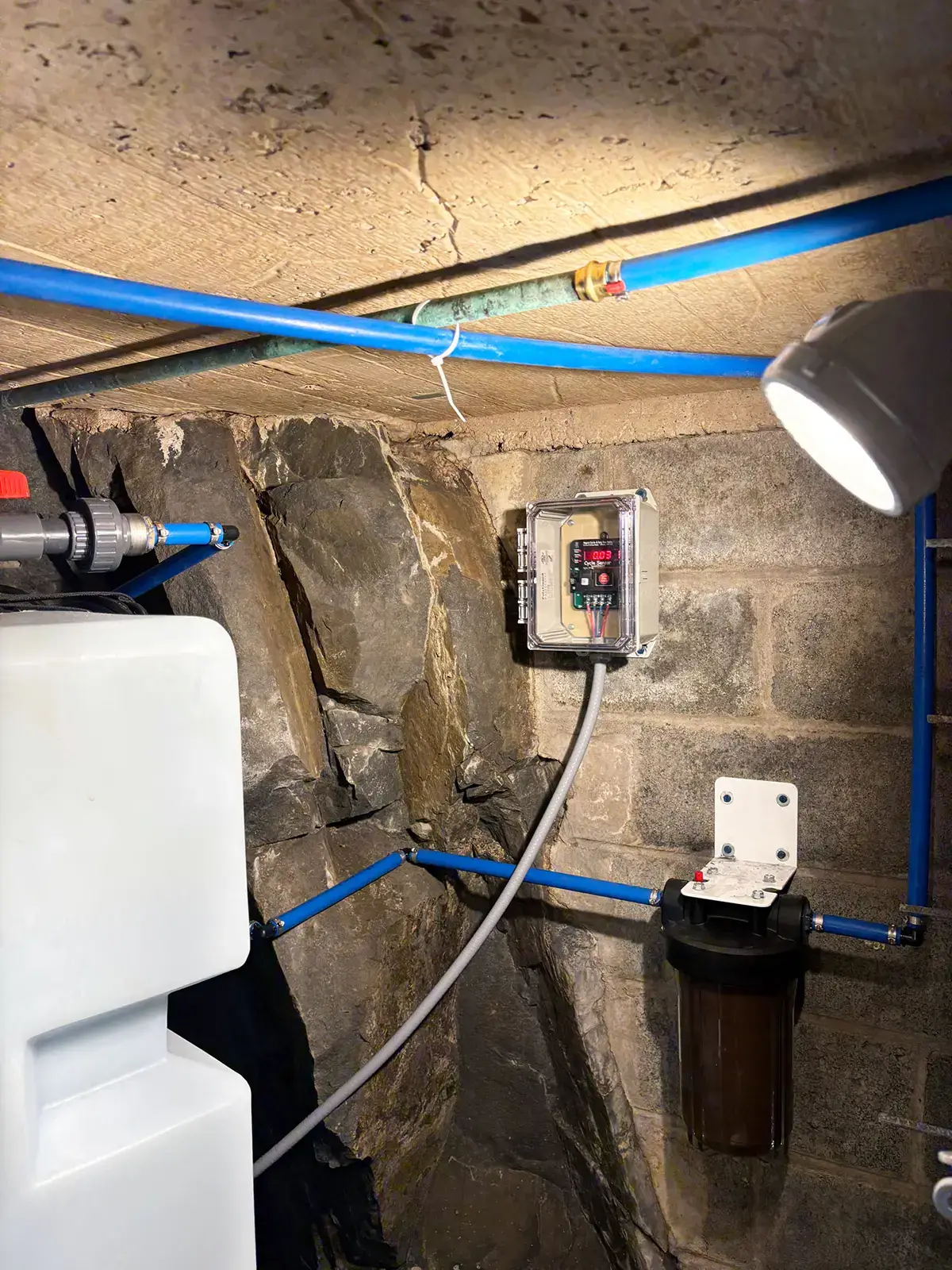
Well Manager fits the buying decision when the well is limited but usable, and the home needs more dependable delivery. The system conversation should start after testing, not before it. A buyer needs information on yield, recovery, storage, pressure, water quality, and equipment before deciding whether storage and controlled delivery solve the real problem.
It also helps to keep the product names clear. Well Manager is the company. Well Manager® and Well Watcher™ are different systems. Bob Halpern’s solution was a Well Watcher™ system, which the Well Manager team determined was the right fit for his home after reviewing the situation.
His review supports the same point the article makes: a low yield well needs proof and the right system design. He wrote that the installation took about three hours, that the system worked flawlessly after installation, and that he had better water pressure. He also said he could run the shower, dishwasher, and washing machine at the same time without worrying about running out of water.
When to Bring Well Manager into the discussion
| Situation | Why It Matters | What Well Manager Helps Review |
| Buying a home with a low yield well | The buyer needs proof before closing. | Yield, recovery, storage, pressure, water quality, and equipment condition. |
| New homeowner already living with the issue | Daily use can reveal problems after move-in. | Whether the well is limited but usable and whether storage can support peak demand. |
| Seller trying to address a well concern | Buyers often want documentation. | Know limits, records, storage options, and a clear explanation of performance. |
| Buyer inheriting an existing system. | The system should not become a mystery after closing. | Operation, parts, and support. |
That last point matters for buyers who purchase a house with a system already installed. Matt Walker bought a home in North Carolina with a Well Manager system already in place. His review said the system was the one constant that worked as expected, and that real people answered the phone, explained how and why it works, and helped with replacement components.
What Well Manager does not Replace
- It does not replace the need for a water quality test before closing.
- It does not make an inadequate source produce unlimited water.
- It does not remove the need to review the pump, pressure tank, storage, and seller history.
- It does not turn every low-yield well into the same system recommendation.
- It works best when the source, storage need, equipment condition, and household demand are reviewed together.
Questions to Ask Before Closing
A buyer does not need to become a well expert before closing. The buyer does need clear answers from the seller, the inspector, the contractor, or the water professional. These questions keep the decision tied to daily use rather than to vague confidence.
| Question | Why It Matters |
| What is the tested yield and date? | Old or informal numbers do not prove current capacity. |
| How fast does the well recover? | Recovery shows whether the well can rebound after heavy use. |
| How much usable stored water exists? | Storage determines whether the home can handle short peak-use periods. |
| Does pressure hold during overlap? | A home must support real routines, not one fixture at a time. |
| When was the water last tested? | The buyer assumes responsibility for water quality after closing. |
| Has the home run out during dry periods? | Seasonal problems can stay hidden during a normal showing or inspection. |
| Who services the system and supplies parts? | The buyer should know whether help is available after the sale. |
The Bottom Line Before You Buy
A buyer should move forward with a low yield well only after the water system proves enough supply, recovery, storage, pressure, and safe water. A low yield well does not automatically ruin the purchase. An untested or poorly matched system should stop the buyer from moving forward unthinkingly. If records show that the well produces enough water daily, recovers consistently, stores enough reserve water, and maintains pressure during peak use, the house can still make sense. If records are missing or the system fails under normal demand, the buyer should pause, negotiate, test again, or walk away. The final question is whether the well system supports the household that plans to live there.