When homeowners start looking for ways to increase water pressure, they are usually reacting to a pattern that feels mechanical. The shower begins strongly and then fades. Running multiple fixtures slows everything down. Pressure seems inconsistent, so the natural conclusion is that the system needs to be “turned up.” That conclusion is understandable, but in many well systems, it is wrong.
The issue is often not pressure at all. It is water availability over time. The system is not failing to push water; it is running out of water to push. Once that distinction is understood, the system’s behavior becomes predictable, and the limitations of pressure adjustments become clear.
Why Increasing Pressure Settings Does Not Fix A Low-Yield Well
Increasing pressure settings does not fix a low-yield well because it does not change how much water the well can produce. It only changes how the system responds to demand, which can temporarily improve the problem without resolving it.
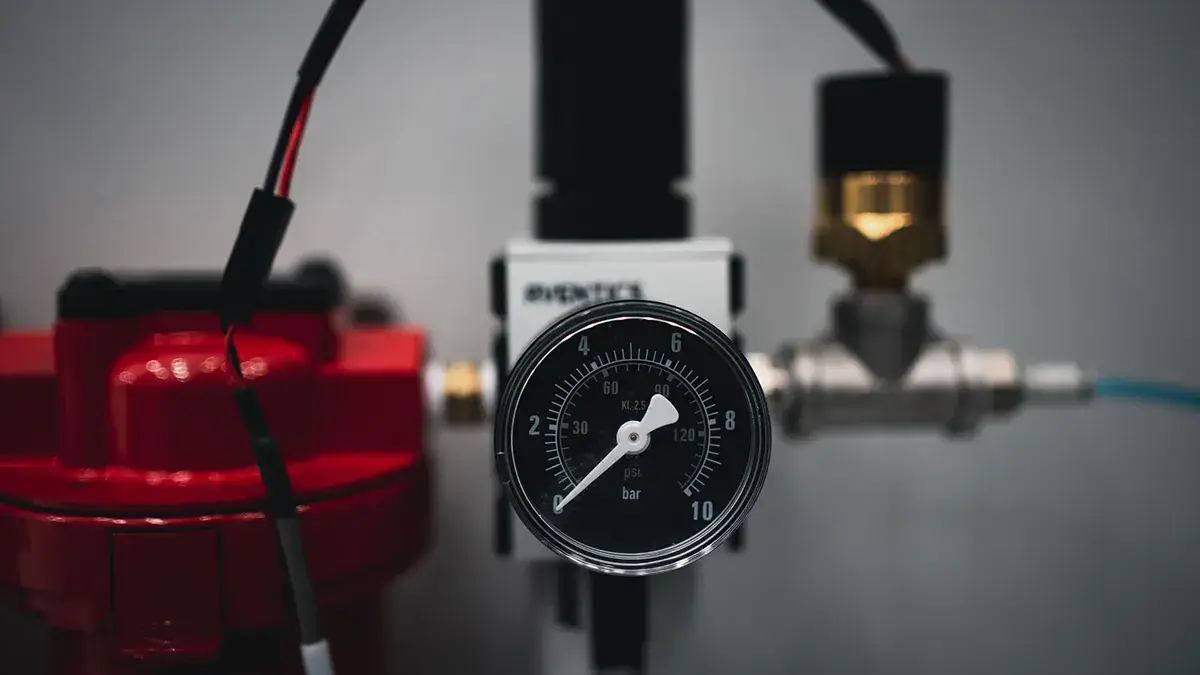
A pressure switch controls when the pump turns on and off within a defined range. Changing those settings shifts the system’s operating thresholds, but it does not affect the rate at which groundwater enters the well. Aquifer conditions, including permeability, recharge, and water table levels, determine that rate.
According to the U.S. Geological Survey, well yield is governed by geological factors, not mechanical adjustments. This means that, no matter how the pressure switch is configured, the well can supply water only at the rate the surrounding formation allows. What makes this misleading is that increasing pressure often appears to work at first. Fixtures may feel stronger, and the system may seem more responsive during initial use. But that improvement is tied to how water is delivered, not to an increase in available supply. Once stored water is depleted, the system returns to the same limitation it had before.
Understanding the Difference Between Pressure, Flow, And Yield
The confusion around pressure adjustments often stems from treating pressure, flow, and yield as interchangeable. They are not, and separating them is essential to understanding what is actually happening inside the system.
- Pressure (PSI) determines how forcefully water moves through the plumbing
- Flow (GPM) determines how much water is delivered at a given moment
- Yield (GPM over time) determines how much water the well can produce
Only one of these variables is truly fixed in a low-yield scenario. Pressure can be adjusted, and flow can be influenced within limits, but yield is constrained by the aquifer. That is why a system can feel like it has a pressure problem when it is actually experiencing a supply limitation.
This distinction is reinforced by Penn State Extension, which defines low-yield wells in terms of their ability to meet demand rather than a single fixed output number. A well may produce a reasonable total volume over time and still fail when water is needed quickly.
The Role of The Pressure Tank in What You Experience
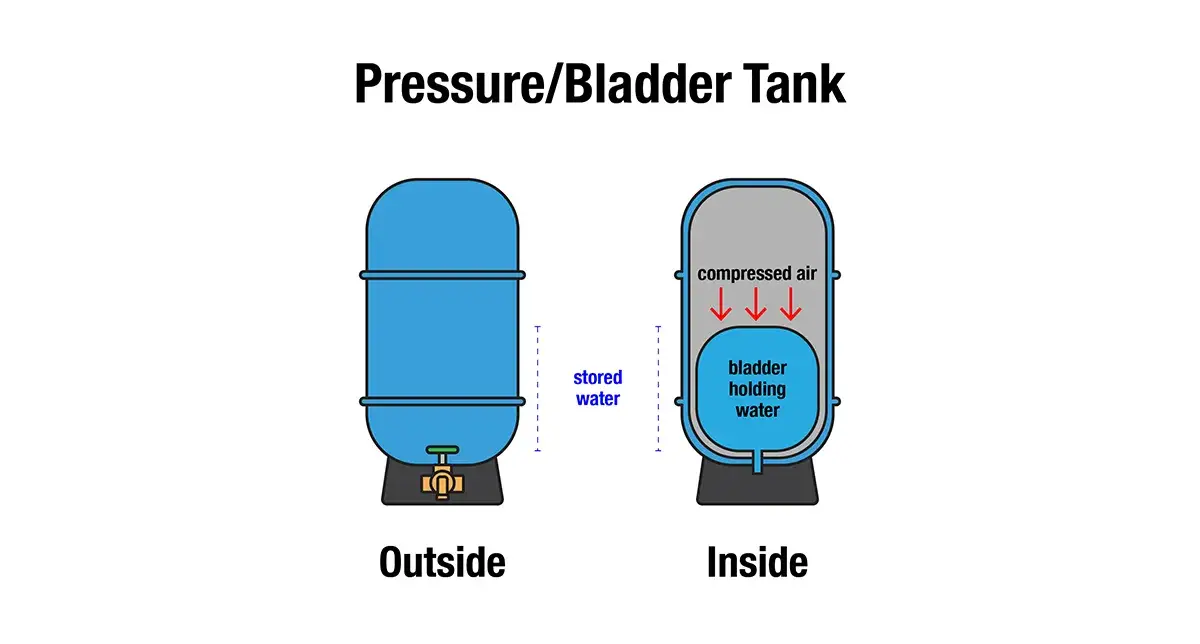
The pressure tank is one of the most misunderstood parts of a well system, and that misunderstanding plays a major role in why pressure adjustments seem effective. The tank does not function as a true reserve. It provides a limited buffer that allows the system to deliver water without immediately activating the pump. Once that buffer is used up, the system becomes dependent on the well itself.
Typical usable water from common residential tanks is smaller than most homeowners expect:
- 20-gallon tank:about 5 gallons of usable water
- 44-gallon tank:about 11 to 12 gallons
- 62-gallon tank:about 16 to 17 gallons
When those numbers are placed in context, the limitation becomes obvious. A single shower, regulated to 2.5 gallons per minute by the U.S. Department of Energy, can empty a small tank’s usable water in just a few minutes. Two simultaneous fixtures can significantly reduce that time. This is the turning point in system behavior. Once the tank is depleted, the system is no longer smoothing demand. It is relying entirely on the well’s real-time production.
Where Low-Yield Wells Actually Break Down
Low-yield wells rarely fail because they produce no water. They fail because they cannot keep up with peak demand. This distinction is critical and often overlooked. As Penn State Extension explains, a well producing 1 gallon per minute can still generate more than 1,400 gallons over a 24-hour period. On paper, that may seem sufficient for a household.
However, during a two-hour period of concentrated use, the same well can supply only about 120 gallons. That gap between total production and the rate of demand is where systems break down. Household usage patterns reinforce this mismatch. The U.S. Environmental Protection Agency estimates that the average home uses over 300 gallons per day, with a large portion of that demand concentrated into morning and evening peaks. During those periods, multiple fixtures may run simultaneously, pushing demand beyond the well’s capacity.
When that happens, pressure drops not because the system cannot generate pressure, but because it no longer has enough water to maintain it.
Why Increasing Pressure Can Make the Problem Worse
In some cases, increasing pressure settings does more than fail to solve the problem. It can accelerate the system’s limitations. Higher pressure settings increase the rate at which stored water is delivered, which reduces the time before the system depends entirely on the well. At the same time, they can reduce the effective drawdown in the pressure tank and increase pump cycling.
The result is a system that reaches its limit more quickly and operates under greater strain. There is also a mechanical dimension to consider. As pump pressure increases, flow does not necessarily increase. In fact, pump performance curves show that higher pressure can correspond to lower flow under certain conditions. This reinforces the same point from a different angle: increasing pressure does not create additional water. It only changes how the system uses what is already there.
What Actually Solves A Low-Yield Well Problem
Once the problem is understood as a supply issue rather than a pressure issue, the solutions become more straightforward. Effective approaches do not try to force more water through the system. They work by aligning water use with water availability.
These approaches typically include:
- Storage systems
- Water is collected gradually as the well produces it
- at higher rates when the home needs it
- Demand management
- Reducing simultaneous water use
- Spacing out high-demand activities
- System design adjustments
- Matching pump behavior to actual well yield
- Protecting against dry-running conditions
Public health guidance reflects this approach. The New York State Department of Health recommends supplemental storage for wells that cannot meet peak demand, allowing systems to maintain consistent performance without exceeding the well’s capacity.
Reframing the Original Question
The question “how to increase water pressure” assumes that pressure is the limiting factor. In many well systems, it is not. A more accurate question is whether the system is constrained by pressure or by supply.
There are a few practical indicators that help clarify the difference:
- Strong pressure that fades during use → supply limitation
- Pressure drops when multiple fixtures run → peak demand issue
- Consistent low pressure at all times → possible pressure problem
Understanding this distinction changes how the problem is approached. Instead of adjusting settings and hoping for improvement, the focus shifts to diagnosing the actual constraint.
The Well Manager Solutions
Increasing pressure settings changes how a well system behaves, but it does not change how much water the system has to work with. A low-yield well is defined by its recovery rate, and once the pressure tank’s limited buffer is exhausted, that rate becomes the controlling factor.
Recognizing that reality is the difference between a temporary improvement and a solution that holds up under real use. Without that understanding, pressure adjustments will continue to provide short-term relief while leaving the underlying problem untouched.