A low water pressure well can make a house feel unreliable in a way few other utility problems do. One minute, the shower is normal; the next, it weakens. Another fixture turns on, and the whole system seems to fall behind. It feels like the well is failing, but that assumption is often wrong.
In many homes, the real issue is not the absence of water but the mismatch between how water is produced, stored, and delivered. A low water pressure well can often be fixed without drilling when the mismatch is corrected, because drilling only addresses a true supply limitation, not how the system handles the water it already has.
What Actually Causes a Low-Pressure Well?
Low water pressure in a well system is usually not caused by one simple defect. In most cases, the failure comes from one of three points in the system: the well cannot replenish water fast enough to keep up with use, the pressure system cannot hold stable delivery under load, or water is being restricted after it enters the home. Those three problems can look similar at the tap, which is why they are so often confused.
That confusion matters because the symptom alone does not tell you what is failing. A shower that weakens after a few minutes points to a different problem than pressure that is weak from the moment a fixture opens, and both differ from pressure loss that appears only after water passes through filtration or treatment equipment. The solution only makes sense once the failure point is correctly identified.
Why a System with “Enough Water” Still Fails
That distinction becomes clearer once you separate total water production from real-time performance. A well can appear adequate on paper and still fail under normal household use because daily volume is not the same as usable supply when water is needed. The problem is not always how much water the well can produce over time. It is whether the system can keep up when demand arrives in concentrated bursts.
A well producing 1 gallon per minute can generate over 1,400 gallons in 24 hours. That appears sufficient. However, during a typical morning routine, demand can exceed 8 to 10 gallons per minute. That gap is where the system breaks down.
The sequence is consistent:
- Stored water supplies the first few minutes of use
- Demand exceeds real-time supply
- The buffer is exhausted
- Pressure drops as the system falls behind
This is why pressure starts strong and then fades. The system is not running out of water. It reveals the limit of how quickly that water can be replaced.
How the House Can Create a Pressure Problem
Not every low water pressure problem starts at the well. In some homes, water is leaving the well, and the pressure system is functioning correctly, but pressure is being lost after it enters the house. That changes the diagnosis completely, because once the restriction is downstream, drilling or changing the source will not fix it.
Where Pressure Is Lost After the Water Enters the System
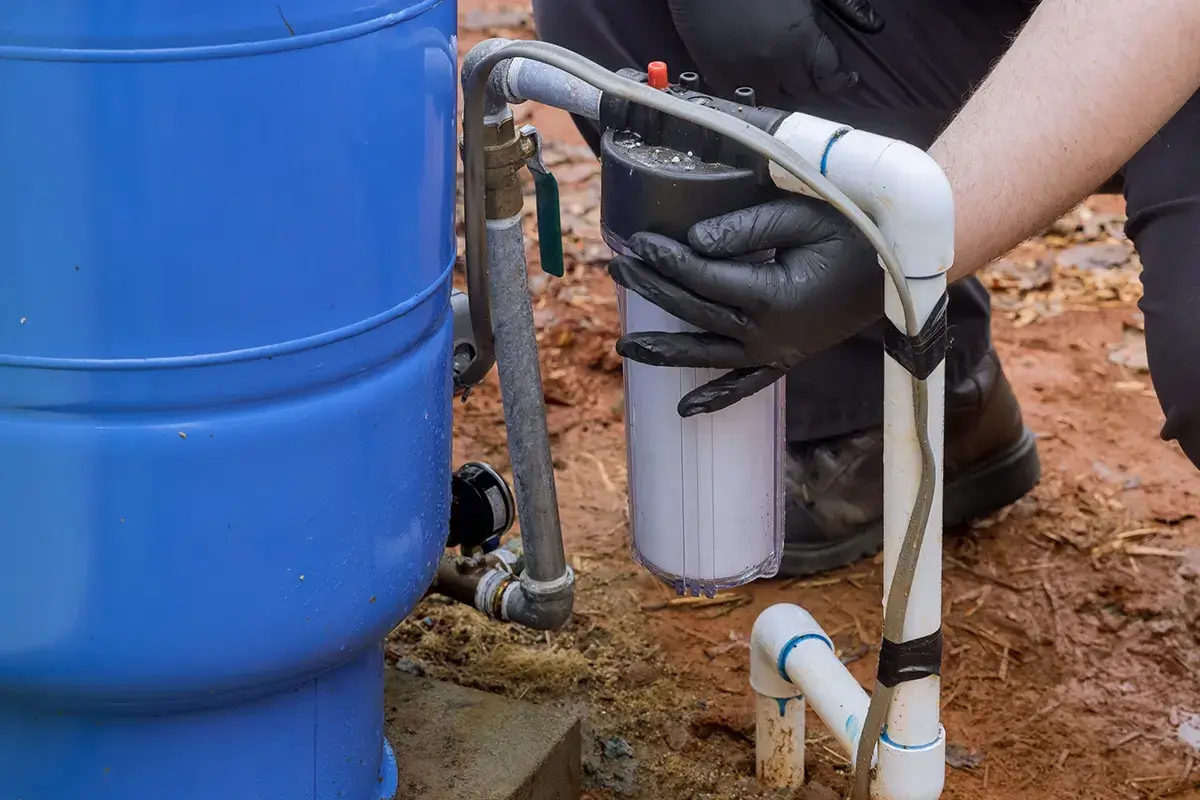
The loss usually comes from resistance inside the system itself. Filtration equipment can reduce flow under load, reverse osmosis systems can limit how quickly usable water is available, and older plumbing can narrow over time as mineral buildup accumulates inside the pipes. The symptom still looks like weak well pressure, but the source may not be the limiting factor.
The clearest clue is location. If pressure is strong before treatment but weak after it, the problem is not the well. It is the restriction that the water encounters once it is already in the house. In those cases, the fix is not to change the source, but to restore usable pressure after the restriction point. That is where systems like RO Re-Pressurization fit, as they address pressure loss within the system without altering the well itself.
What Changes When the Well Recovers Too Slowly
This is the point where a pressure problem stops behaving like a pressure problem. Up to this point, the system may look inconsistent, but still functional. Pressure holds under light use, and then begins to drop as demand continues or multiple fixtures are used. That pattern signals a shift. The issue is no longer how pressure is delivered. It is how quickly water can be replaced once it is used.
A well in this condition is not empty. It is limited by recovery. It can produce water steadily, but not at the rate the house is trying to draw it. That is why the system performs normally at first and then falls behind. The initial pressure comes from stored or immediately available water. Once that is depleted, the system is forced to rely on real-time production, and that is where the limitation becomes visible.
When Slow Recovery Becomes the Real Limitation
A slow-recovery well is the limiting factor when the system behaves normally at first but cannot sustain performance under continued use. The pressure pattern itself becomes the most reliable signal.
- Pressure starts strong, then fades
- Light use is manageable, sustained use is not
- Performance drops once stored water is exhausted
Once that pattern is clear, the solution changes. Increasing pressure does not help because pressure does not create supply. Replacing components does not help if those components are already operating within the well’s limits. The constraint is not mechanical. It is temporal.
The only way to address a timing limitation is to change how water is handled between production and use. Instead of forcing the well to produce water faster, the system must allow it to produce at its natural rate, store that water, and deliver it independently of real-time recovery. That is where systems built around controlled collection and stored delivery, such as Well Manager and Well Watcher, fit into the system, because they are designed specifically to manage this gap between recovery and demand.
This approach works within a clear boundary. It assumes the well can produce enough water over time to meet total demand. If that condition is not met, the limitation is no longer about recovery speed. It becomes a true supply problem, and that is where drilling or source changes come into play.
What Drilling Actually Changes
Once it is clear that weak performance can result from recovery limits, pressure-delivery problems, or downstream restrictions, drilling has to be understood more precisely. It is not a general fix for low pressure. It changes only one variable: the amount of groundwater the source can provide.
That matters because the symptom is usually experienced at the fixture, while drilling acts at the source. If the real failure is happening in pressure delivery, storage, treatment, or piping, a new well changes the wrong part of the system. WellOwner makes the same distinction on the pressure side: a pressure tank cannot compensate for flow exceeding the pump’s capacity, and constant-pressure controls do not increase flow beyond what the pump can supply.
Drilling can improve performance when the source itself is the limiting factor. That usually means one of three things:
- The current well cannot produce enough water over time.Even after storage and system adjustments are taken into account, total production still falls short of household demand.
- Recovery is too slow to support normal use.The well may produce water, but not quickly enough to replenish the system at a workable rate.
- Geologic conditions are limiting output.The issue is not the house or the equipment, but the formation the well is drawing from.
Just as important is what drilling does not fix:
- Pressure delivery problems.If the system cannot hold steady pressure due to pump behavior, controls, or other delivery-side issues, drilling cannot overcome that mechanical limitation.
- Downstream restrictions.If pressure is being lost after water enters the house, whether through treatment equipment, narrowed piping, or other internal bottlenecks, replacing the well won’t remove that resistance.
- Demand mismatches.If the house is drawing water in concentrated bursts that the system cannot handle efficiently, the problem may lie in storage and delivery, not in the source itself.
This is why drilling should be done at the end of the process. It can be the right solution, but only when the evidence shows that the well itself cannot meet the demand being placed on it. Until then, it is an expensive way to change the source without proving that the source is actually the problem.
Solve the Right Problem Before You Replace the Well
The way a system behaves under use usually reveals more than a single pressure reading ever can. Pressure that starts strong and fades points to a supply limitation; pressure that is weak from the start points to a delivery issue; pressure that drops under multi-use points to a capacity problem; and pressure loss after treatment points downstream. Those patterns matter because they show whether the source is truly failing or whether the system around it is.
That is the real takeaway. A low water pressure well is not always a drilling problem, and in many homes, it is not a drilling problem at all. The solution depends on identifying how quickly water can be produced, how it is stored, how it is delivered, and where pressure is being lost. Once that is clear, the path forward becomes narrower and more credible. At Well Manager, that is the approach we believe in: solving the actual failure point first so that homeowners can make decisions with more confidence and less guesswork.