
There is a moment when a well stops feeling like a quiet asset and begins to feel like a risk. A faucet pauses before it flows. A shower that used to feel solid turns thin and uncertain. A hose that once reached the far corner of the yard now barely clears the steps. These changes are easy to dismiss at first, but they carry a specific kind of fear. A private well is supposed to be a dependable source of water. When it falters, the whole house feels more fragile.
A well rarely runs dry in one dramatic instant. It sends signs first. They manifest as changes in pressure, clarity, the frequency of the pump’s operation, and the time it takes for the system to return to normal after heavy use. When those signals are understood, they stop being mysterious. They tell a clear story about whether the well is simply tired, temporarily stressed, or truly struggling to keep up.
When a Well Slows Down
When water stops suddenly, it is tempting to imagine the aquifer beneath the home as empty. In reality, most wells slow or stop because the pump is working faster than the ground can refill the borehole. The water level inside the casing drops below the pump intake for a time. The pump ends up spinning in water that is too shallow to keep it fully submerged.
According to guidance from the Virginia Department of Health, wells begin to recover as soon as pumping stops. In some shallow systems, the water level rebounds noticeably within minutes. In deeper rock wells, the level may rise more slowly, a few inches at a time. That difference has little to do with the pump and almost everything to do with the geology beneath the property.
What feels like a dramatic failure is often a sign that the well needs time, not that the water below has disappeared forever.
Why Recovery Time Changes
One of the most unnerving things for a well owner is inconsistency. Some days, the well seems to bounce back quickly. On other days, it feels sluggish for hours. From inside the house, it can seem random. Underground, it is anything but.
Recovery time is influenced by a combination of factors that are constantly in motion.
- Aquifer material:Wells in sand and gravel typically refill more quickly. Wells in clay or fractured rock refill more slowly.
- Weather and season:Long dry periods lower the water table and slow recharge. A wet spring may not fully erase the effects of a dry year.
- Household demand:More people, more fixtures, irrigation, or livestock can stretch the gap between drawdown and recovery.
- Well construction:Depth, diameter, and pump setting all influence the amount of usable water that stands in the casing before the pump has to pause.
The United States Geological Survey describes groundwater as moving through soil and stone at a slow, steady pace, more like a thick liquid than a rushing stream. That slow movement is why a well can feel fine one week and easily stressed the next. The well is reacting to changes in the ground and in the way water is being used above it.
When recovery slows, it is the earth signaling that conditions have shifted and the well has less room to absorb heavy use.
When Pressure Speaks Before Water Disappears
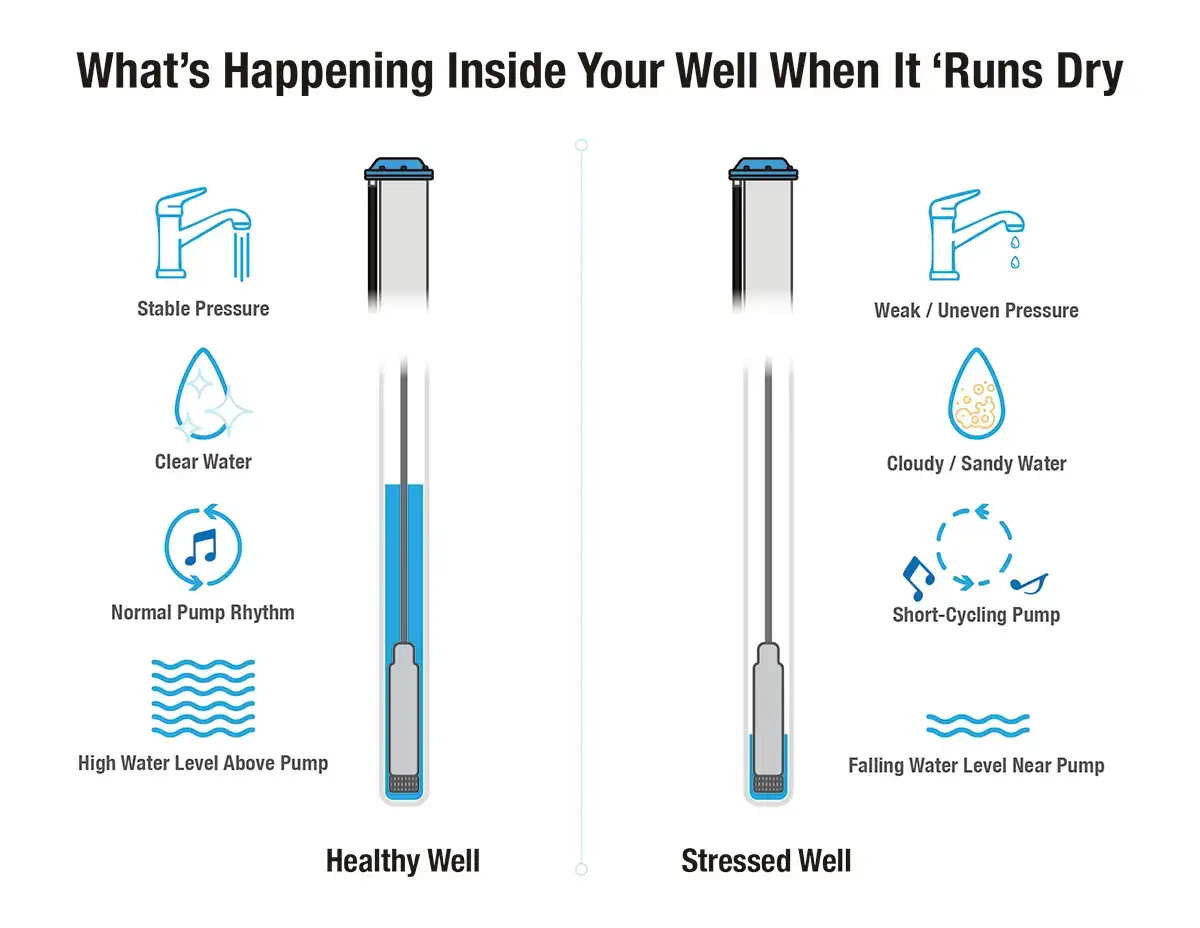
Most wells do not transition from strong flow to silence without an intermediate stage. That middle stage is pressure loss. The first warning is often a shower that weakens halfway through or a sink that takes longer to fill. At busy times, the whole house may feel like it is running on half strength. This is often the point at which well water low pressure becomes a part of daily life.
The Maine Well Drillers Commission notes that when water levels move too close to the pump intake, the pump begins to pull turbulence and pockets of air along with the water. That instability travels through the plumbing as uneven flow, shifting spray patterns, and temperature changes. It is not just a comfort issue. It is the system announcing that the buffer above the pump is shrinking.
Pressure is one of the most honest signals a well will send. It reacts as soon as the balance between pumping and recovery begins to slip.
How Pressure Reveals the Underground Story
Pressure reflects the height of the water column above the pump. When that column is tall and stable, pressure feels effortless. When the column shrinks, every fixture in the house feels it. A drop in pressure means the system has lost the margin that once kept it comfortable.
Many homeowners treat pressure change as a small annoyance. In truth, it is often the first sign that the well is being asked for more than it can deliver in that moment. Listening at this stage can prevent damage later.
When Water Turns Cloudy
Cloudy, sandy, or slightly tinted water feels like proof that the well has finally hit bottom. In most cases, it means the water level has fallen enough to disturb fine material that normally rests at the bottom of the casing.
The Water Systems Council, in its guidance for private well owners, explains that sediment often collects at the base of a well. When pumping lowers the water level further than usual, the turbulence created by the pump can sweep that sediment into the flow. As soon as the well rests and the level rises again, clarity often returns.
Cloudiness is not something to ignore. It is a sign that the well is under strain. However, it typically refers to stress and drawdown, rather than a permanently dry aquifer. It is a sign to pay attention, not a verdict that the well is finished.

What Pump Behavior Reveals
A well pump has a normal rhythm that most people recognize without thinking about it. When that rhythm changes, the well is telling part of its story. A pump that turns on and off more than usual is reacting to unstable water levels.
The Ohio Department of Health warns that pumps that lose full submersion are at risk of overheating and premature failure. When the pump does not see enough water, it loses the resistance it needs to operate smoothly. It starts, runs briefly, then stops, only to start again after a short pause. That pattern is called short cycling, and it is often tied directly to a water level hovering close to the pump.
Short cycling occurs when the system struggles to maintain operation with insufficient water available. It is the mechanical side of the same imbalance that shows up to the homeowner as low water pressure and inconsistent flow.
A change in pump rhythm is rarely just an equipment problem. It is usually a clue about what the water is doing underground.
How Storage Protects a Well That Needs Time
When a well cannot keep up with peak demand, it is easy to assume that the only answer is to drill deeper. In many cases, the better answer is creating more time and space for the well to recover.
The Ohio Environmental Protection Agency recommends intermediate storage for wells with limited yield. A storage tank allows the well to pump at a modest, steady rate that matches its natural recovery. The home does not draw directly from the well during busy times. It draws from the stored water instead.
When that storage is paired with a dedicated water pressure booster, the house can enjoy strong, consistent pressure even when multiple fixtures are in use simultaneously. The well works at a gentle pace. The booster handles the demands of daily life.
Storage does not hide a dying well. It prevents a workable well from being overdriven into exhaustion.
What Real Recovery Looks Like
Recovery is the well regaining a comfortable margin above the pump. For some wells, that margin is restored within an hour. For others, it returns overnight. The United States Geological Survey reports that many residential wells recover a large share of their static water level within a day of rest, with the final rise occurring more slowly as the system returns to equilibrium.
From the homeowner’s perspective, the important question is simple. After a hard day of use, does the well return to a place where the pressure feels normal again? If it does, then the aquifer is still supporting the home. The challenge is managing how and when water is taken so that the well is never pushed faster than it can safely refill.
A well that can still recover can be protected, even if it requires assistance from storage, controls, or improved pressure management.
Wells Rarely Fail Without Telling Their Story
A sputtering faucet. A shower that loses strength. A pump that will not stay running. A brief spell of cloudy water. Each of these moments feels like a crisis when they happen. Together, they are a story about a system drifting out of balance.
Most wells that seem to be running dry are not empty. They are being operated in a manner that no longer aligns with the pace of the aquifer that feeds them. With careful diagnosis, better use of storage, and thoughtful pressure management, many of those wells can continue to serve a home for years.
A well is not just a hole in the ground. It is a relationship with the groundwater beneath the property. When that relationship is respected and supported, the well does not simply avoid running dry. It becomes something the household can trust again.