Dealing with a Low Water Pressure Well
If you turn on a faucet and get nothing, a weak sputter, low water pressure, or a brief burst followed by silence, it is easy to assume your well has failed. Sometimes that is true, but often the cause is more specific. A sudden no-water event can result from a house-side restriction, a power or equipment problem, or a well asked to deliver water faster than it can recover. The key is to stop running fixtures, look for a few clear clues, and sort the outage into the right lane before the pump is stressed further. Stop planning your water usage around a low water pressure well: take control and take action.
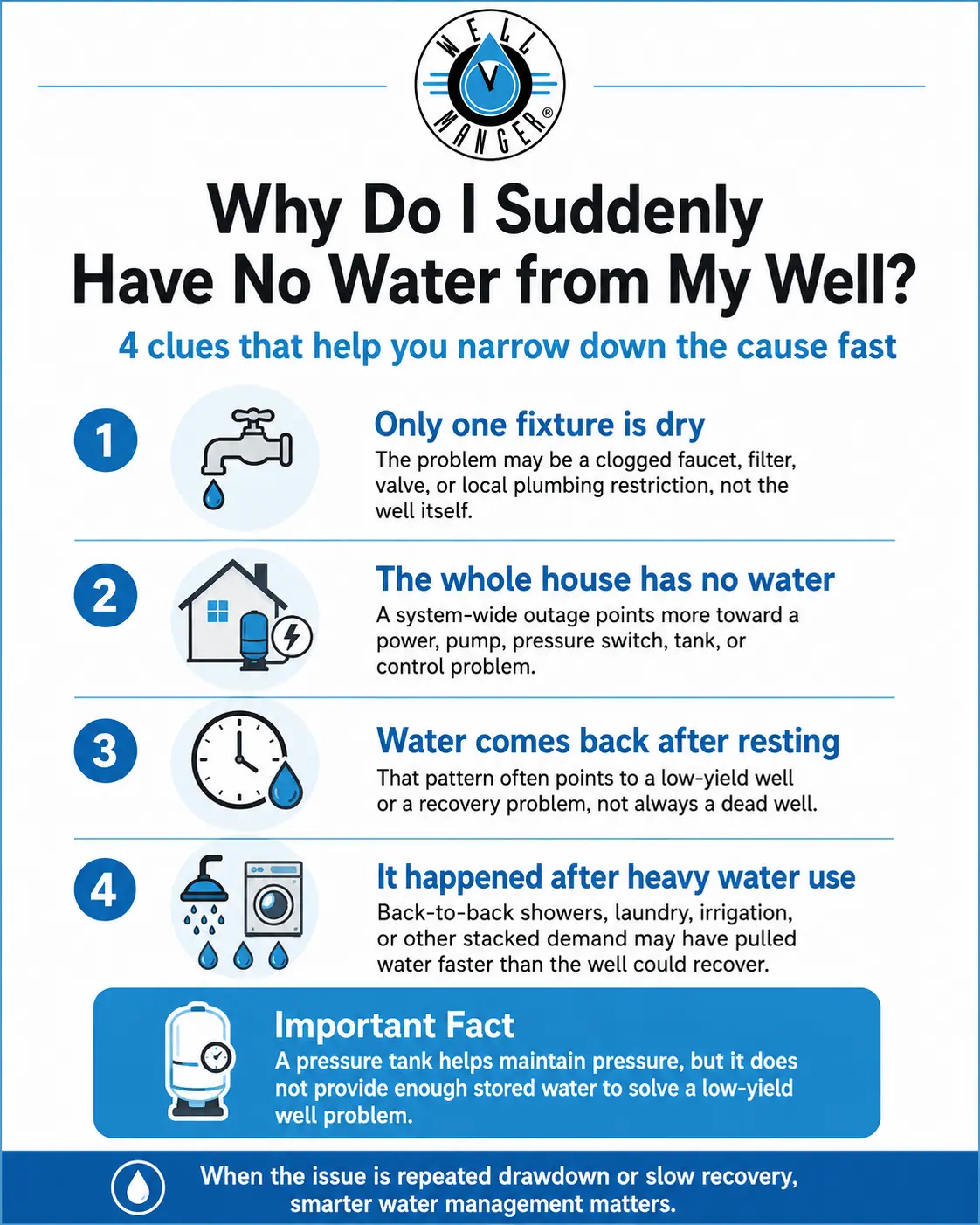
If water stops completely and then comes back after the system rests, that pattern matters. It can indicate a temporary drawdown, meaning the home used water faster than the well, pressure tank, or pump setup could keep up with. Before calling for help, note whether every fixture is affected, whether the outage followed heavy water use, whether the pump appears to run, and whether water returns after an hour or two of rest.
Start with Mechanical and House-Side Checks
Begin with the simplest possibilities to address your low water pressure well. Confirm that the problem affects the entire house, not just one fixture. If only one faucet is dry, the issue may be a clogged aerator, a clogged filter, a local shutoff valve, or a fixture-side restriction. That points to a plumbing problem after water has already entered the home, not necessarily a failed well.
If the whole house is out, check whether the well system has power. A tripped breaker, a disconnected switch, a failed pressure switch, a clogged sediment filter, a closed valve, a waterlogged pressure tank, or a failed pump can interrupt flow. Look at the pressure gauge if your system has one. A very low reading, no movement, or unusual pump behavior can help a professional narrow the problem faster.
Do not treat the pressure tank as the same thing as water storage. In “Using Low-Yielding Wells,” Penn State Extension explains that pressure tanks provide limited storage and mainly maintain pressure in the plumbing system. That detail matters because a pressure tank helps control delivery pressure, but it does not solve a well that cannot meet peak household demand.
If you suspect an electrical or pump issue, stop there and call a qualified well professional rather than repeatedly resetting or forcing the system to run.
Three Considerations to Sort the Problem
1. House-side blockage or valve issue
If some fixtures work and others do not, or if the outage appears limited to one branch of the plumbing, the problem may be inside the house. A blocked filter, a closed valve, a clogged cartridge, or a plumbing restriction can mimic a well failure. This is usually the best-case scenario because the water source itself may be fine.
The useful clue is location. One fixture or one side of the house points toward a local restriction. Every fixture losing water points toward a system-wide issue.
2. Equipment or power failure
If nothing runs and the pump is silent, the system may have lost power, or a component may have failed. Common suspects include the breaker, pressure switch, control box, pump wiring, pressure tank, or pump itself. This is not a wait-and-see issue if the system does not recover after basic safe checks. A licensed well contractor or pump professional should inspect it.
This lane is different from a recovery problem. A pump or control failure usually does not correct itself because the home waited an hour. If the system comes back after rest, the timing of that recovery becomes part of the diagnosis.
3. Well recovery problem
This lane fits a specific pattern: water stops or sputters after a period of use, then returns after the well has time to recover. In plain language, the home drew water down faster than the well could refill the system. That does not always mean the well is permanently failing.
In “Individual Water Supply Wells, Fact Sheet #2,” the New York State Department of Health explains that low-yield wells may provide enough water for daily use but fail to meet peak demand. That is the middle category many homeowners miss. The well may still make water, but not fast enough for back-to-back showers, laundry, irrigation, guests, or other stacked demand.
The U.S. Geological Survey explains in “Groundwater Wells” that pumping lowers the water level around a well, forming a cone of depression. This supports the recovery clue. If use stops and the well has time to refill, water may return. If demand resumes too quickly, the same outage may happen again.
If the system recovers after resting, avoid the bad next step of continuing to run fixtures, repeatedly flushing toilets, or starting more water-using appliances. That can deepen the drawdown and add stress to the pump. Instead, stop nonessential water use, wait for recovery, and note how long it takes for the system to come back.
Also note whether the outage followed back-to-back showers, laundry, irrigation, water treatment backwash, or another high-demand event. That information helps distinguish a low-yield or slow-recovery well from a mechanical failure.
Quick Guide: What the Signs May Mean
| What you notice | What it may mean | Best next steps | When to call Well Manager |
| No water at every fixture | Whole-house issue, not one clogged faucet | Check power, breaker, disconnect, pressure gauge, main valves, and filters. | Call if the system recovers later, but this keeps happening after normal or heavy use. |
| One sink or one side of the house is affected | Local blockage, valve issue, or house-side plumbing problem | Inspect shutoff valves, aerators, filters, and localized restrictions. | This typically needs a plumber first. Consider well service only if the problem is system-wide. |
| The pump does not seem to run | Possible power, switch, control, wiring, or pump failure | Check the breaker once, then contact a qualified well professional. | Not usually the first call unless repeated drawdown or low-yield behavior is also present. |
| Water returns after resting | Possible slow recovery or temporary drawdown | Reduce water use immediately and avoid running multiple fixtures. | Call if the well repeatedly runs short and then recovers. |
| Outage happened after showers, laundry, irrigation, or heavy demand | The home may have used water faster than the well replaced it | Pause use, spread demand out, and document how long recovery takes. | Call if the pattern suggests low yield, slow recovery, or repeated drawdown. |

What a Well Professional Will Check
A qualified well professional will usually check the pressure gauge reading, pump cycling, pressure switch, electrical supply, pressure tank, filter restrictions, and valve position. They will also look at recovery behavior: does the system show low pressure or fail only during high demand, and does it return to normal after rest?
This pattern matters because “dry well” does not always mean the well will never produce water again. In “What Determines If a Well Will Go Dry?,” the U.S. Geological Survey explains that a well is considered dry when water drops below the pump intake, but the water level may return as recharge increases.
Pump protection should also be part of the conversation. In “Well Going Dry,” Oregon State University’s Well Water Program describes a low-flow shutoff switch, often called a pump saver, as a way to protect the pump during dry-well conditions. The takeaway is clear: repeated drawdown is not only a water-supply issue. It can also become a pump protection issue.
Use Well Manager’s Real Expertise in Low-Yield Wells
When the issue points to slow recovery, low yield, or repeated drawdown, Well Manager fits the conversation differently than a standard repair-only response. Its expertise lies in managing available water more intelligently through timed water collection, water storage, pump protection, and recovery rate management.
In other words, if your well can make water but not fast enough to match household demand, the answer may be better water management rather than assuming you need a new well immediately. Penn State Extension, in “Using Low-Yielding Wells,” and the New York State Department of Health, in “Individual Water Supply Wells, Fact Sheet #2,” both identify added storage as a recognized response when low-yield wells cannot keep up with peak use.
The practical goal is not to force the well to produce faster. The goal is to collect water when the well can produce it, store it, and reduce stress on the pump during household demand.
Final Takeaway
A sudden loss of water is serious, but it is not always permanent. Start with safe mechanical checks, pay attention to whether every fixture is affected, and note whether water returns after rest. Those clues help separate a plumbing restriction, an equipment failure, and a recovery problem.
The most important pattern is simple: if water disappears after heavy use and returns later, the well may still be producing water. It may not be producing water fast enough for peak household demand. That is when recovery rate, storage, pump protection, and smarter water management matter.