
By the time most homeowners start looking at Well Manager and Well Watcher, they are past the mild annoyance stage. Low water pressure has become a recurring issue. Showers weaken when the washing machine runs. Faucets sputter after irrigation. Pressure recovers eventually, but never as quickly as it used to. In many cases, the system has already been “fixed” once or twice, yet the problem keeps returning.
Most homeowners do not realize that low water pressure in a private well is rarely a single issue. It is the result of timing, recovery, and demand drifting out of alignment. Choosing the right system is not about boosting pressure. It is about matching the system to how the well actually behaves. That is where the distinction between Well Manager and Well Watcher becomes critical.
Why Low Water Pressure Is Usually a Recovery Problem, not a Plumbing Problem
Pressure is what you feel. Recovery is what determines whether that pressure can last. A private well does not behave like a city water line. It does not supply water on demand. It supplies water at a pace determined by geology, construction, and pumping history. When water is drawn faster than it can be replaced, the system begins borrowing from its future.
Early on, that borrowing looks harmless. Pressure drops only during peak use. Recovery still happens, just more slowly. Over time, however, the gap widens. Pumps run longer. Tanks empty more often. Pressure fluctuations become the norm.
This is why many homeowners experience a cycle of temporary improvement followed by more profound frustration. Stronger pumps and higher pressure settings increase draw, but they do nothing to improve recovery. Understanding whether a well needs protection or pacing is the foundation of choosing between Well Manager and Well Watcher.
What Homeowners Typically Experience Before a System Change
Most wells do not fail suddenly. They send signals long before that point. Common patterns include:
- Pressure that is fine in the morning but poor in the evening
- Showers that weaken only when other fixtures run
- Pumps that cycle more frequently or run longer than they used to
- Air, sediment, or cloudy water after heavy use
- Pressure that improves temporarily after adjustments, then worsens
These symptoms point to a system that is asking the well to respond in real time when it can no longer do so. At this stage, the question is no longer how to increase water pressure. The real question is how to stop forcing the well to keep up with demand it cannot meet.
The Role of Storage and Timing in Stabilizing Pressure
Pressure tanks are designed to smooth short bursts of use. They are not intended to supply sustained household demand from a low-yield well. Once a pressure tank empties, the well must immediately respond.
When recovery is slow, that response does not exist. This is why effective systems introduce intermediate storage and control when water is collected. Instead of pulling water during peak demand, water is collected gradually and used later.
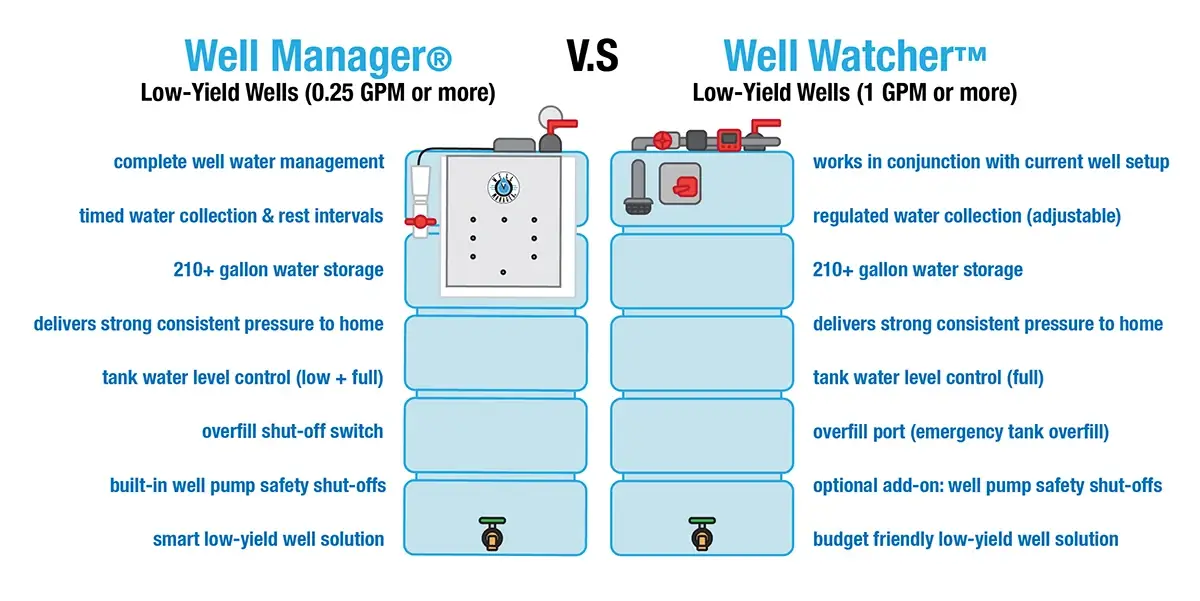
Think of it as separating earning water from spending it. Both Well Manager and Well Watcher follow this philosophy, but they apply it in different ways depending on the level of intervention the well requires.
How the Well Manager 210 Addresses Extreme Low-Yield Wells
The Well Manager 210 is designed for wells that cannot tolerate aggressive pumping. These are wells producing as little as one-quarter of a gallon per minute, often due to poor construction, improper pump placement, or long-term overpumping. In these scenarios, the well itself is fragile. Protection is the priority.
How the system works in practice
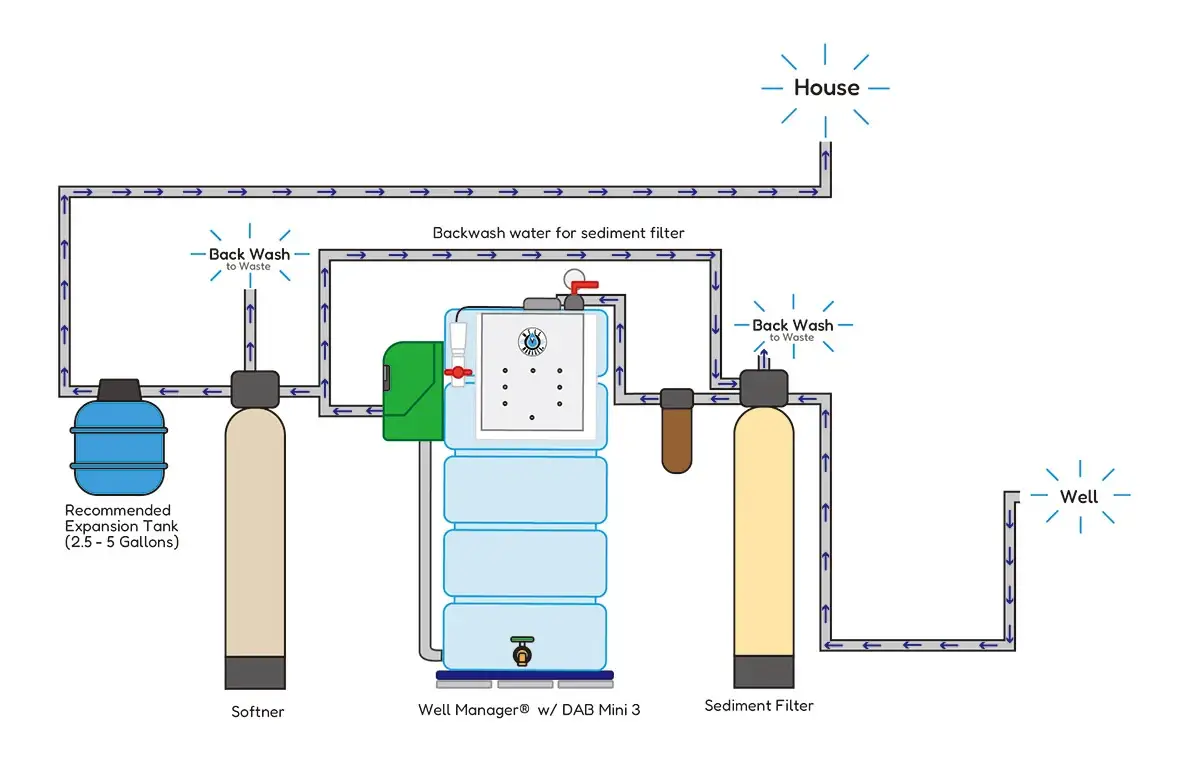
The Well Manager 210 acts as a buffer between the well and the home through a three-stage process.
First, water is collected using timed, controlled pumping. Instead of running continuously, the system sips water according to adjustable on-time and rest periods. This allows the well to replenish naturally between cycles.
Second, collected water is stored in a 210-gallon tank, with the option to add additional tanks for higher demand. Storage absorbs peak household use without ever asking the well to respond instantly.
Third, water is delivered to the home through repressurization. A pressure pump supplies consistent flow and pressure regardless of how slowly the well is yielding.
From the homeowner’s perspective, pressure feels normal. From the well’s perspective, stress is dramatically reduced.
Control logic and safeguards
The Well Manager 210 is equipped with a UL-listed control panel that supports both automated and manual operation. Indicator lights provide system status, while a three-position toggle switch offers Auto, Manual, and Off modes.
Internally, the panel manages the control system, the well pump, and the pressure pump separately. Timers, flow detection logic, and relay switches work together to prevent over-pumping and short cycling.
Three signal floats inside the tank provide layered protection:
- A full-tank float stops collection at capacity
- A low-water float protects the pressure pump from running dry
- An overfill shut-off float acts as a fail-safe
Another layer of protection comes from the flow detector switch, which monitors water pressure during an active timed fill cycle. Timers are adjustable, but at the factory setting the flow detector expects to see between seven and ten pounds per square inch within six seconds. If that minimum pressure is not detected, the system immediately stops the fill cycle and shuts off the well pump. It then waits until the next scheduled cycle to retry. This prevents dry-run conditions and protects the well pump from operating without sufficient water.
When Well Manager is the right choice
Well Manager is best suited for homeowners who:
- Have wells producing less than one gallon per minute
- Experience seasonal or progressive yield decline
- Have run out of water in the past
- See sediment or air after heavy use
- Need strong protection for a stressed aquifer
In simple terms, Well Manager is for wells that need discipline.

How the Well Watcher Supports Moderate, Low-Yield Wells
Not all low-yield wells are fragile. Many recover reliably, just not fast enough to support simultaneous household demand. This is where Well Watcher fits.
Well Watcher is designed for wells with recovery rates of one gallon per minute or more. These wells can supply water consistently, but they struggle during peak usage.
How the system works differently
Instead of controlling the well directly, Well Watcher collects water from the existing pressure tank. A float-controlled ball valve manages intake into the storage tank. Homeowners can manually set the collection rate to match both household needs and well recovery.
Storage again plays a central role. Water is available during peak demand without pulling aggressively from the well.
Monitoring and protection
Well Watcher includes a digital flow meter that displays instantaneous flow and tracks total water usage over a resettable period. This provides clear visibility into how much water is moving through the system.
Built-in dry-run protection guards the pressure pump. However, the base Well Watcher does not detect a dry-running well pump on its own. For well pump protection, an optional Cycle Sensor add-on monitors the well pump’s electrical current and detects rapid cycling or dry-run conditions. If these conditions are detected, the Cycle Sensor shuts off the well pump to prevent damage.
Physical design and flexibility
Like the Well Manager 210, Well Watcher uses a 210-gallon storage tank with options to add more capacity. The tank’s slim 24-inch width allows it to pass through standard doorways. Configurations are available for vertical, horizontal, or low-clearance installations.
Choosing the Right System Comes Down to How Your Well Behaves
If a well struggles to recover and shows signs of stress, it needs protection. If a well recovers steadily but cannot meet peak demand, it needs pacing.
Well Manager exists to protect wells that cannot afford to be pushed. Well Watcher exists to smooth the demand for wells that can recover.
Both address low water pressure, but only when matched to the well’s conditions and the home’s water use. That match is what turns low water pressure from a recurring crisis into a solved problem.
See the Systems in Action
How Well Manager Protects Fragile, Low-Yield Wells
Well Manager system overview
If your well feels like it is constantly on the edge, this video helps show why protection matters more than pressure. You can see how the Well Manager slows everything down, collecting water in controlled cycles instead of pulling hard when the house needs it most. Water is stored first, then delivered to the home at normal pressure, so the well is never forced to keep up in real time. For homeowners who have dealt with running out of water, sediment, or repeated pump issues, this video makes it easier to understand how stress is removed from the well itself.
Watch: How Well Watcher Smooths Demand for Recovering Wells
Well Watcher system overview
This video is helpful if your well usually keeps up, but struggles when several things run at once. It shows how the Well Watcher quietly collects water into storage and makes it available during peak use, without aggressive pumping. You can also see how flow monitoring gives homeowners a clearer picture of how water is actually being used. For wells that recover reliably but not quickly, this video shows how pacing demand can stabilize pressure without overcomplicating the system.