
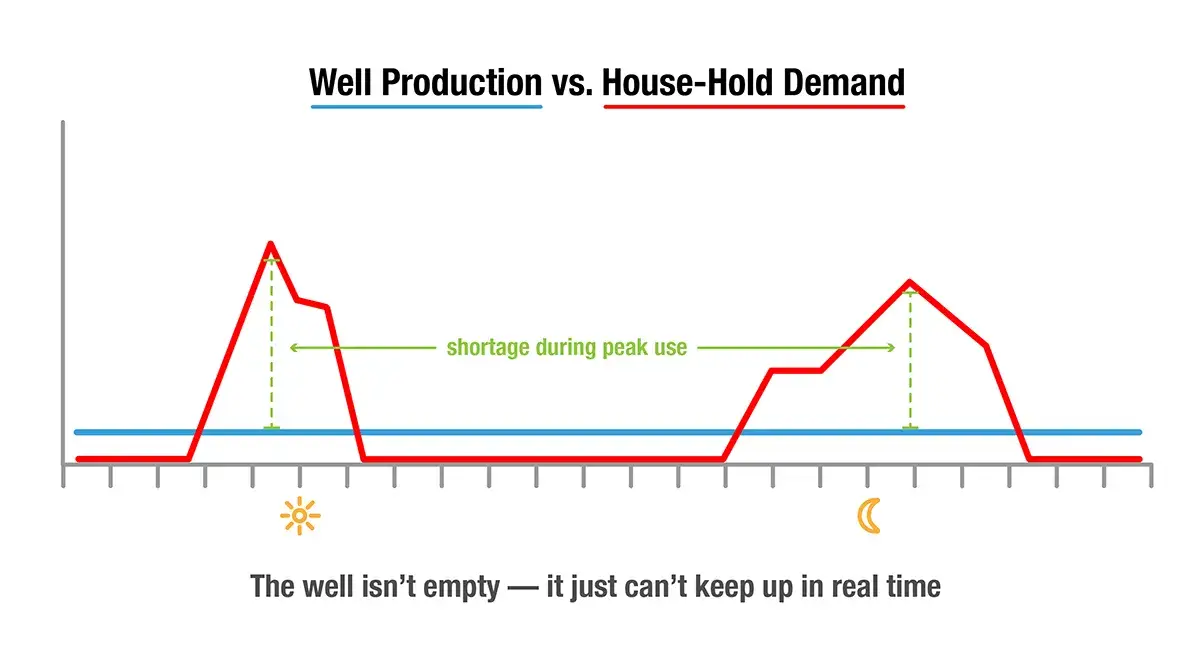
Low water pressure is often the first sign that something is wrong with a well. But in many homes, pressure is not the real problem. It is the symptom of a system that cannot deliver enough water when demand is highest. A well can produce water continuously and still fail during everyday use. That is because water demand does not happen evenly throughout the day. It happens in short bursts, showers, laundry, and dishwashing, all overlapping. During those periods, the system is asked to deliver more water than the well can produce in real time.
That gap between steady production and peak demand is what defines a low-yield well problem. And it is what separates solutions that actually improve water supply from those that only change how the system feels.
Demand Reduction: Easing the System Without Expanding Supply
Once the issue is understood as a mismatch between production and peak demand, the most immediate way to stabilize the system is to reduce the water needed during those high-demand periods. Spacing out water use, upgrading fixtures, and using efficient appliances all slow the rate of water consumption. Extension guidance shows these changes can reduce household water use by up to 30 percent. In homes where low water pressure only appears during heavy use, that reduction can be enough to prevent the system from falling behind.
But nothing about this approach increases the amount of water available. The well still produces at the same rate, and there is no added reserve to draw from during peak demand. This is why demand reduction works best in marginal cases. It can stabilize a system that is close to keeping up, but it cannot carry a system that consistently runs out of water.
Intermediate Storage: Making Limited Water Actually Usable
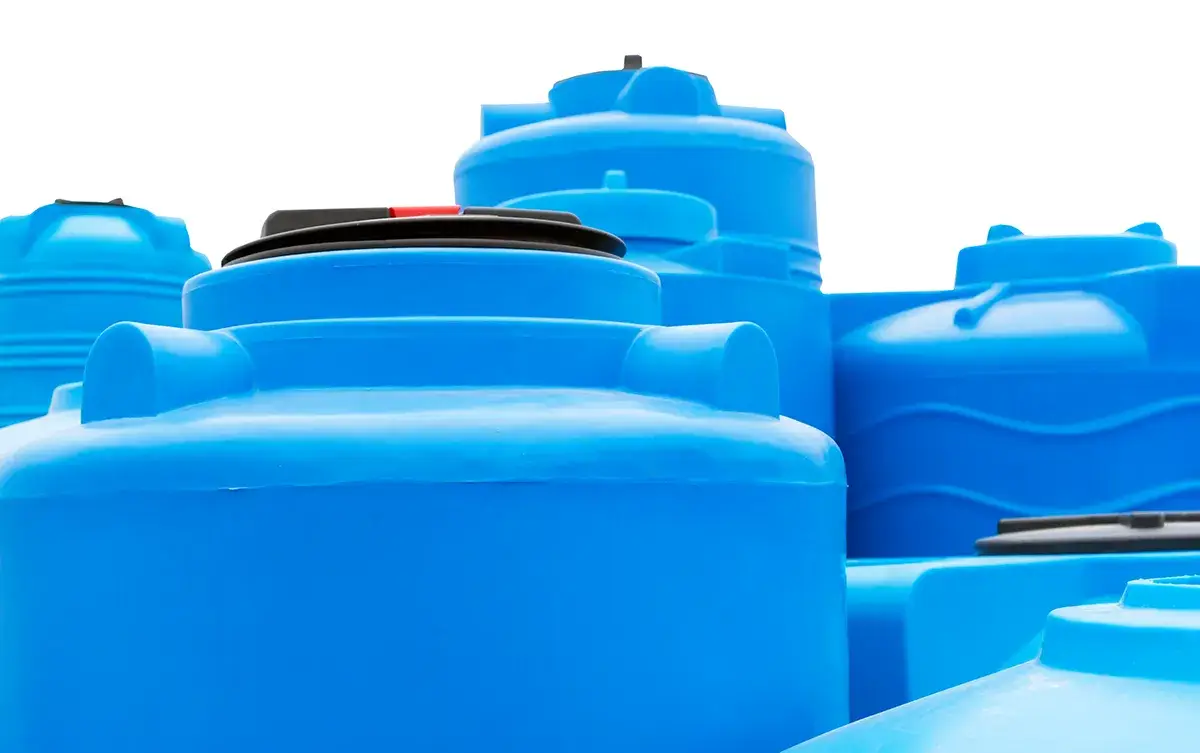
When reducing demand is not enough, the system has to change how it handles water altogether. Instead of trying to match production to demand in real time, it has to store water ahead of use. Intermediate storage does exactly that. The well slowly pumps water into a storage tank, and a separate pump delivers the stored water under pressure to the home. The house no longer depends on what the well can produce at that exact moment. Virginia Cooperative Extension describes this as placing a reservoir between the well and the pressure system. The well gradually fills the reservoir, and the home draws from that stored volume during peak use.
This changes the system at its core. The well is no longer forced to keep up with demand. It is allowed to recover, while the home uses water that has already been collected. Sizing determines whether this works. Storage must be large enough to cover peak demand, typically at least two hours, and often closer to a full day. A common benchmark is about 100 gallons per person, or roughly 300 to 500 gallons for a typical household. This is the only solution that consistently turns a low-yield well into a system capable of meeting real household demand without interruption.
Pressure Boosting: Why Stronger Flow Does Not Mean More Water
Are you and your family tired of low water Pressure?
Low water pressure often leads homeowners to look for ways to increase flow at fixtures. In systems where water is available but not delivered effectively, this can help. Booster pumps improve how water moves through the home, especially in cases with elevation changes or long pipe runs. But pressure and supply are not the same thing.
A system can deliver water more forcefully without increasing the amount of water in the system. In a low-yield well, that distinction becomes critical. Increasing pressure can make water feel stronger, but it also allows the system to use available water faster during peak demand.
That is why pressure improvements often create a temporary sense of resolution. The experience improves, but the underlying limitation remains. If the system cannot keep up during real use, stronger delivery does not fix the shortage. It only reaches the limit faster.

Pressure Tanks: Why More Tank Does Not Mean More Supply
Pressure tanks are frequently suggested as a solution because they store water and stabilize pressure. But their usable capacity is much smaller than most homeowners expect. Extension data shows that only about 20 percent of a pressure tank’s total volume is available before the pump turns on. A 42-gallon tank provides about 8 gallons of usable water, an 82-gallon tank about 16 gallons, and a 120-gallon tank roughly 24 gallons.
Those volumes help smooth short bursts of use and protect the pump from constant cycling. They do not provide enough water to support a household through peak demand. This is where confusion around low water pressure often leads to the wrong fix. A larger pressure tank can make the system feel more stable, but it does not create the kind of usable water reserve needed to solve a true low-yield problem.
Changing the Well: The Only Approach That Tries to Increase the Source
Once demand, storage, and delivery are understood, the only remaining option is to try to increase the water available at the source itself. This includes deepening the well, increasing its diameter, or drilling a new well. These approaches can increase in-well storage or access additional water, but their success depends entirely on the aquifer. A larger diameter well, for example, can hold more standing water at the same depth, but only if water is present to fill that space.
If the aquifer cannot supply more water or if water levels drop during drought, the benefit is limited. These solutions also entail higher costs and greater uncertainty than system-based approaches. They represent the most direct attempt to increase supply, but also the least predictable.
What Actually Improves Water Supply
Low-yield well solutions are often grouped together, but they do not do the same thing.
- Intermediate storage increases usable water during peak demand
- Well modification may increase total available water, depending on conditions
- Demand reduction lowers how much water is needed at once
- Pressure boosting improves delivery, not supply
- Pressure tanks stabilize system behavior, not water availability
Only one of these consistently changes whether a home can meet demand without running out of water. A low-yield well problem is not solved when pressure improves. It is solved when the system can deliver enough water during the moments that matter. Understanding that difference is what allows the right solution to be chosen, and prevents temporary improvements from being mistaken for a permanent fix.