It starts as a small frustration. The shower weakens halfway through. The kitchen faucet sputters when the washing machine kicks on. The pressure gauge flickers between bursts of silence from the pump. For most homeowners, this is when the search begins: why am I running out of water, and how do I fix it? How to increase water pressure?
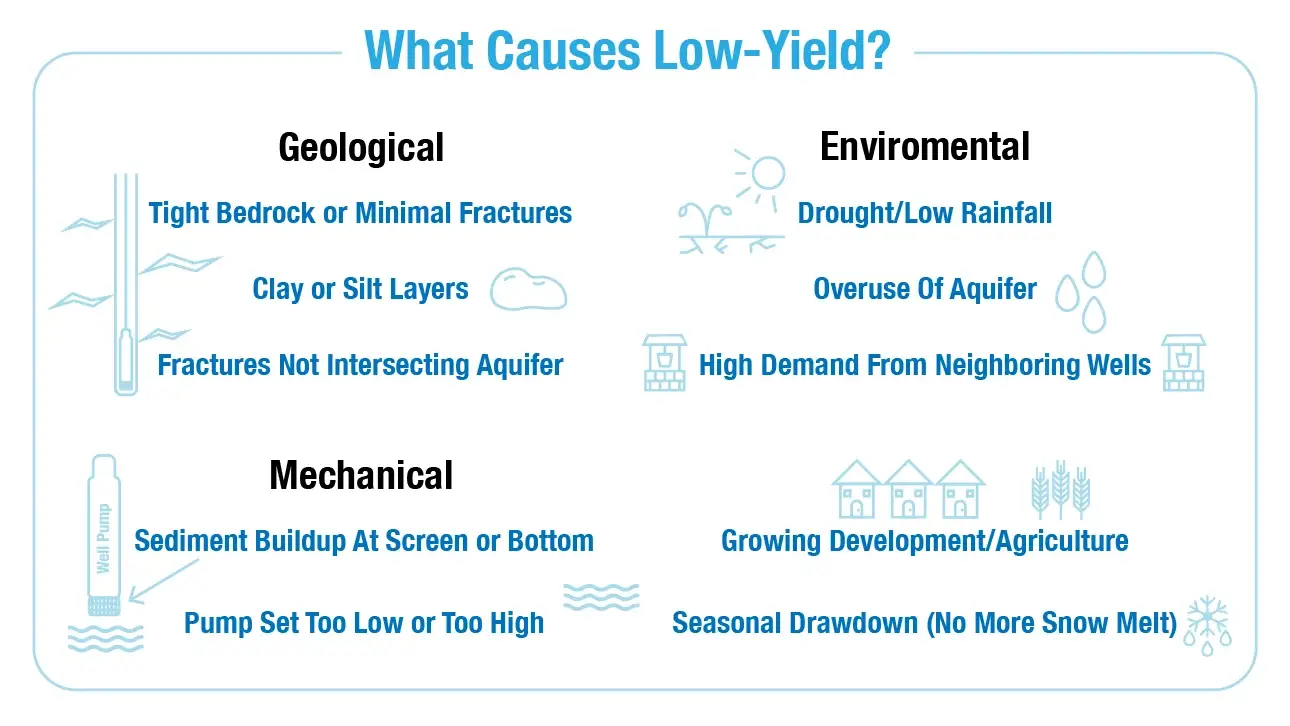
The truth is that many different factors can cause a low-yield well, from drought and geology to buildup inside the well itself. But there is one consistent answer to how homeowners can keep steady water pressure without damaging the source: the right management system.
At Well Manager, we design systems that turn low-yield wells into dependable, high-performance water supplies. Instead of fighting against limited yield, our approach measures it, protects it, and delivers steady water pressure no matter how slow the recharge.
Why Wells Lose Yield
Every well draws water from an underground aquifer and not all aquifers behave the same. Some release water freely through sand and gravel. Others are trapped in tight layers of clay or rock where movement is slow. Over time, natural changes and human activity can further reduce that flow.
Natural and Geological Factors
- Low water table or drought:When rainfall is scarce or groundwater is heavily used, the aquifer’s level drops and the well draws air.
- Restricted formations:Dense bedrock or clay layers slow the natural movement of groundwater.
- Seasonal fluctuation:Wells often produce less in dry months when recharge is lowest.
Maintenance and Construction Issues
- Clogging and buildup:Mineral scaling, sediment, or bacterial growth narrows the well screen, reducing flow. The National Ground Water Association reports that neglected wells can lose more than half their original capacity.
- Overpumping:Drawing more water than the aquifer can replenish lowers the level faster and increases the intake of air and sediment.
- Poor design:A shallow well, narrow casing, or mispositioned pump can limit yield from day one.
Environmental and External Factors
- Nearby pumping:Large agricultural or industrial wells can intercept local groundwater.
- Construction and excavation:Disturbance of the subsurface can redirect water away from your well.
Whatever the cause, the result is the same: a system that cannot replenish fast enough to maintain pressure.
Recognizing the Warning Signs
Low yield often shows up as low water pressure, but the real signal is inconsistency. Water starts strong, then fades. Faucets hiss with air, or the pump runs continuously.
The National Ground Water Association explains that this happens when the pressure tank empties faster than the well can refill it. The pump then cycles repeatedly, adding wear and driving up energy costs. Homeowners typically notice some of the following issues:
- Pressure drops when more than one fixture runs
- Air bubbles or cloudy water at taps
- A pump that starts and stops every few seconds
- Long recovery times after showers or laundry
If any of these sound familiar, the well may not be failing; it’s simply unbalanced. The supply needs to be managed to match the household’s use.
The Right Way to Restore Pressure
Fixing a low-yield well means matching your system to the well’s safe production rate. The U.S. Geological Survey and Penn State Extension both emphasize that wells yielding under three to five gallons per minute need careful design to meet household demand. That doesn’t mean drilling deeper. It means managing what you already have.
- Measure and understand the well’s capacity:Have a professional perform a yield test to determine how much water your well can sustainably produce. This establishes the safe recovery rate your system must work within.
- Add proper storage and a water pressure booster:A standard pressure tank holds only a few gallons of usable water. A Well Manager system adds a controlled storage tank and a water pressure booster that draws from it. The well fills storage slowly at its natural rate, and the booster supplies the house at steady, city-quality pressure. This approach protects the aquifer, eliminates pump cycling, and guarantees consistent water flow even when the well itself is slow to recharge.
- Maintain and clean the well:Over time, mineral scale and bacterial slime reduce yield. Regular cleaning or professional rehabilitation can restore flow. After any service, flush the system and test for water quality before returning it to service.
- Use water efficiently:High-efficiency fixtures and smarter scheduling prevent sudden peaks that drain the system. The University of Wisconsin Extension notes that upgrading appliances and spreading out heavy use can cut demand by up to thirty percent.
- Modernize controls:Variable-speed and constant-pressure pumps can help smooth delivery, but only when combined with managed storage. The Well Manager system integrates both by maintaining pressure automatically while preventing overpumping.
How Well Manager Solves the Problem
Other systems may help temporarily, but Well Manager guarantees results because it works with your well, not against it. Instead of pulling directly from a limited source, our system:
1. Measures and controls how much water the well provides. We timely collect water or adjust the rate of incoming water from the well to accommodate for its yield and to give it rest periods. While we can’t measure the actual water level inside the well, using the well’s tested yield numbers allows the system to be attuned precisely to that well’s specific needs.
2. Stores that water safely in a cistern sized to your family’s needs.
3. Delivers steady pressure through a calibrated water-pressure booster that runs the home as if it were connected to city water.
4. Protects the well from damage by ensuring recovery time between pump cycles.
The result is simple: strong, reliable water pressure every day, regardless of yield or season.
A Smarter Fix, Not a Temporary One
Hydrofracturing, deepening, or pump adjustments may offer short-term improvement, but they can’t guarantee long-term balance. The Well Manager system can. It is engineered to work with the geology you already have, using measured control instead of guesswork.
Thousands of homeowners have discovered that even slow wells can deliver dependable performance when managed correctly. With Well Manager, low yield no longer means low comfort.