Well Water System Solutions FAQ – Fix Pressure & Storage Issues
Need help with your well water system solutions? Our FAQ covers all our Well Manager Systems, answering common questions about pressure, storage, and performance.
General Product Questions & Solutions
Well Manager® Well Water System Solutions & Questions
What is Well Manager®, and how does it work?
Well Manager® is a water management system designed to solve low-yield well issues(0.25 GPM or more). It collects water slowly from your well in timed intervals, stores it in a water storage tank, and uses a high-performance VFD pump to provide consistent water pressure and flow throughout your home. It protects the well by preventing over-pumping and ensures a steady water supply even during periods of low yield.
Who can benefit from a Well Manager® system?
Well Manager® is ideal for homeowners or business owners with low-yield wells, experiencing fluctuating water pressure and supply; or anyone seeking reliable water access for high-demand situations or emergencies.
What sets Well Manager® apart from other water management solutions?
Unlike traditional booster pumps or storage system, Well Manager® protects your well by collecting water in timed intervals. Giving your well the rest it needs to replenish. Also the Well Manager® acts as a buffer between the well and home. Allowing homeowners to draw from a storage tank rather than over-pumping the well. Its customizable configurations, advanced water management and consistent output pressure – ensure reliable performance in any household setup.
How does Well Manager® help fix low water pressure in your home?
Well Manager® is designed to solve low recovery/low pressure problems by storing and managing water efficiently, and delivering it at optimal pressure. Ensuring you have steady water pressure even if your well’s natural recovery rate is slow.
Is Well Manager® a good solution for a low-yield well?
Yes, Well Manager® is specifically engineered for low-yield wells, ensuring timely collection and storage of water so that every drop your well produces is utilized efficiently. Instead of overpumping and risking a dry well, it protects your well while delivering consistent water pressure when you need it.
What should I say when looking for a plumber to install my Well Manager® system?
When contacting a plumber or well professional, describe the system clearly and simply: “I have a Well Manager® water storage and pressure system. It’s a water storage tank system with a pre-wired control panel, float level controls, and a VFD pump. The system arrives pre-engineered — the internal electrical components are already wired.”
Then add this important clarification: “The installer does not need to wire any internal controls. The work mainly involves standard plumbing connections and tying into the existing well or water line. Electrical work is limited to supplying power to the system and pump—typically through a dedicated circuit breaker—and replacing the existing pressure switch with the system’s junction box. The system includes an Installation Guide and Quick Start Guide with step-by-step instructions and wiring diagrams.”
Are your control panels proprietary, and can they be replaced in the future?
Yes — and yes.
Well Manager® control panels are proprietary and purpose-built for our systems, ensuring proper operation, safety, and long-term reliability. They are fully replaceable, and new panels and individual replacement components are available if needed in the future.
Our panels are:
UL Listed
Manufactured in the USA by SJE Rhombus
Built using industry-standard, off-the-shelf components, including relays and timers that are widely available
This means:
You are not locked into a one-off or unsupported design
Replacement parts are serviceable and obtainable
The system is designed for long-term support and maintainability
Well Manager® continues to support both panel replacements and component-level repairs to ensure longevity of your system.
Can I use a different tank with your modular system?
Yes—rotomolded, NSF-certified, potable-grade tanks are recommended. Installation requirements vary by tank size and shape.
Where Well Manager® Fits in Your Water Line
Diagram highlights pre- and post-filtration recommendations for a complete setup.
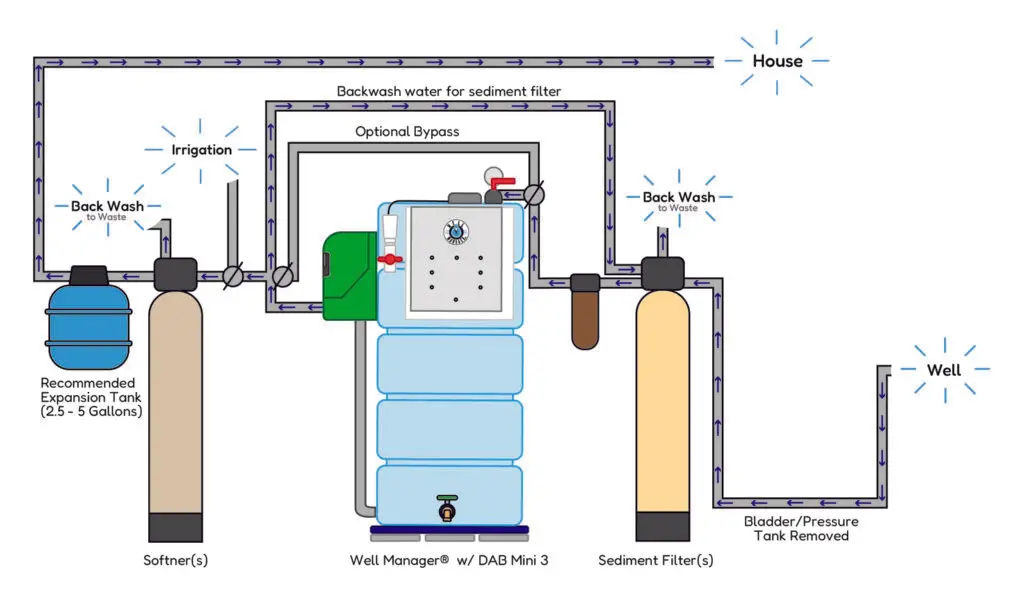
Installation Note: An expansion tank (2.5–5 gallons minimum) is recommended on the pump’s outlet side to prevent short-cycling. With a Well Manager® system, the existing pressure tank can often be reinstalled after the system to serve this purpose. Otherwise, a separate expansion tank should be added.
Well Watcher™ Well Water System Solutions & Questions
What is Well Watcher™, and how does it work?
Well Watcher™ is a simplified version of the Well Manager® System, designed for homes with less complex water needs (typically 1 GPM or greater). It collects water at a slow, adjustable, well-safe rate and stores it in a tank to provide steady water pressure and flow. A built-in digital flow meter monitors water intake into the system, and optional well-pump protection is available through an add-on cycle sensor module.
Who can benefit from a Well Watcher™ system?
Well Watcher™ is perfect for households and properties with moderate water demands (1 GPM or more), or those looking for an affordable water management solution that protects the well while maintaining reliable water access.
What sets Well Watcher™ apart from Well Manager®?
Well Watcher™ offers a more straightforward system with fewer components, making it an affordable option for homeowners who don’t require the advanced features of Well Manager®. Well Manager® replaces your blue pressure/bladder tank, while the Well Watcher works in conjunction with it.
Can the Well Watcher™ System boost well water pressure?
Yes, the Well Watcher™ System acts as a well water pressure booster by optimizing how water is drawn and stored, preventing sudden drops in pressure. It ensures steady, reliable water flow while safeguarding your well from overuse.
How does the Well Watcher™ System manage water for low-yield wells?
The Well Watcher™ System collects water slowly at an adjustable rate, stores it, and re-pressurizes the water throughout the home. Additionally, with an optional Cycle Sensor, users can add pump protection to help prevent well overuse and dry pumping, further safeguarding their well system.
Where Well Watcher™ Fits in Your Water Line
Diagram highlights pre- and post-filtration recommendations for a complete setup.
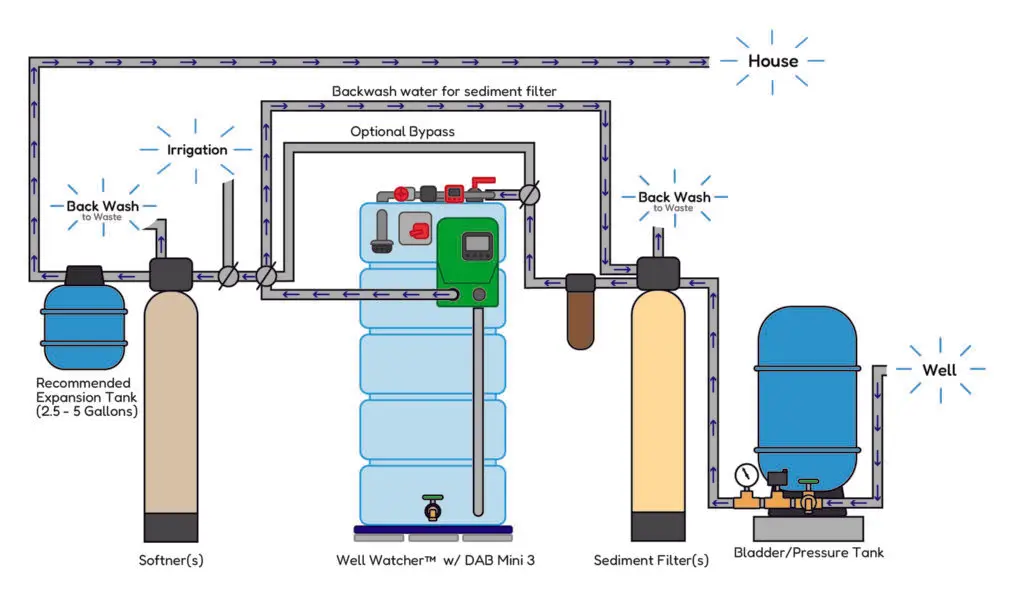
Installation Note: An expansion tank (2.5–5 gallons minimum) is recommended on the pump’s outlet side to prevent short-cycling.
ConstaBoost™ Well & City Water System Solutions & Questions
What is ConstaBoost™, and how does it work?
ConstaBoost™ is a water pressure-boosting system designed to deliver consistent, high-pressure water throughout your home or business. It’s ideal for homes with reliable water sources but inconsistent water pressure.
Who can benefit from a ConstaBoost™ system?
ConstaBoost™ is ideal for homeowners or business owners who experience low water pressure but don’t have issues with water yield. Typically requiring adequate water storage and consistent output pressure to run their homes or businesses efficiently.
What sets ConstaBoost™ apart from traditional pressure boosters?
Unlike traditional pressure boosters that can cause pressure fluctuations, ConstaBoost™ uses a storage tank and a VFD pump to provide consistent water pressure, eliminating surges and improving the performance of household appliances.
How does ConstaBoost™ improve low water pressure in a home?
ConstaBoost™ is a whole-house water pressure booster system that collects water at a fixed rate, stores it in a tank, the re-pressurizes throughout the home. By pulling from a dedicated storage tank, it prevents fluctuations in pressure, delivering steady water flow for showers, faucets, and appliances—even during peak demand.
Do I need a booster pump to fix low water pressure in my home?
If your home has low water pressure, a booster pump like ConstaBoost™ can help increase water pressure to all taps and appliances. It ensures steady and reliable water flow, even during peak demand.
Where ConstaBoost™ Fits in Your Water Line
Diagram highlights pre- and post-filtration recommendations for a complete setup.
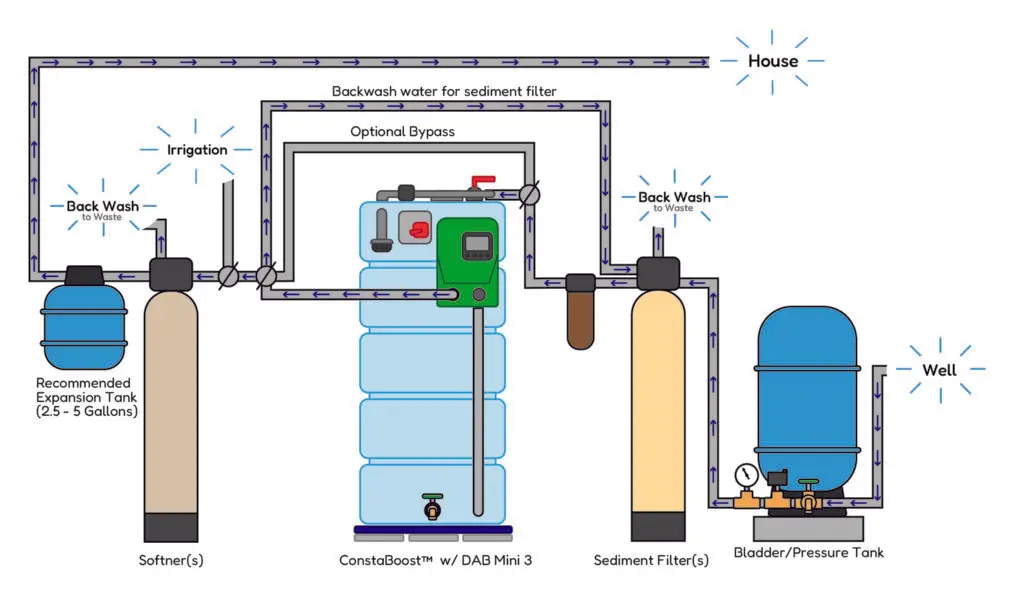
Installation Note: An expansion tank (2.5–5 gallons minimum) is recommended on the pump’s outlet side to prevent short-cycling.
RO Re-Pressurization Well & City Water System Solutions & Questions
What is the RO Re-Pressurization system, and how does it work?
The RO Re-Pressurization system is designed to boost water pressure in homes with reverse osmosis (RO) systems (or other filtration). It stores the filtered water in it’s storage tank and delivers consistent water pressure throughout the home with it’s VFD pump.
Who can benefit from the RO Re-Pressurization system?
This system is ideal for homeowners using reverse osmosis or water filtration systems who experience low pressure, especially during backwashing cycles or when multiple outlets are in use.
What sets the RO Re-Pressurization system apart?
The RO Re-Pressurization system offers reliable water pressure specifically tailored for filtration needs, ensuring smooth operation and optimal performance of RO systems while integrating seamlessly into existing setups.
How does the RO Re-Pressurization System help with low water pressure from an RO system?
Reverse osmosis systems often cause low water pressure due to the filtration process, but the RO Re-Pressurization System restores pressure by ensuring strong, steady flow from your RO-treated water. Additionally, RO systems require a large volume of water for backwashing, and the RO storage tank provides sufficient stored water to support the system’s backwash cycle, preventing pressure drops and water shortages.
Where RO Re-Pressurization Fits in Your Water Line
Diagram highlights pre- and post-filtration recommendations for a complete setup.
Installation Note: An expansion tank (2.5–5 gallons minimum) is recommended on the pump’s outlet side to prevent short-cycling.
Technical Specifications
What are the dimensions of the storage tanks for each system?
- Well Manager® 210:
- Vertical: 24″ x 45″ x 68″
- Horizontal: 24″ x 70″ x 46″
- Low Horizontal: 37″ x 70″ x 32″
- ConstaBoost™ & Well Watcher™ 210:
- Vertical: 24″ x 41″ x 64″
- Horizontal: 24″ x 64″ x 42″
- Low Horizontal: 37″ x 64″ x 28″
- RO Re-Pressurization 210:
- Vertical: 24″ x 37″ x 64″
- Horizontal: 24″ x 60″ x 42″
- Low Horizontal: 37″ x 60″ x 28″
- Well Manager® 100:
- 24″ x 32″ x 56″
- Well Watcher™ & ConstaBoost™ 100:
- 24″ x 27″ x 52″
- RO Re-Pressurization 100:
- 24″ x 24″ x 52″
What materials are the tanks made from? Are they safe for drinking water?
All tanks are constructed from Virgin PE Resin that complies with FDA Regulation 21 CFR 177.1520 (c) 3.1 and 3.2, ensuring they are safe for storing drinking water.
What are the power requirements for each system?
Well Manager®: 115V – Dedicated 15A
Well Watcher™: 115V – Dedicated 15A
ConstaBoost™: 115V – Dedicated 15A
RO Re-Press: 115V – Dedicated 15A
DAB DTRON 2 Pump: 115V – Dedicated 15A
DAB DTRON 2 + DOC 68 Pump: 115V – Dedicated 15A
DAB E.SYBOX Mini 3: 115V – Dedicated 15A
DAB E.SYBOX 2HP: 230V – Dedicated 20A
Do you offer backup options for power outages?
While the system will not operate during a power outage unless connected to a generator, the stored water in the tank can still be used as emergency water. We recommend placing the system on a dedicated circuit breaker to prevent accidental power loss.
Installation and Maintenance
What should I say when looking for a plumber to install my Well Manager® system?
When contacting a plumber or well professional, describe the system clearly and simply: “I have a Well Manager® water storage and pressure system. It’s a water storage tank system with a pre-wired control panel, float level controls, and a VFD pump. The system arrives pre-engineered — the internal electrical components are already wired.”
Then add this important clarification: “The installer does not need to wire any internal controls. The work mainly involves standard plumbing connections and tying into the existing well or water line. Electrical work is limited to supplying power to the system and pump—typically through a dedicated circuit breaker—and replacing the existing pressure switch with the system’s junction box. The system includes an Installation Guide and Quick Start Guide with step-by-step instructions and wiring diagrams.”
How easy is it to install a Well Manager system?
Well Manager systems are designed to be plug-and-play, making installation straightforward for a professional plumber, electrician, or skilled homeowner. Every systems comes with a installation and quick start guide – to make the process even more seamless.
Do you have any installation instructions?
Yes, each of our systems includes its own Installation & Quick Start Guide with system-specific instructions and diagrams.
In general, installation involves connecting the system to a dedicated power source and plumbing the incoming water into the system, with the outlet supplying water to the home. Most systems—including the Well Watcher™ and ConstaBoost™—are typically installed after the pressure tank and work in conjunction with the existing pressure tank and pressure switch.
The Well Manager® System is more advanced and is designed to replace the traditional pressure switch and pressure tank. It ties directly into the well pump wiring and manages water collection, storage, and delivery through its pre-wired control panel.
Depending on the system purchased, pump selection, and site configuration, additional system-specific steps may be required. These details—including any unique installation elements—are clearly outlined in the Installation & Quick Start Guides provided with each system.
For proper filter placement and final system layout, please refer to the system-specific diagram included with your Installation Guide, as configurations may vary.
How is power supplied to the system, and how does the pump connect to it?
We provide an auto-reset 15-amp GFCI plug on every system, designed to connect to a dedicated 15A outlet in your home. The DAB pump plugs into the 115V outlet on the system. If your system is configured with a DAB E.SYBOX 2 HP pump, that pump requires its own dedicated 20A outlet.
Can the system be installed in tight spaces like basements, crawl spaces, or garages?
Yes. The tanks’ versatile configurations—including vertical, horizontal, and low-horizontal options—make them well-suited for tight spaces such as basements, garages, and crawl spaces. If you have any sizing or space constraints, we recommend discussing them with us so we can help determine the most feasible configuration for your setup.
Are your Well Manager® control panels proprietary, and can they be replaced in the future?
Yes — and yes.
Well Manager® control panels are proprietary and purpose-built for our systems, ensuring proper operation, safety, and long-term reliability. They are fully replaceable, and new panels and individual replacement components are available if needed in the future.
Our panels are:
UL Listed
Manufactured in the USA by SJE Rhombus
Built using industry-standard, off-the-shelf components, including relays and timers that are widely available
This means:
You are not locked into a one-off or unsupported design
Replacement parts are serviceable and obtainable
The system is designed for long-term support and maintainability
Well Manager® continues to support both panel replacements and component-level repairs to ensure longevity of your system.
What ongoing maintenance is required for the system?
Routine maintenance involves checking seals, cleaning filters (if applicable), and ensuring the system operates smoothly. For summer and winter vacation maintenance check out these Well Manager Blogs:
Does the storage tank require maintenance?
Yes, we recommend cleaning the tank about once a year. Most customers simply drain the tank, use a soft-bristle brush through the vent opening to scrub the interior, rinse thoroughly, and then refill. Regular water turnover typically prevents buildup, but if the system is unused for extended periods, you may also use time-release purification tablets (such as Aquatabs) to maintain water quality.
Do I need a dedicated circuit for the system?
Yes. We recommend a dedicated electrical circuit for all Well Manager® systems. A dedicated circuit helps ensure reliable operation and prevents the system from unintentionally shutting off if another appliance or outlet in the home trips a breaker. This is especially important because the system may be collecting or managing water automatically, and a loss of power could go unnoticed without a dedicated circuit.
Specific voltage and amperage requirements depend on the system and pump selected and are outlined in the Installation & Quick Start Guide provided with your unit.
Can this system be installed indoors or outdoors?
Yes, with important considerations. Well Manager® systems can be installed indoors or outdoors, depending on the system configuration, tank selection, and local climate.
Tanks should not be installed outdoors in areas where freezing temperatures are possible, unless proper freeze protection is provided.
For outdoor installations, only our black, UV-resistant tanks should be used. Transparent or blue tanks are not recommended outdoors, as sunlight exposure increases the risk of algae growth in stored water.
Indoor installations are common in basements, garages, utility rooms, and crawl spaces, where temperature and light exposure can be controlled.
Do I need a plumber, electrician, or both?
In many cases, a plumber—or a technically capable homeowner—can install the system, as installation primarily involves standard plumbing connections.
However, for certain configurations, additional expertise is recommended:
For Well Manager® Systems, we strongly recommend a licensed electrician for junction box connections, as the system replaces the traditional pressure switch.
If your system includes a Cycle Sensor, a certified electrician is also recommended for proper installation.
If a new dedicated outlet or circuit needs to be added, this should be handled by a licensed electrician per local code.
In addition to plumbers and electricians, well drillers and water treatment professionals (with the appropriate certifications) are also commonly qualified to install these systems. All systems include pre-wired controls and clear installation instructions to simplify coordination between trades.
Can I upgrade or expand my system later?
Yes. Many Well Manager® systems are designed with future flexibility in mind. Depending on the system and site configuration, you may be able to add additional storage tanks, change pumps, or incorporate optional modules such as a Cycle Sensor as your needs evolve. Our team can review your existing setup and help determine compatible upgrade or expansion options.
Usage and Performance
How does a Well Manager System maintain consistent water pressure?
The system stores water in a tank and uses a VFD DAB pump to deliver consistent pressure, regardless of well output or demand fluctuations.
Can the system handle multiple water outlets being used simultaneously?
Yes, Well Manager systems and their DAB VFD pumps are designed to provide sufficient pressure and flow for multiple water outlets operating at the same time.
How does the Well Manager® prevent over-pumping and protect the well?
The Well Manager® System collects water from the well in timed intervals, which are set by the homeowner based on their well’s specific yield. A flow detector on the system inlet monitors incoming water and automatically stops a fill cycle if insufficient flow or pressure is detected (typically below 7–10 PSI). By supplying the home from a storage tank rather than directly from the well, the system reduces strain on the well and helps prevent over-pumping, which can lead to well damage.
Should water pressure be instant when a faucet is opened?
There may be a slight delay. The DAB pump has a 45/90 PSI internal switch and maintains approx. 60–65 PSI once active.
Will the system keep supplying water if the well stops producing?
Yes, it will supply water from the storage tank until that tank is depleted. System’s will only fill when there is sufficient water.
Are there optional modules for pump protection?
Yes. The primary optional add-on module for pump protection across all systems is the Cycle Sensor.
The Cycle Sensor monitors pump cycling and helps prevent excessive starts and short cycling, which can significantly reduce wear on the well pump. It can be used with all Well Manager systems to provide an added layer of protection.
Emergency Preparedness
How does a Well Manager System help during emergencies, like droughts or natural disasters?
The system stores water in the tank, providing an emergency reserve that ensures access to water even when the well is not operational.
Can the tanks be used for emergency water storage independently of the system?
Yes, the tanks can be installed and used as standalone emergency water storage solutions.
Warranty
What are the warranty terms for your systems?
All products are warranted to be free of defects in materials and workmanship for one year from the date of purchase. Some individual components may be covered by their manufacturers for longer periods. (e.g. DAB Pumps are 24 to 30 months warranty)
Customer Support
What kind of support does Well Manager provide for customers?
Well Manager offers technical support, installation guidance, troubleshooting assistance, and access to educational resources to ensure success for dealers and satisfaction for customers.
How Our Systems Compare to Traditional Options
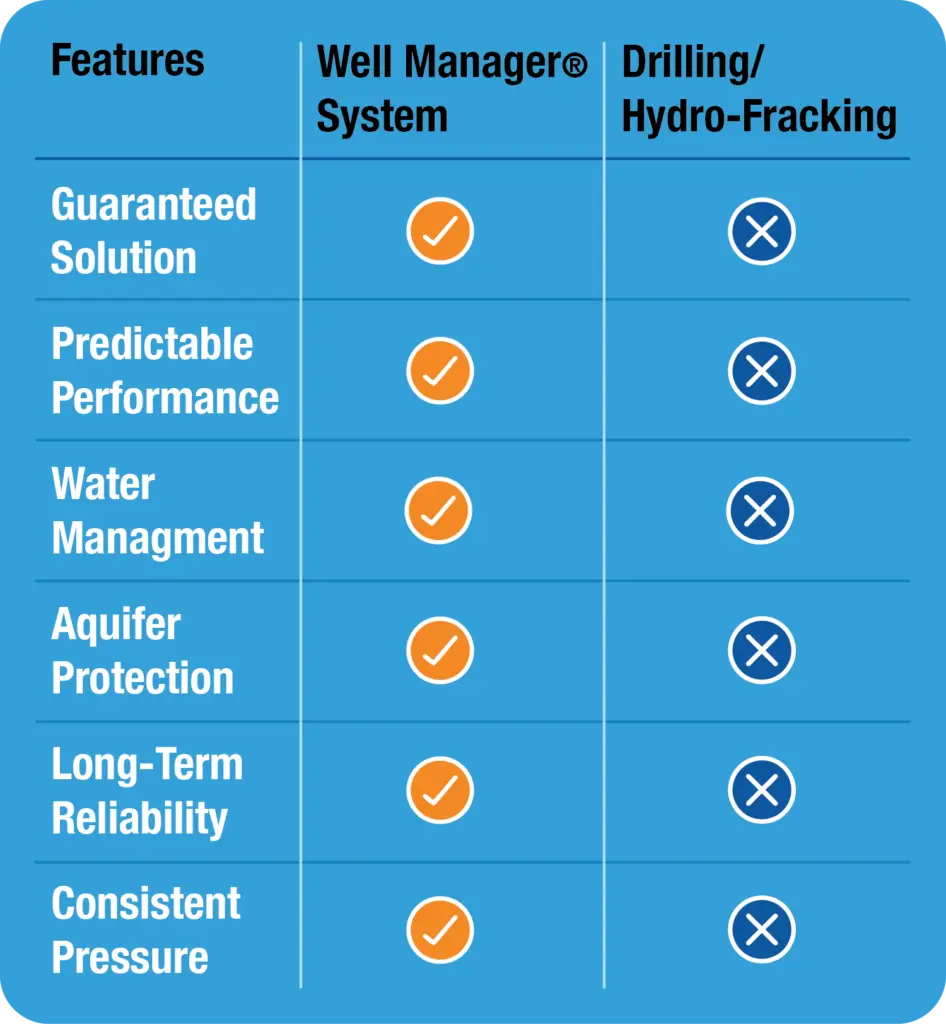
Drilling or Hydro-Fracking
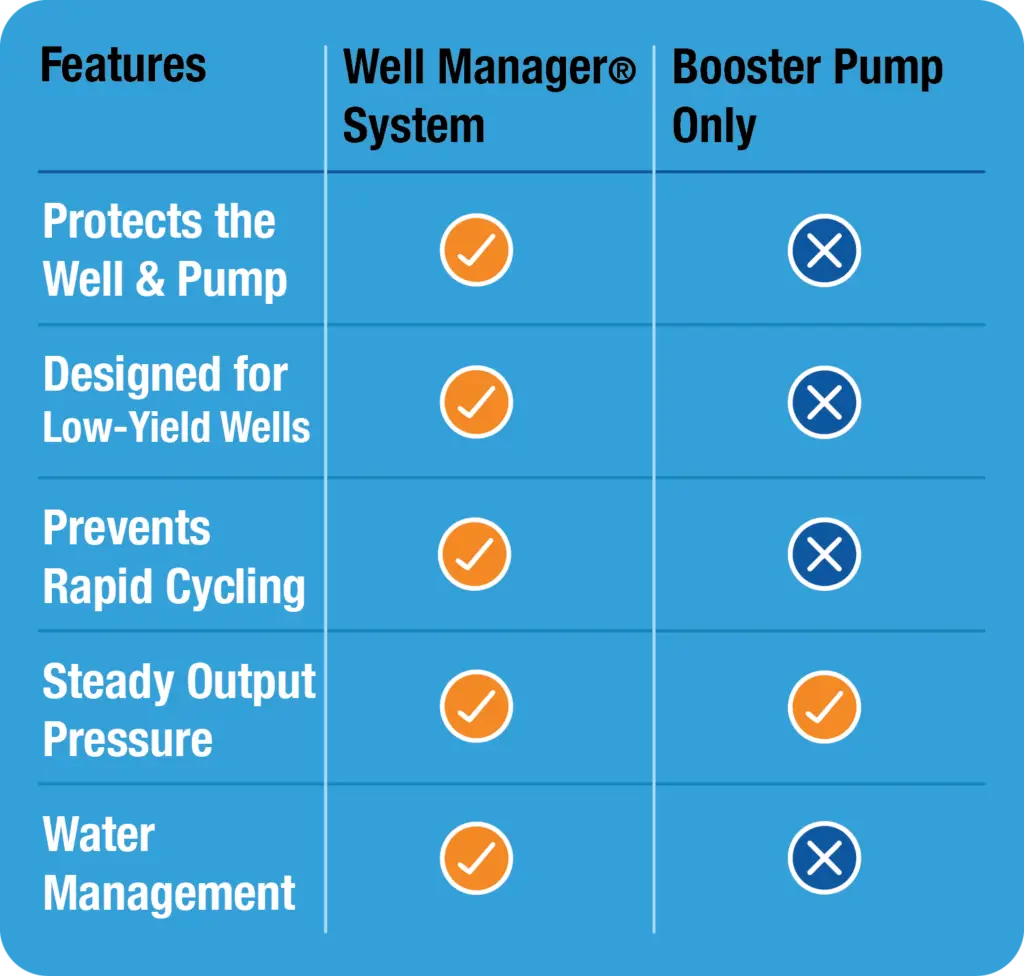
Booster Pumps Only
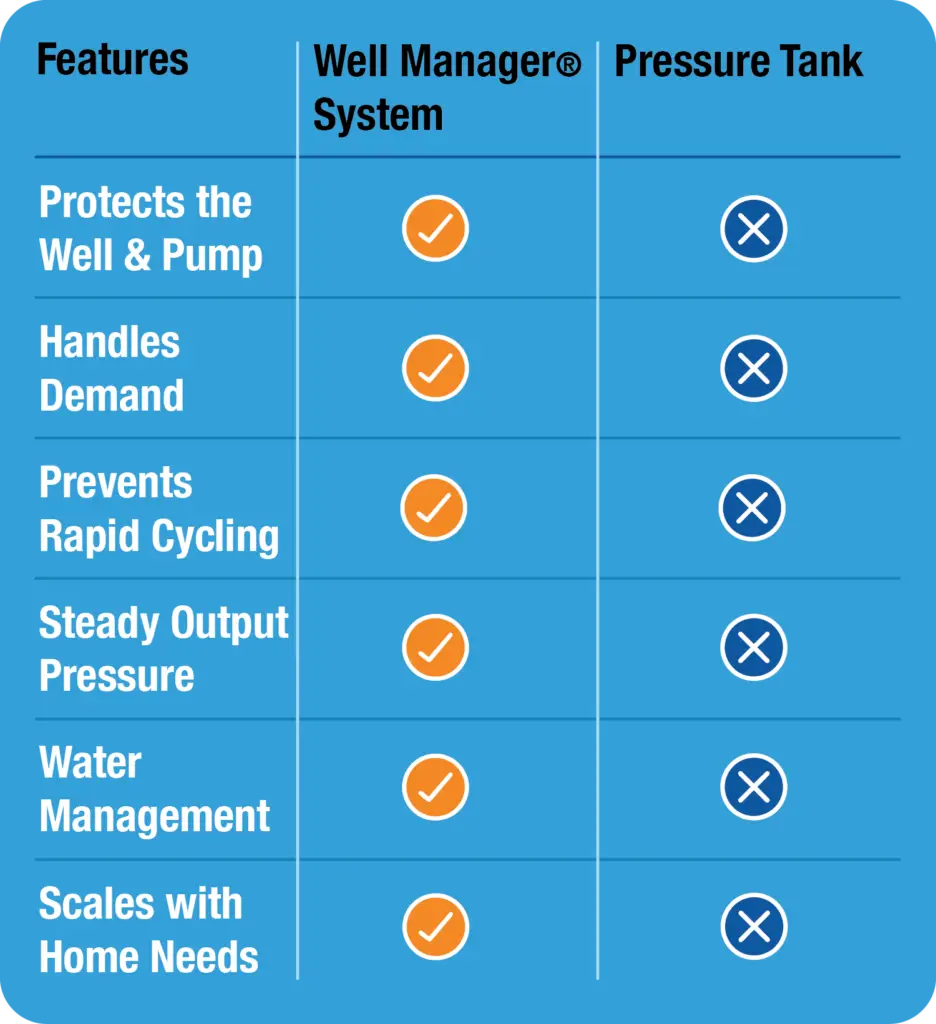
Pressure Tank Only
Want to Learn More?
Explore our products, compare solutions, or find answers to common questions.
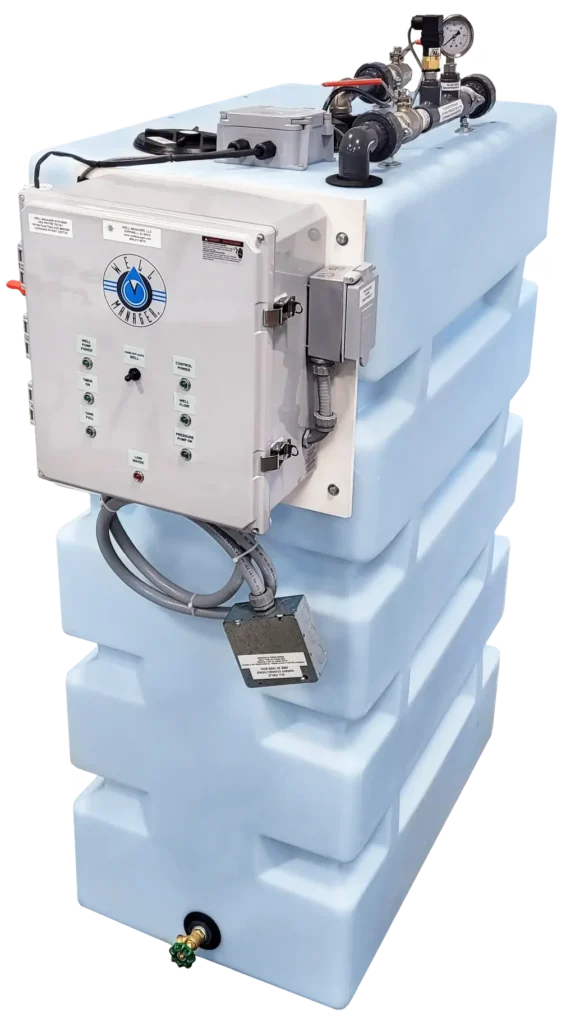
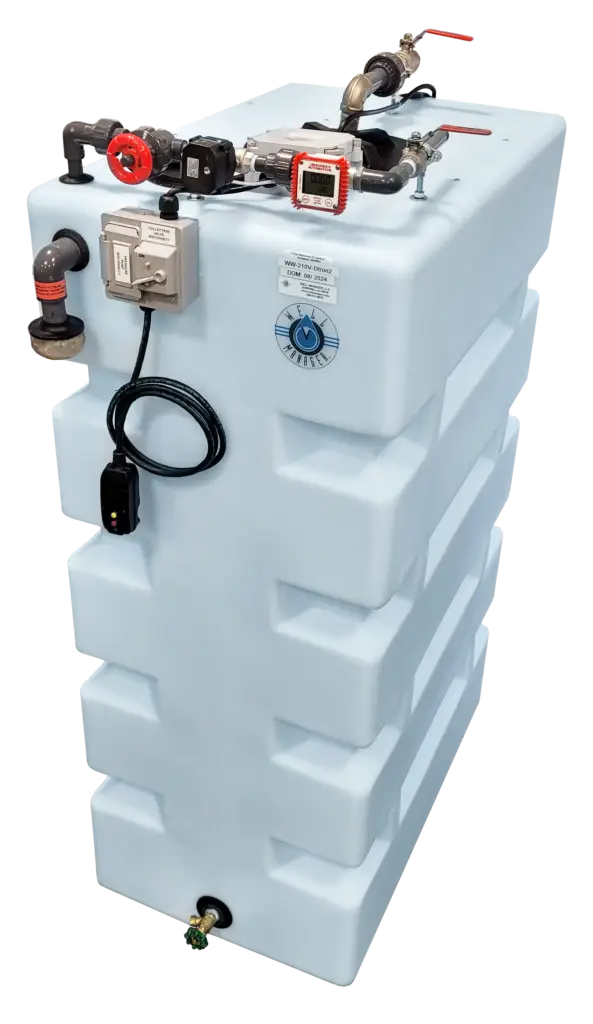
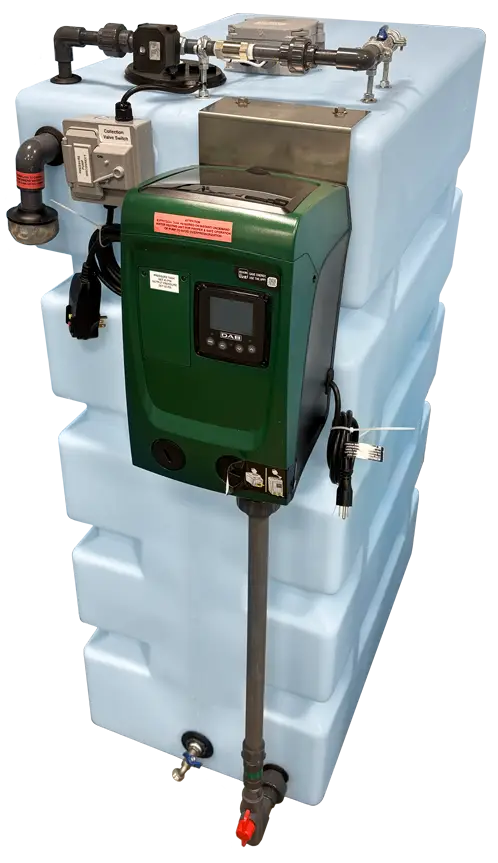
Various Tank Sizes & Configurations
Installation Resources
Learn More About Your Well Water
Explore expert articles on low water pressure, low-yield well solutions, well maintenance, seasonal changes, and current well water issues — all written to help you understand your system and protect your water supply.