Well Manager Water Pressure Booster Helps Homeowners Maintain Water Pressure and Control after Treatment
After PFAS testing, many homeowners move quickly into treatment, only to be blindsided by another issue: low pressure, pressure fluctuations, and slow recovery during peak use. Reverse osmosis is inherently production-limited, and even at higher capacities, it may not be suitable for many household activities without additional storage and pressure delivery. Filtration can also introduce restrictions: finer sediment filtration requires higher pressure, and media beds can develop head loss that manifests at the tap as reduced performance. The water may be treated correctly, but the system no longer performs like household water should.
PFAS treatment solves the chemistry problem, but household life depends on performance: steady pressure, predictable flow, and reliable recovery when people use water. Evidence from an EPA-supported evaluation of point-of-entry PFAS treatment makes the point clearly: whole-house RO requires storage and a delivery pump approach to behave like a household water system. This is the gap the Well Manager is built to address by separating water production from household demand, allowing treated water to be stored and delivered at a consistent pressure when the home needs it.
PFAS Testing Is Expanding, and Treatment Is Only Step One
Even if you are on a private well, PFAS is becoming harder to ignore as public monitoring and reporting enter a defined, scheduled phase. EPA’s UCMR 5 requires certain public water systems to monitor for 29 PFAS (plus lithium), with sample collection occurring from 2023 to 2025, and results continuing to roll out through the reporting cycle, keeping PFAS data in circulation beyond the sampling window. That kind of structured monitoring changes what homeowners hear from neighbors, town meetings, and local headlines, because more systems are measuring and disclosing results on a timetable rather than only after a crisis.
EPA’s PFAS drinking water rule adds to that momentum by setting an implementation timeline for public systems that includes initial monitoring within 3 years of promulgation (2024–2027) and MCL compliance 5 years after promulgation (2029). For a homeowner, the practical consequence is simple: even if your home is not on a municipal system, PFAS is moving into routine water decisions, not one-off conversations.
Two important clarifiers for homeowners without a well water pressure booster:
- These federal timelines apply to public water systems, not private wells.
- Private wells are generally not regulated like public systems, which means private well owners are responsible for testing and determining next steps with qualified help.
Why PFAS Filtration Can Make Water Feel Worse
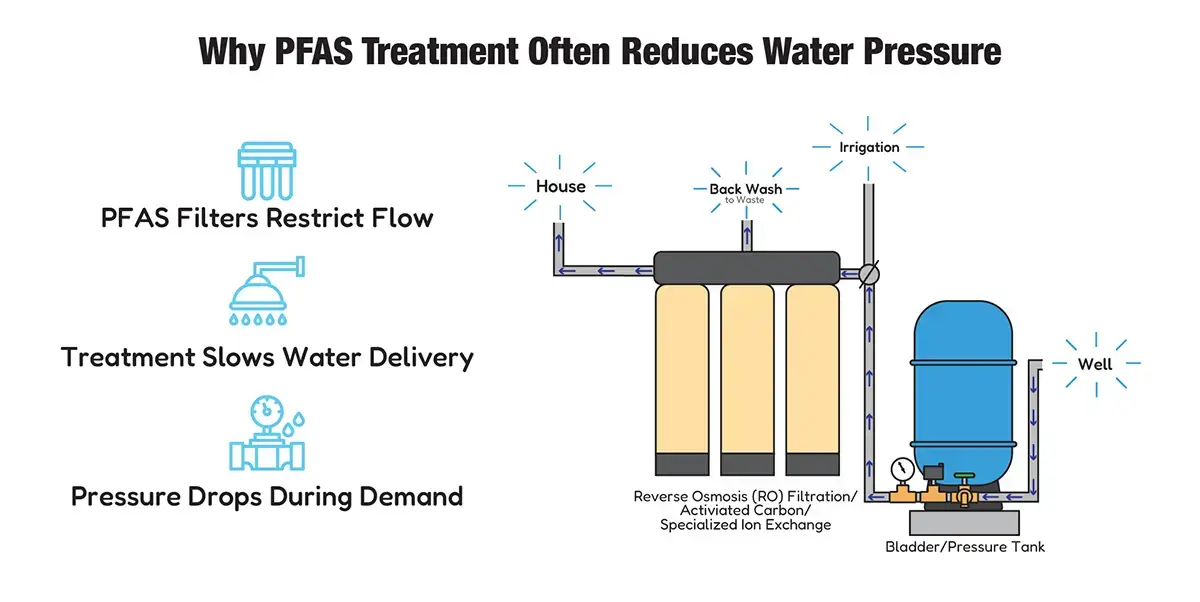
When homeowners install PFAS treatment, they expect the water to get safer and to keep behaving like normal household water. What surprises people is that these are two different system jobs: contaminant reduction and household delivery. EPA describes treatment approaches such as granular activated carbon (adsorption), ion exchange media, and membrane processes like reverse osmosis, and these technologies can alter flow and pressure conditions, resulting in noticeable changes at fixtures.
The pattern is consistent: treatment changes either how fast water is produced, how easily it moves through the system, or both.
Production vs demand (RO is not an on-demand appliance)
- University of Nebraska–Lincoln Extension reports that typical home RO membrane production is often discussed as daily output, with a typical range of 10 to 35 gallons per day. That output depends on operating conditions, including pressure.
- A peer-reviewed EPA-supported evaluation of PFAS point-of-entry treatment states that RO systems producing 500 to 1,000 gallons per day (about 0.35 to 0.70 gpm) are not suitable for many household activities and do not produce water at a significant pressure.
- That same evaluation explains that whole-house RO requires additional components for household use, including a 200- to 500-gallon storage tank, a delivery pump, and a bladder tank.
What these facts mean in a home
RO is a production process. It creates treated water over time based on operating conditions, and that treated water often needs to be stored so it can be delivered when the home demands it. A household does not consume water in “gallons per day.” It consumes water in spikes: consecutive showers, a dishwasher cycle, laundry, multiple sinks, a hose bib, and toilet refills. When demand spikes exceed production and storage is not sized or delivered correctly, the homeowner experiences it as slow recovery, pressure drops, or “running out” of usable water at the worst times.
If PFAS treatment includes RO, performance problems are often a sign that production, storage, and pressure delivery were not engineered as one system.
Restriction and head loss (filters can require more pressure)
- North Dakota State University Extension notes that a small-particle-size (2- to 5-micron) sediment filter has smaller pores and therefore requires more pressure to push water through the filtering material.
- EPA’s PFAS technology cost document notes that solids accumulation in GAC can cause excess pressure drop and that GAC beds typically require periodic backwashing to prevent head loss or biomass accumulation.
What these facts mean in a home
A PFAS treatment train is rarely “one thing.” It commonly includes prefiltration, the main treatment stage, and sometimes post-treatment polishing. Each stage can add resistance to flow, and that resistance shows up as lower available pressure at the fixtures, especially when multiple demands occur simultaneously. Over time, the issue can intensify if a media bed accumulates solids and head loss increases, or if maintenance cycles are missed, because the system has less hydraulic margin to begin with.
When homeowners say, “My water got worse after I treated it,” the most common explanation is not that treatment failed chemically. It is that the system’s ability to deliver water at household demand was not designed as carefully as its ability to remove contaminants.
Pressure Is Not Proof of Safety
Pressure and flow are comfort and usability metrics. They are not contaminant-removal proof. University of Nebraska–Lincoln Extension notes that pressure drop is not a perfect indicator of adsorption capacity, and breakthrough can occur before you “feel” a pressure change.
- You want water to feel normal again (performance).
- You still need verification testing and credible maintenance practices (safety).
Where Well Manager Fits after RO or Carbon Treatment
Well Manager is used after treatment decisions are made, not as a substitute for PFAS reduction. The role is to stabilize household performance when treatment changes how water is produced and delivered.
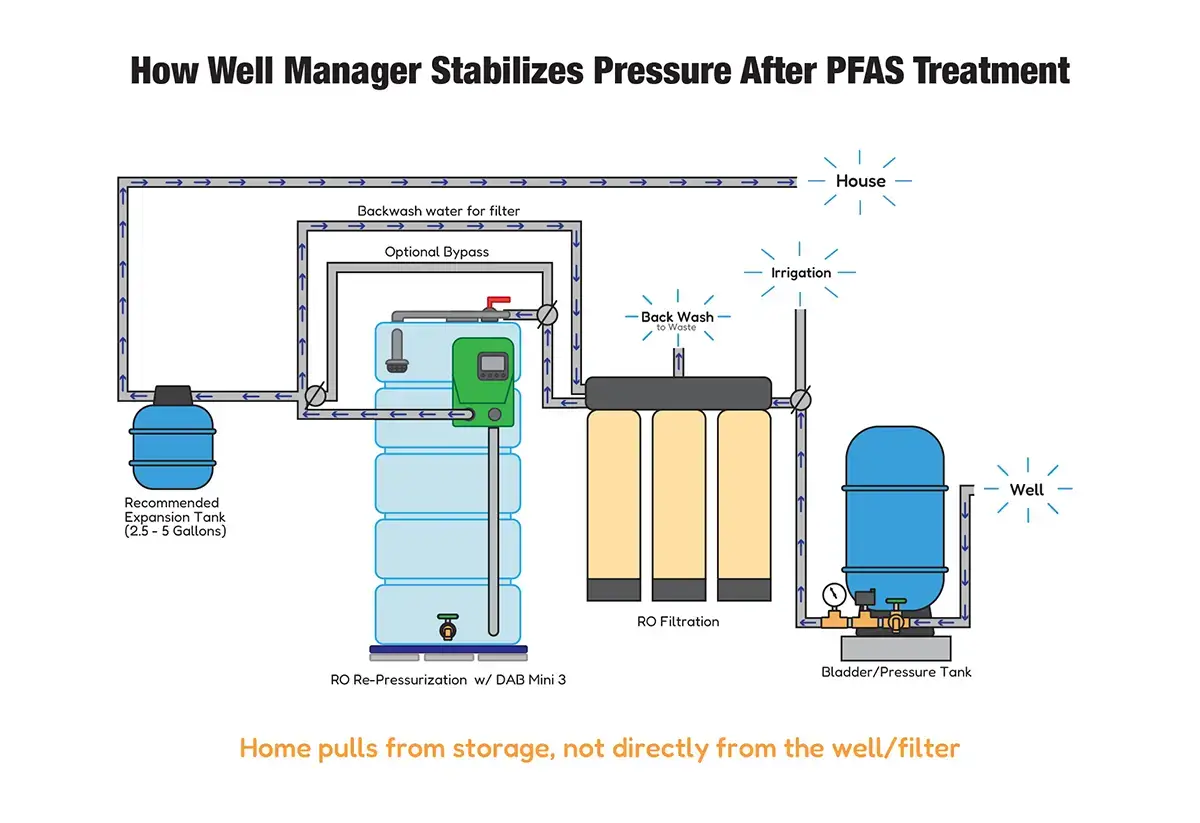
RO Re-Pressurization, when RO output cannot match household demand
Reverse osmosis produces treated water at a finite rate, and whole-house configurations often require dedicated storage and pressurization to behave like typical household water. In this scenario, RO Re-Pressurization belongs downstream of the RO system, storing permeate and supplying fixtures at steady household pressure, so showers, multiple fixtures, and peak-use windows are not constrained by real-time RO production.
Core Well Manager System, when the well itself is supply-limited
If the well yield is marginal, treatment restrictions can amplify performance issues because the system has less available water to recover from peak use. In that scenario, the core Well Manager approach focuses upstream: collecting water on a controlled schedule into storage and delivering it to the home at consistent pressure, reducing the day-to-day impact of a low-yield source.
See How RO Re-Pressurization Restores Household Pressure
When PFAS treatment is added, the goal should be twofold: reduce contaminants and keep the home functioning normally. For homeowners dealing with low pressure or slow recovery after a whole-house RO, the practical next step is to evaluate whether post-treatment storage and pressure delivery are the missing components in their setup. Our well water pressure booster is enough to keep the whole family happy.
Learn more about the Well Manager RO Re-Pressurization System here:
https://www.wellmanager.com/r-o-re-pressurization-system/