What GPM, Recovery Rate, and Drawdown Actually Tell You
A low-yield well test report can feel deceptively simple. You see a few numbers, maybe a summary, and it seems like it should answer a basic question: Does this well work or not? But that is not what the report is designed to tell you. It is not a pass-or-fail document. It is a performance snapshot. Stop asking, “Why do I have a low yield and low water pressure well?” and start testing.
The real value of the report is understanding how your well behaves under demand and how it responds after that demand is removed. That is what determines whether your house runs out of water during normal use, not just whether water exists in the ground. Once you start reading the report that way, the numbers begin to form a clear pattern rather than standing alone without context.
Start Here: What the Test Is Actually Showing You
Before focusing on any individual number, it is important to understand what the test is trying to capture. The report does not measure the total amount of underground water. It measures how well your system performs when water is actively being used and how it responds immediately afterward. That distinction is what turns a confusing set of numbers into something you can apply to daily life.
A well can technically produce water and still fail during normal use. What matters is not just whether water can be pulled from the well, but whether it can keep up with how water is used in a home. The test is designed to show three things at once: how fast water can be produced, how much stress that production creates, and how well the system recovers. Those three pieces are what you are really reading.
GPM: How Fast Water Is Coming Out
Once you understand that the report is measuring performance under use, the first number to evaluate is how quickly water is being produced in response to that demand. GPM is usually the most visible number on the report, which makes it easy to overvalue. It feels like the answer, but it is only describing one moment in time. To understand what it really means, it has to be placed in context with everything that happens before and after that moment.
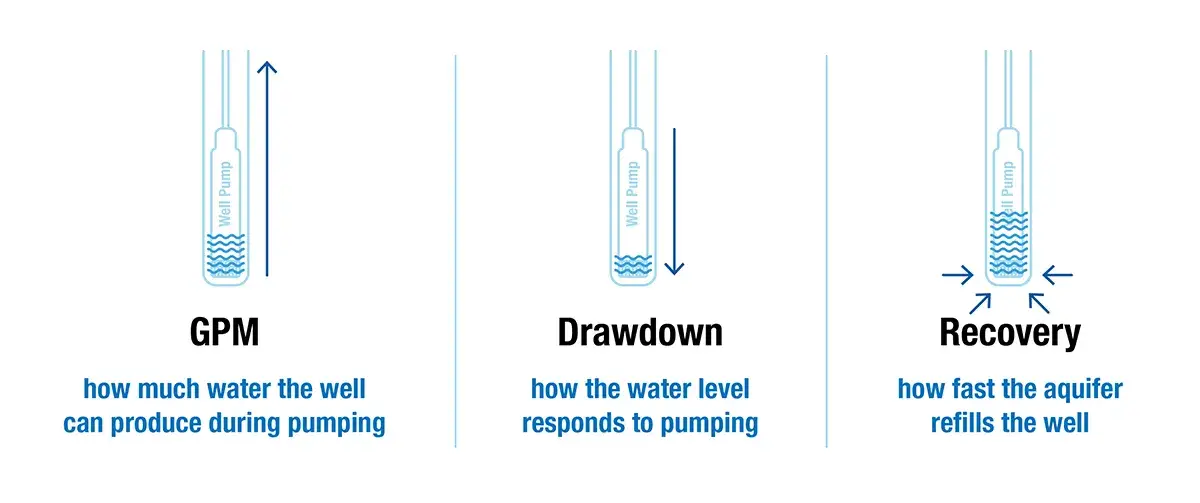
GPM (gallons per minute) is the rate at which water is produced while the well is actively being pumped. It tells you how quickly water is being delivered during use, which makes it useful for understanding immediate demand.
Here is how to interpret it:
- Low GPM means the well cannot supply water quickly
- Moderate GPM may work, depending on recovery
- Higher GPM reduces risk, but does not guarantee reliability
The mistake is assuming GPM equals performance over time. It does not.
A standard shower uses about 2.5 gallons per minute. That means a 1 GPM well cannot sustain even one continuous shower without relying on stored water. When multiple uses overlap, the shower, sink, and laundry, demand quickly exceeds supply. Even if the well produces enough water across a full day, it may still fail during short periods of concentrated use.
What to look for in your report:
- The tested GPM rate
- Whether that rate was stable or declining
- Whether it required a heavy drawdown to maintain
GPM tells you speed. It does not tell you whether the system can keep up repeatedly.

Drawdown: How Hard the Well Is Being Pushed
Understanding production rate naturally leads to the next question: What does it cost the well to produce that water? Two wells can show the same GPM and behave completely differently depending on how much strain is placed on the system during pumping. That is why the next step is not to look for more production data, but to examine how the water level responds to that demand.
Drawdown is the difference between the water level before pumping and the level during pumping. In simple terms, it shows how far the water level drops when the well is being used. This number changes how you interpret GPM.
- Small drawdown means the well is handling demand comfortably
- Moderate drawdown means the well is working under stress
- Heavy drawdown means the well is struggling to keep up
The key idea is that drawdown reveals whether the production you saw is sustainable or forced.
Two wells producing the same GPM are not equal if one experiences minimal drop and the other sees the water level fall quickly and deeply. The second well may be producing water, but it is doing so in a way that is harder to sustain over time.
What to look for in your report:
- How quickly the water level drops after pumping starts
- How far it falls relative to the starting level
- Whether the level stabilizes or continues declining
Drawdown shows stress. It does not tell you whether the system can recover from that stress.

Recovery Rate: What Happens After You Stop Using Water
GPM shows how fast water can be produced, and drawdown reveals how much stress that production creates. But neither explains what happens after that demand ends, which is where many real-world issues begin to appear. A well can perform acceptably during short periods of use but still fail under normal daily patterns if it cannot recover quickly between those periods. Understanding the recovery rate-how fast the well refills after pumping stops-helps you evaluate whether your well can sustain regular household water use over time.
The recovery rate tells you how quickly the well refills after pumping stops. It answers a different question than GPM. Instead of asking how fast water comes out, it asks how fast the system resets. Here is how to interpret it:
- Fast recovery means the well resets quickly between uses
- Moderate recovery means spacing out usage becomes important
- Slow recovery means repeated demand will outpace the system
This is where many inconsistent water problems come from. A common pattern looks like this:
- Experience low water pressure well during use
- It returns after the system rests
- Then drops again when demand increases
That pattern is not random. It is a recovery limitation.
What to look for in your report:
- How long does it take for the water level to return
- Whether it fully returns or only partially recovers
- Whether recovery slows over time
A well can produce enough water across a full day and still struggle during the exact windows when water is needed most. That is why recovery often matters more than the initial production number.

Read the Numbers Together, Not Separately
At this point, each number has its own meaning, but the report only becomes useful when those numbers are read as a pattern. Looking at GPM, drawdown, and recovery individually can create mixed signals. Reading them together reveals how the system actually behaves under real conditions. This is where the report shifts from technical data to something you can apply to daily life.
Use this framework to interpret what you are seeing:
| Pattern | What You’ll See | What It Means |
| Manageable Slow Well | Lower GPM, controlled drawdown, steady recovery | Works if usage is spaced out |
| Strained Supply | Moderate GPM, heavy drawdown, weak recovery | Will struggle during normal use |
| System Mismatch | Decent GPM, moderate drawdown, slow recovery | Enough water exists, but not fast enough for peak demand |
| Serious Limitation | Low GPM, heavy drawdown, poor recovery | Likely to fail under regular use |
The goal is not to decide whether the well is good or bad. The goal is to understand how it behaves. Once you identify the pattern, the issues you experience in the home start to make sense. That is the real purpose of correctly reading a low-yield well test. It turns a vague problem into a specific one. And once the problem is specific, it becomes something you can actually solve.
Working with Well Manager
A low-yield well test is not just a list of numbers; it is a snapshot of how your well performs under demand, the stress it creates, and how well the system recovers afterward.
GPM, drawdown, and recovery rate are only useful when read together, because each explains a different part of the same water-supply problem. That is what allows a homeowner to move past the vague idea of “low water pressure well” and understand whether the real issue is limited production, heavy strain, or slow recovery. When the report is read that way, it becomes much easier to connect the test results to what is actually happening in daily life.
At Well Manager, that distinction matters because low water problems are solved by identifying the true limitation in the system, not by guessing at the symptom. The clearer the report is, the clearer the path to the right solution becomes.